
I. The Parsimonious Proof
Don’t take this entire exercise too seriously.
I am a fan of parsimonious proofs. While they are often never very short once fully unpacked, it is neat to see the work condense down. A particular example that comes to mind is a function whose nature unpacks into a non-trivial counting argument. (One-Sentence Proof of Fermat’s Theorem on Sums of Two Squares)
I’m trying to find a single point of failure where the whole structure unravels once we pull the thread. The following is my best attempt at a such a construction, a one sentence demolition of Marxism
Humans do not naturally form classes, they form cartels.
Let’s unpack why this pivot in terminology might break the machine. A Marxist defines a class based on a person’s relationship to the means of production. We are defining a cartel by its mechanism of exclusion and rent-seeking.
At a theoretical level, this attacks the core idea of viewing human history as binary class warfare. If we naturally form cartels, history isn’t a two-sided struggle of oppressor versus oppressed. It looks more like a multi-polar, fractal conflict, a chaotic overlapping of countless exclusive in-groups constantly guarding their borders and renegotiating leverage.
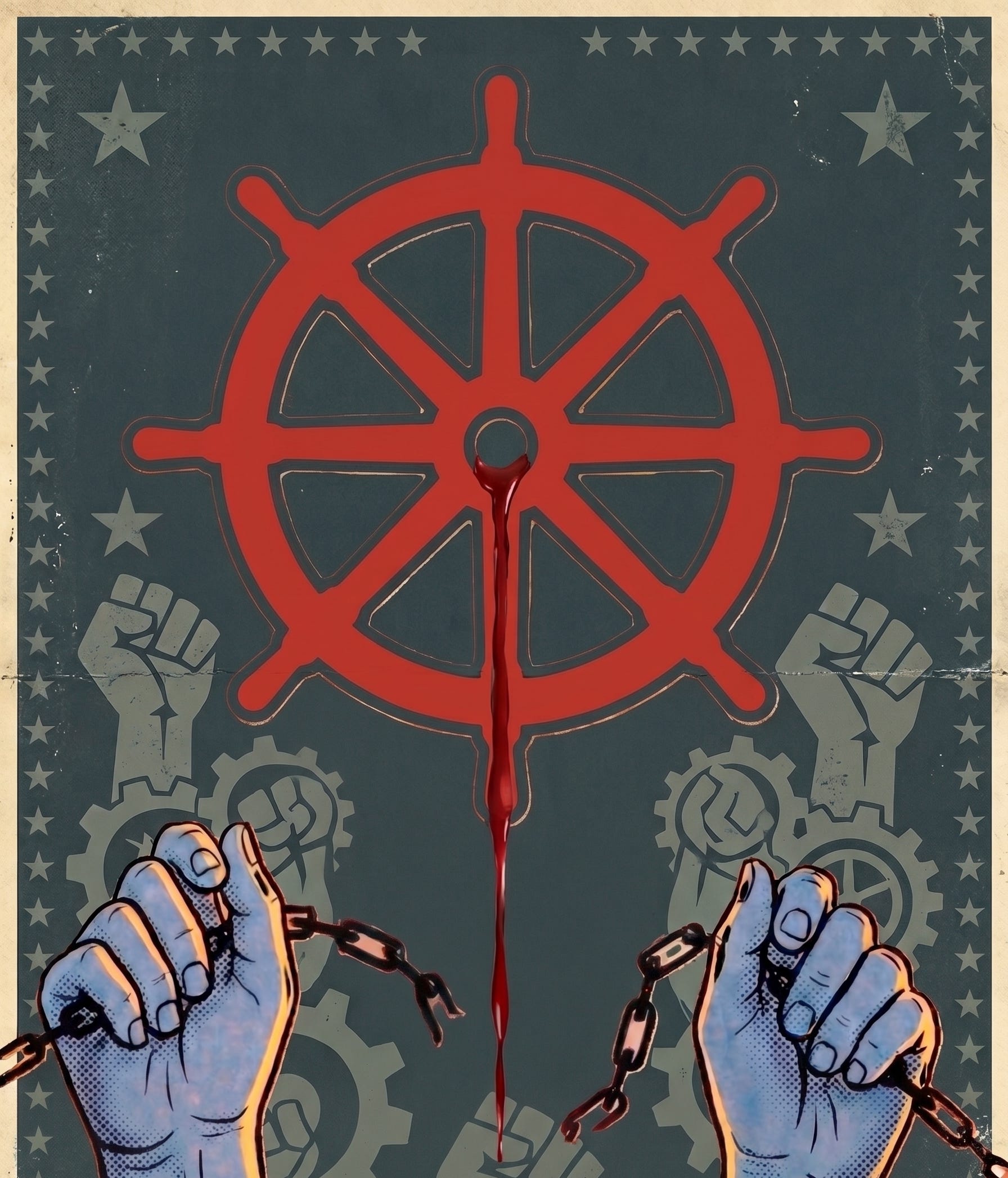
At a practical level, if cartel-building is the human default, then the Marxist project is trying to make water flow uphill. This explains its historical authoritarian tendencies. To maintain a classless system, a communist state has to continually break the human spirit upon the wheel, using force to prevent us from doing what we instinctively do: form exclusionary coalitions.
At an aesthetic level, it rejects the praxis of universal proletarian solidarity. We see this friction in real life constantly. A consistent application of Marxism demands an altruism that bridges vast cultural, national, and even temporal boundaries. Our social software just isn’t wired for that scale of unconditional solidarity.
Marxism has a built-in immune response to sociological critique: it points to false consciousness or a symptom of capitalist alienation. A Marxist would likely argue that the urge to form a cartel is just a temporary symptom of the artificial scarcity generated by capitalism.
But I’m not sure that counter-argument finds much purchase here. The impulse to form an exclusionary group to secure resources feels basic enough to completely predate agriculture and private property.
Which brings up a vital nuance: Why use the word Cartel instead of something older, like Tribe?
Tribe feels a bit too restrictive. It invokes specific mechanisms like blood, kinship, and shared identity. Cartel, on the other hand, is modern, amorphous, and much better at capturing market-driven, opportunistic motivations. We need a concept that can flex to explain how people collude today.
To see how exclusion translates backward in time is easy. But how does rent-seeking, a modern economic term, translate backward in time? Rent-seeking is the universally sought-after comfort of survival without friction. It is the predator waiting over a watering-hole. It is biological. It’s almost entropic.
II. The Fragility of the Marxist Triad
How does an ideology actually survive outside the library?
Marxism and perhaps any ideology capable of mobilizing a mass movement, requires a very specific structure to stay standing. It needs a Theoretical framework, a Practical mechanism and an Aesthetic vision.
I am using the word Aesthetic here intentionally, though it might seem like an odd fit for a materialist philosophy. What we are talking about is the animating ethos of the movement. It is what Georges Sorel would call the Social Myth—the emotional engine required to convince millions of people to risk their lives. In this case, it is the vision of universal proletarian solidarity.
By categorizing this mythos as an Aesthetic, we can bypass ontological or psychological debates about the nature of myth and its relationship with human persons. As a branch of philosophy, aesthetics is simply the most agnostic container for this concept. It is the art that makes the theory step off the page.
If we pull this structure apart to see what happens when one leg fails, it becomes clear that Marxism cannot survive a compromise. Let’s look at the permutations:
1. The Academic Observation (Theoretical + Practical, No Aesthetic)
What happens if we understand the structural conflict of human groups and how resources are guarded, but we abandon the vision? We lose the revolutionary spirit entirely.
We are left with something resembling Analytic Marxism, a school of thought pioneered by philosophers like G.A. Cohen. It becomes an academic lens through which to view history. It observes the machine of human conflict, but lacks mechanism for inspiring a mass movement. It diagnoses the world without offering the emotional engine required to build a utopia.
We note here that the Practical here is the utility or the mechanism of execution. Saying the Theorists lack the Practical because their theory does not account for aspects of human nature opens up attack by clever reformulation that demonstrate the power of the Marxist model, simplified but still a strong tool.
The Theoreticians are practical. They have succeeded in spreading Analytic Marxism throughout the academic sphere. This is proof of its practicality, it succeeds in its own terms. It also explains why despite their persistent attempts, they fail to export their brand of Marxism to the masses. They are often at a loss to explain why their theories either fail to take or quickly become distorted.
2. The Utopian Mirage (Theoretical + Aesthetic, No Practical)
Suppose we maintain the strict theoretical binary of class warfare and hold fiercely to the aesthetic vision of universal solidarity, but we ignore the reality of human nature. We ignore the cartel.
If we pretend that humans do not default to forming exclusionary, rent-seeking in-groups, we end up with Utopian Marxism. It is a system that shatters upon contact with reality. This is the exact trap Marx and Engels accused the Utopian Socialists of falling into. It demands a version of human behavior that does not exist in the wild, requiring ever-increasing amounts of authoritarian force to simulate it.
3. The Pragmatic Compromise (Practical + Aesthetic, No Theoretical)
Finally, what if we accept the practical reality that humans naturally form cartels and operate within markets, but we still refuse to let go of the aesthetic desire for public welfare and solidarity?
To do this, we have to abandon the strict theoretical binary of class warfare. The result is something much closer to modern Social Democracy. It is an ideology of compromise. Rather than attempting to abolish cartels and force a classless society, it attempts to manage, regulate, and tax those cartels to simulate the aesthetic of solidarity. It is an admission that the underlying theoretical architecture of Marxism is flawed, opting instead to negotiate with human nature as it actually is.
None of these three outcomes are Marxism as a Marxist would understand it.
III. Anticipating the Defense
Here we try to anticipate how a Marxist would defend their model.
The immediate counter-attack comes from their own origin story: Marx didn’t believe classes were a biological or natural state either.
He argued that primitive communism was our natural origin, and that classes only emerged artificially with the invention of agriculture and private property. In a way, telling a Marxist that classes aren’t natural is preaching to the choir. To them, classes are a historically contingent phase that we are eventually going to evolve out of. This belief is the engine of their teleological history. If we started in the Eden of primitive communism, we can return to a higher-order Utopia at the end of history.
But it has been over a hundred years since Marx formulated his views and anthropology has moved on. Eden looks a lot more like a syndicate. Long before farming, hunter-gatherers were experimenting with hierarchy, building monumental architecture like Göbekli Tepe, and leaving behind Ice Age burials with rich grave goods that heavily suggest social stratification. Our closest biological relatives, chimpanzees operate on violent alpha-male hierarchies, waging wars and hoarding resources.
To patch these holes, Marxists often point out that within many early human bands, food was shared strictly and egalitarianism was the norm. This is true, but it misunderstands how that egalitarianism was maintained. It wasn’t a passive, utopian default brought about by human nature; it was an active, sometimes violent process brought about by human socialization. The group would team up to mock, ostracize, or even execute anyone who tried to act like a boss or hoard resources. Often called a reverse dominance hierarchy by anthropologists.
In other words, it was an agreement by the cartel to violently suppress internal monopolies so the broader group could survive external threats. These early tribes weren’t a Marxist classless society; they were cartels. Sharing food was a survival strategy for reducing the variance of hunting. It was no more a Marxist utopia than a subscription to an insurance policy. Furthermore, this mechanism only works at the scale of the tribe, roughly 150 people. It simply does not scale up. The enforcement mechanisms of the tribe (gossip, ostracization) break down when people become anonymous past the Dunbar limit.
The second defense we wrestle with is the Marxist observation of capital. Marx argues that capital inevitably consolidates, creating a ruling class that operates to suppress wages and guard assets. So, does our sentence demolish class warfare, or does it just describe how a class operates?
It’s tempting to just label the entire Bourgeoisie as a macro-cartel, but that is problematic. Capitalists are terrible at forming universal cartels because their primary incentive is to undercut one another. They only successfully form sustainable cartels when they can capture state institutions to build regulatory moats.
While a Marxist might argue that the state is entirely captured by capital, it becomes nonsensical to define every entity capable of influencing the state as bourgeois. The world is too chaotic for that. Marxists are often forced to reduce the number of distinct entities by claiming they have all been captured by capital. While this sounds broadly convincing from a distance, the closer you look, the worse the model fits.
The deepest theoretical issue, however, lies on the other side of the equation. Can we sensibly call the Proletariat a class?
A Marxist would argue that proletarian solidarity does not rely on altruism at all. It relies on rational self-interest. A worker doesn’t unionize out of charity for their fellow worker; they unionize because they cannot survive alone. In that light, if human nature is to form cartels, then “Workers of the World, Unite” is simply an instruction to form the ultimate labor cartel to crush the capital cartel.
But we can see how this breaks down in real life all the time, particularly in the job and housing markets. While it is true that you cannot survive alone, it rarely makes sense to consider some distant, unseen worker halfway across the world to be part of your cartel. A cartel requires boundaries and exclusion to function. This is exactly where the theoretical and practical legs of Marxism fail, and why the Aesthetic, the social myth of universal solidarity, has to do all the heavy lifting.
IV. The Paradox of the Universal Cartel
Marxism requires a finish line. If classes are a historically contingent construct born from agriculture and private property, then they can logically be dismantled. Once dismantled, history, which Marx defined almost exclusively as the friction of class struggle, reaches its final form.
But if we substitute classes with cartels, the engine of history suddenly has no off switch.
If cartel-formation is a perpetual reality, a fundamental human instinct to organize into exclusive, resource-guarding in-group, then there is no end of history. To force a finish line onto a species wired for cartel-building requires continuous pressure. You would need a permanent, heavily armed state apparatus dedicated to suppressing the human instinct to splinter into favored factions. The state doesn’t wither away, as Marx predicted; it has to become a permanent leviathan just to keep the cartels from reforming.
This brings us to the deepest contradiction in the Marxist project. Where does a cartel actually derives its power?
A cartel’s entire utility comes from exclusion. It only functions if there is an out-group that is being denied access. Because of this, the concept of a universal cartel or a globally unified, victorious Proletariat is a mechanical oxymoron. If everyone is in the group, the mechanism that binds the group together dissolves. A wall that surrounds the entire world isn’t a wall anymore; it’s just the ground.
This makes sense of a historical pattern that often attributed to aberrations. When communist regimes successfully eliminate the Bourgeoisie, they immediately turn inward. They begin endlessly searching for counter-revolutionaries, kulaks, or ideological deviants.
This isn’t paranoia, a personal failing. This is a structural necessity inherent in the failure of theory.
The cartel needs an enemy to justify its own cohesion. The Proletariat can only exist as a coherent, unified concept while it is oppressed. The moment it wins, it must manufacture a new out-group, or the universal cartel will immediately fracture back into localized, warring factions.
It makes complete logical sense for humans to form a local cartel. We see it constantly: NIMBYs restricting local housing supply to artificially boost their property values, or a domestic autoworkers union lobbying for tariffs to protect their own jobs at the direct expense of foreign autoworkers.
But it makes zero rational, material sense to extend that loyalty to a distant, unseen worker on the other side of the globe. In a globalized system, that distant worker isn’t your brother; they are your direct competition.
This leads to an inversion of Marxist theory. Marx claimed to be a materialist, grounding his worldview in economic realities rather than idealism. But if material reality actually pits workers against each other in competing, localized cartels, then the material incentives point in the exact opposite direction of global solidarity.
To bridge that massive gap, the movement has to rely entirely on the aesthetic of solidarity, that idea we return to over and over. The ideology, the social myth, has to do all the heavy lifting to convince people to act against their immediate cartel-interests. And the moment that aesthetic fails to inspire, the entire movement collapses back into the chaotic, fractal tribalism that is our natural state. It is the reason why totalitarian states are so neurotic about information control. They can’t afford to be otherwise.
V. Beyond Materialism
Marxism relies on the idea that material economics—the base—is the root of all human conflict. Everything else—culture, religion, status, art—is just superstructure, a downstream reflection of who owns the factories and the farmland.
What if we don’t just form cartels to secure material resources? What if we guard status, power, and social hierarchy just as violently as we guard food and housing?
If we look directly downstream of Marx, to the Post-Structuralists and Critical Theorists who spent the 20th century trying to salvage the project, we see the answers. Thinkers like Michel Foucault and Pierre Bourdieu spent their careers demonstrating that power, status, and cultural capital operate quite independently of material wealth.
Power and status aren’t merely downstream of material scarcity. They are often the very tools we use to invent and enforce scarcity.
Consider the relationship between diamonds, De Beers, and marriage from the 1940s onward. It serves as a parsimonious example. Diamonds are not inherently scarce, nor are they a material necessity. But by capturing the cultural narrative. By tying a specific, artificially hoarded rock to the highest social proof of romantic commitment, a cartel was able to invent a material scarcity out of thin air. The cultural capital drove the material economics, not the other way around.
Even if a society achieved post-scarcity or approached material abundance, human beings wouldn’t stop colluding. We would form new cartels around discursive power and cultural capital. The Nomenklatura in the Soviet Union didn’t own capital in the traditional sense, but they formed an exclusionary cartel that guarded status, better housing, and political access.
Why is this instinct so unbreakable?
It comes down to the nature of status itself. Material wealth is often just a proxy for status, but status is inherently a zero-sum game. If everyone is wealthy, nobody has status. And if human beings are wired to seek the survival advantages of the in-group, we will always find a metric by which to exclude an out-group.
If material wealth is just a proxy for status, are we arguing that status is the actual base of human history?
I dislike material reductionism but I dislike status reductionism even more. In the chicken and egg relationship at least the Marxist start from the right place, even if they mistake ontology for causation. Just because material conditions are the prerequisite for society, doesn’t mean it is the causal driver for all subsequent historical movements.
In the De Beers example, a Marxist would diagnose it as Commodity Fetishism dictated by capital. This requires some pulling apart because it is in part correct. The cost of the stone is what allows it to capture status. But it is also entirely wrong about the underlying driver.
Let us return to the idea of solidarity again.
A Marxist might look at our framework and say: “Sure, a local autoworkers union might try to form a localized cartel, but global Capital will simply move the factory to a cheaper country. Eventually, the workers will realize that local cartels fail against global capital, forcing them to unite as a global proletariat.”
This sounds logically sound on paper, but it ignores the mechanics of how human beings actually organize. Consider Mancur Olson’s The Logic of Collective Action, Olson showed that small, exclusive groups (cartels/guilds) are vastly more effective at organizing to extract rent than massive, diffuse groups (a global proletariat). The larger the group, the more there is an incentive to free-ride.
Instead of taking the path of organizing a global revolution, human nature looks for the path of least resistance to protect the in-group. And this introduces a mechanism Marx severely underestimated: the enduring power of the State as a tool for rent-seeking.
The cartels people really want to be in aren’t the ones that fight capital in the streets; they are the ones that sit above capital. They manage to extract a permanent toll on the economy through institutional capture.
When capital becomes globally mobile, the autoworker in Michigan doesn’t try to forge a transnational alliance with the autoworker in Mexico. They do something much more pragmatic: they lobby their domestic government for tariffs, subsidies, and regulatory moats. They use political power to force capital to pay a toll.
While this might lead to an objectively less prosperous global economy in the long run, it secures the immediate status and survival of the in-group. This mechanism explains almost everything from the rigidity of occupational licensing boards to the persistence of corporate bailouts.
Humans simply do not form broad, universal classes. We form hyper-specific cartels and use whatever leverage we can find, especially the monopoly of state institutions, to extract a permanent toll from everyone standing outside our walls.
VI. The Death of Teleology
Looking at the whole picture, the one-sentence pivot from class to cartel doesn’t really demolish Marxist economics, but it absolutely shreds Marxist teleology.
Without a finish line, the utopian project evaporates. Marxism ceases to be a prophecy of salvation and becomes another analytical lens for viewing an endless, cynical struggle for power.
Worse, as a political ideology, stripped of its utopian endpoint, Marxism becomes a piece of technology—a machine for endless, violent factional suppression. If we accept the premise that humans will always default to forming cartels, but your stated ideology requires the absolute destruction of cartels, then the State’s only purpose becomes waging an infinite war against its own citizens’ nature.
In that sense, the demolition works exactly as intended. It shatters the Aesthetic Pillar. Without the credible promise of a final, harmonious utopia, the theory loses its emotional engine. It can no longer inspire a mass movement or sustain the sacrifices required for a revolution.
Looking at the ideological wreckage left behind, we are left with a somewhat tragic, cyclical view of human history, a fractal landscape of endless, shifting cartels constantly fighting for rent, collapsing, and reforming.
This isn’t an entirely new view of human nature. It echoes ancient, cyclical concepts of time, the Hindu Kalpas, the Yeatsian Gyres, the endless turning of the wheel. But it is a worldview that has always struggled to gain mass traction because it lacks an Aesthetic Pillar. It doesn’t offer salvation; it advocates for pragmatic, contingent management. It points us toward uninspiring compromises like Social Democracy or, arguably, Chinese State Capitalism, rather than ideological crusades.
Because pragmatic statecraft lacks a mobilizing Social Myth, a void opens up and that void aggressively invites itself to be filled with something uncontrollable. To substitute for this lack, the tension between Social Democracy and Nationalism or Racism or Religion now becomes an inherent feature that has to be maintained rather that something to be solved. Left to their own devices, these deep-seated ideologies will happily swallow the pragmatism of the state whole. The state is forced into a permanent, unhappy marriage with its governing aesthetics.
This is a somewhat controversial point that I have stated in an unassuming manner. Part of the appeal of Marxism and other totalizing ideologies is the claim it will solve Nationalism, Religion, Racism, Sexism and so on. Many see them as the “Current Systems” failures, something to be solved. I disagree. What do all of these have in common? They are the lowest-friction tools for cartel boundary-drawing. Rather than being byproducts of a broken system, they are the raw materials of the human psyche—the innate desire to draw an exclusionary circle. Trying to solve these impulses is precisely what creates the Void. We can balance and control but we can’t solve.
We’ve been getting better at balancing them, but this is a complex system that abhors simple solutions. A complexity that is not well defined enough to apply Ashby’s Law directly but in spirit.
And this is where we stand now. Ultimately, the systems that actually survive contact with human nature are inherently unromantic. They do not require revolutionary zeal. They require plumbing. They demand constant, exhausting, and unglamorous maintenance to manage the cartels we cannot help but build.
Summary and Post Scripts - Lineage of Anti-Marxist Thought & The Psychology of Passivity and Action
The Proof: We deliver our thesis statement, suggesting cartels rather than classes.
The Targets: We demonstrate the three legs on which popular ideologies stand.
The Defense: We anticipate the counter-arguments, focusing on empirically demonstrable failure of Primitive Communism.
The Paradox: We point out the central paradox of a cartel with no one to exclude.
The Impossibility: We pivot into the economics of status.
Broken Promises: We arrive at the realization that there is no end of history.
Post Script
Where do we sit in the lineage of anti-Marxist thought?
The Anarchists were one of the earliest critics of Marx, identifying what we call the Paradox of the Universal Cartel. Mikhail Bakunin warned Marx in the 1870s that a “dictatorship of the proletariat” would inevitably result in a “Red Bureaucracy.” He predicted that the moment the working class took state power, they would cease to be workers and would become a new ruling elite.
Decades later, Milovan Djilas, a high-ranking Yugoslav communist who was imprisoned for his views, wrote The New Class (1957). He argued that the communist party apparatus had become a new exploiting class that extracted rent from the state monopoly on property.
In both these cases Djilas and Bakunin still relied on the language of class. Class implies a vast, somewhat passive categorization based on economics. Cartel implies an active coalition of exclusion. It names the action (rent-seeking) rather than just the status.
Vilfredo Pareto called history a “graveyard of aristocracies,” arguing that society always divides into a ruling elite and the masses. When a revolution happens, it is a new elite using the masses to displace the old elite.
In the same vein, Robert Michels coined the Iron Law of Oligarchy in 1911. After studying socialist political parties, he concluded that any large organization, no matter how democratic or egalitarian its stated ideals, will inevitably be taken over by a small, self-serving bureaucratic cartel.
The Elite Theorists of the early 20th century focused heavily on political power and psychological types (Pareto’s “lions and foxes”). The argument we have presented here is grounded in economics, self-interest and extends the thesis downwards.
Rather than a power-hungry elite, we place the idea of exclusivity and rent-seeking as a single step abstraction from the mechanism of human survival.
The focus on Self-Interest brings us to a close intersection with Public Choice Theory, the economic school associated with James Buchanan and Gordon Tullock.
Here, everyone is an amoral utility maximiser. Tullock’s work on rent-seeking basically describes the mechanism of cartels: spending resources to capture a political advantage (like a tariff or a guild license) rather than creating new wealth.
However instead of staying completely rooted in the base, the economic incentives, we acknowledge that the human mind is psychological. Cartels form around cultural capital and status. In fact they can generate it through exclusivity.
Historically, critics attacked Marxism either from the political side (saying power corrupts, via Michels/Bakunin) or from the economic side (saying collective action fails, via Olson). By using the word cartel, we have fused the two. It answers both the how and the why in a single word. It isn’t just that power corrupts; it’s that power is the currency used to enforce the economic exclusion.
Post-Post Script
A cartel is an economic entity, but it maintains its existence through political exclusion, which in turn requires a narrative justification to remain stable. This means a Cartel is also a psychological entity. So much like Marxism itself, each Cartel sits on a three legged stool.
Belonging to a historically determined Class absolves the individual of moral responsibility. If I am in the Proletariat, my lack of success is the fault of the Bourgeoisie; my ultimate victory is guaranteed by the teleology of history. I don’t have to do anything except wait for the contradictions of capitalism to heighten. It is a state of blameless passivity.
But human beings are restless. We are not naturally passive. So, while we might enjoy the aesthetic victimhood or moral superiority of being in a Class, in our actual day-to-day lives, we demand agency. We want to act. And the way we act is by forming Cartels.
The conclusion is that Cartels give back agency to humans that class deprives of them.
People want to be classified into classes but they demand to be agents of a cartel.
This is then the basis for fourth, relatively unexplored angle of criticism against Marxism. The Psychology of Passivity and Action. Marxism demands an impossible psychological state: it requires humans to act as passive subjects of history
Marxism assumes that the working class will awaken to their class consciousness and execute a revolution as a unified block. But this ignores the reality that individuals constantly seek to exert their own agency right now. A worker doesn’t want to wait for the end of history; they want to build a regulatory moat around their specific job today. And what happens when the worker succeeds in this goal? It kills the incentive for revolution and the worker becomes a conservative force set against the emancipation of other workers.
Marx believed that a passive, objective economic category (Class in Itself) would eventually gain consciousness and become an active, unified revolutionary force (Class for Itself). But our argument makes it clear that when a Class in Itself becomes active, it shatters into competing Cartels for Themselves.