I. A Weapon, Not a Textbook
Much of the criticism surrounding The Grapes of Wrath is a dissection of 1930s agricultural economics and labor politics. This strikes me as a deeply uninteresting way to read the novel. If one wants an factual accounting of the transition from tenant farming to corporate agriculture, a textbook provides a more accurate, more impartial view. The purely economic landscape of Steinbeck’s California is structurally important to the narrative, but as an end in itself, it is rather banal.
What actually grounds the novel is not the economics, but the minutiae of human suffering. The enduring legacy of the book lives in its intimacy: Ma Joad burning her keepsakes before abandoning Oklahoma. The anxiety of listening to a grinding engine part on Route 66. The degradation of Grampa and Granma as they are severed from their land. Finally, the tableau of Rose of Sharon giving her breast milk to a starving stranger in a barn.
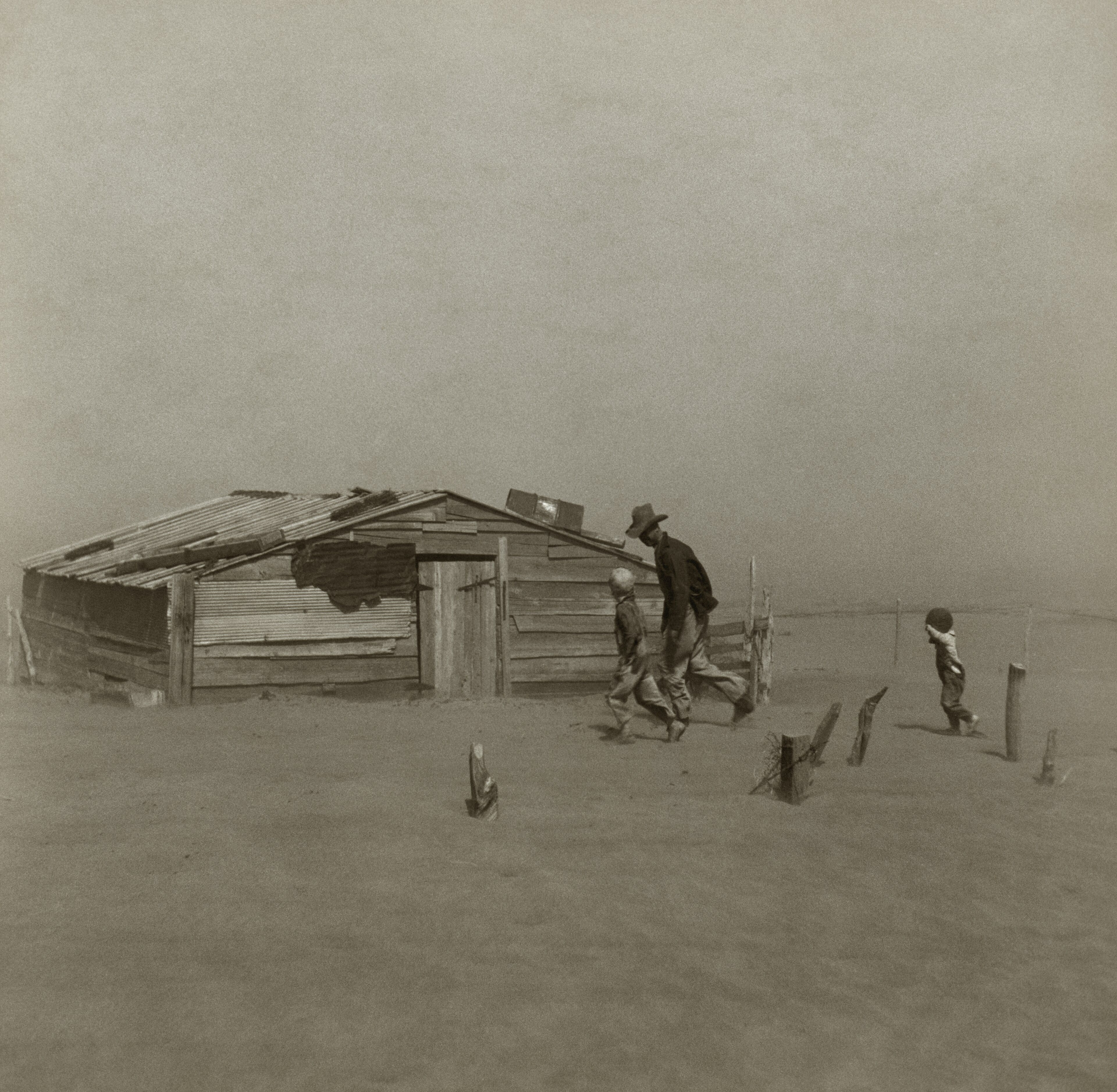
Yet, Steinbeck goes out of his way to ensure the reader understands that this suffering is not an act of God. It is an act of man. The Dust Bowl was the result of unsustainable farming practices. The evictions were orchestrated by the “Monster” (the banks), a faceless economic machine that forced landowners to use tractors to maximize yield, destroying homes in the process. The starvation the Joads encounter in California is engineered by agricultural monopolies that hoarded land, fixed wages, and destroyed crops—pouring kerosene on oranges and dumping potatoes into rivers—to inflate prices while children starved.
Steinbeck designed the novel to fuse these two realities. Through his use of intercalary chapters, he alternates between the intimacy of the Joad family and panoramic chapters detailing the socio-economic forces shifting the country. By weaving them together, he forces the reader to realize that the micro-suffering and the macro-economics are indivisible. You cannot understand the Joads without understanding the machine that is grinding them down.
To make this critique legible to a moderate, Christian public, he deliberately maps this modern alienation onto an ancient biblical framework. The journey to California becomes an Exodus, a wandering through the desert toward a Promised Land that reveals itself to be a corrupted Eden. Reverend Jim Casy operates as the novel’s literal and thematic prophet, a Jesus Christ figure (J.C.) who sacrifices himself in the wilderness of the labor strike. The novel concludes with a biblical deluge, washing away the old world and forcing a muddy rebirth.
What Steinbeck was trying to capture is the moment when humanity became alienated from the land by industrial capitalism. He did not write The Grapes of Wrath to be an economic textbook; he wrote it to be a weapon. As a journalist who had spent time in the squatter camps witnessing this starvation firsthand, he was absolutely furious. He famously noted of his intentions for the novel: “I want to put a tag of shame on the greedy bastards who are responsible for this.”
II. Pharaohs and Foreclosures
Steinbeck faced a challenge: how to sell a radical, borderline-socialist message to a middle-class American public. His solution was to borrow the architecture of the Bible. By mapping the displaced Okies onto the Israelites of the Exodus, Steinbeck gave dignity to a demographic that the broader public widely dismissed as white trash or dangerous vagrants. However, despite being hailed as one of the greatest American novels, that religious theming actively contradicts Steinbeck’s own political goals.
When the Joads reach California, they do not find a land flowing with milk and honey, but an exploitative labor market. By making the Promised Land a false Eden, Steinbeck deliberately cuts off the option of divine deliverance.
Reverend Jim Casy is the novel’s Christ figure (sharing the initials J.C., wandering the wilderness, and ultimately sacrificing himself for the people). Casy abandons the traditional church because he realizes that preaching about the afterlife, “pie in the sky,” does nothing to feed starving children. He redefines the Holy Spirit as human solidarity, suggesting that “maybe all men got one big soul everybody’s a part of.” Steinbeck goes out of his way to frame those who cling to tradition as either tragic or dangerous. Uncle John is paralyzed by his belief in his own sinfulness, while the zealots in the migrant camps who urge the workers to pray and accept their misery are portrayed as actively harmful to the community’s survival.
Steinbeck’s Exodus ends not with God parting the Red Sea, but with humans realizing they are entirely on their own. While many modern readers will naturally follow with Steinbeck to his materialist conclusion, this reveals a misreading of the religious mind. A religious-minded interpretation does not look at a tragedy and conclude that God is obsolete; it compares the existing myth to the story and concludes that the tragedy is an example of why God is necessary. A religious reader watches the Joads abandon traditional faith for secular action—following Casy into unionizing and labor strikes—and the end result is still starvation, utter destitution, and a stillborn baby. Their logical takeaway is not, “we need better unions.” The takeaway is: Look at the despair of a world that has abandoned God.
By borrowing the architecture of the Bible, Steinbeck lost control of the interpretation. A religious framework will always reabsorb a religious myth.
This brings us to the core flaw of the novel as a political weapon. You cannot write a sweeping, timeless myth about the eternal struggle of humanity and simultaneously expect it to serve as an effective critique of 20th-century banking practices. The timelessness swallows the specific politics whole. To fix 1930s banking, a society needs legislation, regulatory reform, and specific economic policy. But the moment Steinbeck elevates a California farm owner into an archetype of an Egyptian Pharaoh, he abstracts the problem.
An archetype cannot be legislated against. Mapping a 1930s labor crisis onto the Exodus implies that this suffering is eternal—a fundamental human condition to be endured, not a modern logistical failure to be solved. If the Dust Bowl is just the latest iteration of humanity’s eternal struggle, then the specific bank executives and politicians of the 1930s are let off the hook.
This is why many Marxist critics of the 1930s eventually turned on Steinbeck. Agrarian displacement is driven by systemic shifts in technology, ecology, and global markets. Whether it was the Roman latifundia, the medieval enclosure movements in England, or the Irish Potato Famine, the power dynamics of agriculture have always been more complicated than good versus evil. Yet, Steinbeck frames the Dust Bowl as a morality play: the virtuous, salt of the earth farmer versus the soulless, greedy “Monster” of the bank. To achieve this moral binary, Steinbeck deliberately ignores the Okies’ own culpability in over-farming and destroying the topsoil, reducing macroeconomic mechanization to cartoonish villainy. The myth requires absolute moral binaries and thus denies Okies their own agency, ruining the story as a Marxist parable of worker action.
III. The Death of the Proletarian Myth
A modern criticism of The Grapes of Wrath that fixates on its agricultural economics is to watch academics beat a dead horse. The economic landscape of the book is extinct in the modern West. Even in its own time, the novel’s political efficacy was deeply contested. While the American public was scandalized by the book’s perceived vulgarity and radicalism, Marxist and hard-left critics were deeply frustrated by its lack of genuine political rigor.
Critics like Edmund Wilson and Philip Rahv noted that Steinbeck tended to view the Okies through a lens of ineffectual innocence. He didn’t treat them like a proletariat capable of organized political revolution. He treated them like a herd of animals reacting to stimuli. To the radical Left of the 1930s, the novel’s ending was an absolute failure. They wanted a strike, a union victory, or a genuine class uprising. Instead, Steinbeck gave them Rose of Sharon breastfeeding a starving man in a barn, an almost medieval religious tableau.
The book did, of course, succeed as a megaphone. It sparked the Tolan Committee’s congressional hearings, prompted Eleanor Roosevelt to champion the migrants, and forced the nation to look at the squatter camps. However, it wasn’t the book that solved the Okie crisis; it was World War II. The defense plants that sprang up across California absorbed the migrant labor force almost overnight.
Why track this historical outcome so closely? Because looking at the messiness and contingency of historical praxis shatters the novel’s theoretical legacy. In The Philosophical Joads, critic Frederic Ives Carpenter argued that Steinbeck had successfully fused American transcendentalism, pragmatic action, and Christian mysticism into a cohesive, democratic labor philosophy. And theoretically, there is precedent for this. The entire tradition of Christian Socialism, from the Catholic Worker Movement to Liberation Theology, proves that the Exodus myth can be used to successfully mobilize radical worker action.
But Carpenter’s thesis fails when tested against the reality of the people Steinbeck was writing about. Carpenter believed the Joads would use their religious mysticism to forge a new, collective labor movement. The actual Joads who moved to California, secured defense jobs, and entered the middle class used their religious mysticism to forge the Evangelical bedrock of Sun Belt conservatism, eventually voting in places like Orange County against the very labor movements Steinbeck championed. Steinbeck’s vision of a secular, collective “over-soul” failed to take root in the actual population he wrote about.
Today, the economic ecosystem of the 1930s—where families held generational, sentimental ties to 40-acre tenant plots—is gone. Western agriculture is dominated by corporate agribusiness, and the labor force is largely composed of migrant immigrants, not displaced domestic citizens. One might argue that the underlying dynamic of displacement (automation, gig-economy exploitation) remains. But in the American mythos, this dynamic only resonates when it happens to farmers. The cultural establishment relies heavily on Jeffersonian agrarianism: the belief that there is inherent virtue in working the soil. When a farmer loses their land, it triggers a mythic resonance; it feels like a loss of American innocence. But when a plumber, an HVAC technician, or a rust-belt auto worker is exploited, there is no pastoral elegy to fall back on. Their labor is viewed by the cultural elite as purely transactional and devoid of romantic aesthetic.
This lack of aesthetic romance is compounded by an inversion in political demographics. The white working class and blue-collar trades, the modern descendants of the Joads, have heavily shifted toward right-wing populism. Steinbeck’s empathy for the Okies was absolute and uncritical; he forgave their ignorance, their prejudices, and their flaws because he saw them as victims of a predatory system. Today, the cultural Left demands that victims be ideologically pure. If Tom Joad were a displaced manufacturing worker in Ohio due to the China Shock, the urban and progressive literary establishment would not offer him their sympathies as a victim. They would turn and deliver a polemic on the benefits of global free trade. The modern white working class has lost the literary establishment’s sympathy because they have shifted rightward in response to the very economic displacement Steinbeck warned about. To modern critics, the Joads are no longer the salt of the earth. They are the deplorables.
Consider Jessica Bruder’s Nomadland (which became an Oscar-winning film) which attempts to be the modern Grapes of Wrath, chronicling itinerant workers living in their vans and exploited by Amazon warehouses. Tellingly, Nomadland centers almost entirely on older, native-born, white Americans who lost their pensions.
A true critique of modern migrant labor, the people picking the fruit in California or slaughtering the meat in the Midwest, creates an insurmountable cognitive dissonance for the modern literary Left. To accurately depict the modern “Monster” (corporate agriculture and mega-warehouses), a writer would have to explicitly acknowledge that illegal immigration and a porous border are the very mechanisms corporations use to shatter unions, suppress wages, and maintain a permanent underclass without legal protection. Because the cultural establishment views strict border enforcement as a right-wing or xenophobic stance, they are paralyzed. They cannot write the definitive modern labor novel because doing so would require them to admit that open-border policies feed the capitalist “Monster” they claim to oppose.
This is the death of the acceptable proletarian myth. The people who fit Steinbeck’s economic parameters today have the “wrong” politics, and the people who represent the modern labor reality force the establishment to confront the “wrong” political realities.
IV. The Permanent Battleground
Some critics operate under the assumption that propaganda and Great Literature are mutually exclusive. They are not. The idea that canonical literature must be politically neutral or morally ambiguous is largely an invention of post-war critics anxious to separate art from the ideologies that tore the 20th century apart. But The Grapes of Wrath is pure agitprop, operating in the same tradition as Harriet Beecher Stowe’s Uncle Tom’s Cabin or Upton Sinclair’s The Jungle. Steinbeck wrote the novel to make the American middle class furious enough to demand better conditions for migrant workers, and to do so, he stacked the deck. He rendered the Joads unfailingly noble and morally pure, while reducing the California landowners to universally cruel, paranoid avatars of greed.
This engineered binary explains why The Grapes of Wrath remains the common denominator in American letters. It survives not because it is the most flawless piece of literature, but because it serves the needs of the classroom. For a book to become a high school and undergraduate staple, it must be what educators call “highly teachable,” and Grapes is an English teacher’s dream. Its allegory is loud and easy to decode (the turtle crossing the road, the dust, the flood), it holds interdisciplinary value alongside a 1930s history unit, and it possesses absolute moral clarity. There is no risk of a classroom defending the wrong side.
Because Steinbeck’s myth was locked into a specific 1930s agrarian aesthetic, it froze the idea of the American Proletariat in amber. The establishment can safely assign Grapes as a historical artifact; it allows academia to feel politically engaged without having to grapple with the muddy, uncomfortable moral ambiguities found in the works of Faulkner, Melville, or McCarthy.
It is safe to teach because its crisis is extinct.
This reveals the difference in utility between Steinbeck’s two novels.
In The Grapes of Wrath, the myth (Exodus and determinism) and the purpose (political action) are working at cross-purposes. Using a timeless myth to try and change localized tax and labor laws is clumsy and quickly becomes dated. This allows it to be used as a sterile tool by others, often in contradiction to the author’s intent.
Compare this to East of Eden. Its myth and its purpose are in flawless alignment. By utilizing the biblical story of Cain and Abel, Steinbeck anchors a psychological and philosophical novel to a myth that is about individual morality, jealousy, and choice. The thesis of East of Eden boils down to the word Timshel—the idea that humanity is not bound by original sin or biological fate, but possesses the free will to choose goodness. Steinbeck used this myth to explore the human soul, not to change legislation. It restores the agency that the moral binary of Grapes had to strip away.
Both books center upon the idea of the family but treat it entirely differently. In The Grapes of Wrath, the family is everything. The Joads survive only as long as the unit remains cohesive; the tragedy of the book is the slow chipping away of that unit by external forces. But as those specific forces vanished, the Joads’ struggle became historical rather than immediate.
In East of Eden, Steinbeck abandons sociology for psychology. The family unit is constantly being shattered, primarily by Cathy, who violently rejects the fictions of motherhood and marriage. She destroys the Trask family because she is indifferent to the social contract. Yet, while the family unit in East of Eden is fragile and easily dismantled, Steinbeck establishes that the shadow of the parent is a permanent reality. Cal and Aron are haunted by who birthed them. You can destroy the family, but you cannot deny the parent.
Thus East of Eden anticipates the defining psychological obsession of the 21st century: generational trauma. Society has traded the material, economic anxieties of the 1930s for an inward fixation on inherited wounds and historical guilt. For modern audiences, the logic of a historical grievance is secondary. What matters is the identity that the grievance provides, a framework to weaponize the sins of the father against the previous generation. Ultimately, this weapon is turned against the user. A tool designed for liberation becomes a fatalistic belief that everyone is defined and doomed by the evils of the previous generation.
Cal Trask is the modern protagonist because he is not fighting a bank; he is fighting his own DNA. He looks at his mother, a brothel-owning sociopath, and is paralyzed by the terror that her darkness is hardwired into him. The philosophical weight of the book rests on the realization that while the parent is a permanent reality, they are not destiny. Cal is forced to look directly at the monster who birthed him, acknowledge that her blood is in his veins, and consciously choose to be good anyway. Because of this, The Grapes of Wrath has only grown weaker and more distant with time, while East of Eden has grown more relevant.
V. The Pathology of Cathy Ames
To give a defense of East of Eden, one must reckon with the novel’s most controversial figure: Cathy Ames. Critics have frequently dismissed her as a flat, unrealistic caricature of evil. But this critique relies on a remarkably narrow definition of literary realism. Characters like Cathy exist throughout the highest tiers of the Western canon—and more unsettlingly, they exist in real life. Out of the billions of human beings, there are always those who make a mockery of the idea of inherent human goodness.
If we align Cathy with Shakespeare’s Lady Macbeth, Milton’s Satan, or Cormac McCarthy’s Judge Holden, her literary function becomes clear. These characters are not given sympathetic backstories or sociological excuses for their behavior. They are elemental forces. A lack of traditional, sociological nuance does not equal bad writing; it is simply a different register of storytelling.
Before Cathy is even properly introduced, Steinbeck writes a preamble explicitly defining her condition: “I believe there are monsters born in the world to human parents... just as there are physical monsters, can there not be mental or psychic monsters born?” Steinbeck is not pretending Cathy is a normal woman who was driven to bad choices by poverty or a tragic childhood. He is explicitly diagnosing her as an anomaly—a sociopath lacking the natural spark of morality—and this diagnosis is something Cathy wholly believes in. She views herself as an untouchable, elemental force. She wants to be Judge Holden or Satan.
However, to say Cathy lacks nuance is to misread her interactions. If one looks for nuance, it is present in her specific calibrations. She connects with Charles Trask because they recognize the mark of Cain in each other. Charles is the only person she cannot manipulate because he operates on her same ruthless frequency. Even when he beats her, she returns to him, demonstrating a twisted, transactional respect.
Aron, by contrast, merely disgusts her. His naive goodness is irritatingly easy to exploit. But it is Cal who serves as her breaking point. Cal possesses her darkness, recognizes it, and consciously chooses not to use it. In doing so, Cal destroys her worldview. Cathy’s survival relies on the belief that everyone is secretly corrupt and hypocritical. Cal proves her wrong.
This brings us to her suicide. Why does she take the capsule? It is not an act of moral awakening or redemption. She kills herself because her world is shrinking. Cal’s rejection, the realization that goodness actually exists, and her own failing physical health trigger a psychological collapse.
If Cathy operates for most of the novel as an elemental force, her suicide reveals the mortal cracks in her armor. Much like the Coen Brothers’ version of Anton Chigurh, who stalks through No Country for Old Men as an avatar of death until a random car crash violently reduces him to a bleeding, limping mortal, Cathy is ultimately undone by human frailty. She doesn’t die a dramatic, cartoonish villain; she dies a frightened creature hiding in a dark room. Her death proves she was a deeply broken human being terrified of a world she could no longer manipulate.
Was Cathy hardwired to be evil? Does she lack Timshel? Does her biological determinism break Steinbeck’s thesis of free will? It does not, because Timshel is ultimately about choice, and Cathy makes her choice clear at every single intersection of her life. She actively nurtures her depravity. The existence of Cal is the ultimate proof of this. Cal shares her biological inheritance, but he chooses differently. Cal proves that Cathy could have chosen otherwise.
Understanding Cathy sets up her impact on the audience. Early critics of the 1950s often accused Steinbeck of misogyny for creating such a vile female antagonist. But this accusation says more about the anxieties of the post-war establishment than it does about Steinbeck’s writing. Cathy Ames represents the psychological and domestic anxieties of the 1950s. She is the manifestation of the fear that the post-war nuclear family is fragile, and that maternal love is not an absolute guarantee. This is what makes her timeless. The creeping domestic terror of the “stranger in your own home” never expires.
VI. The Establishment’s Revenge
John Steinbeck was correct in his own self-assessment: East of Eden is his greatest work. While drafting the novel, he famously wrote to his editor and close friend, Pascal Covici: “Always I had this book waiting to be written... Everything else I have written has been, in a sense, practice for this.” He poured his own family history into the narrative, viewing it as his magnum opus.
When East of Eden was published in 1952, the American critical establishment was broadly disappointed, if not outright hostile. Critics like Arthur Mizener in The New Republic, along with reviewers in The New York Times, tore the novel apart. Why? Because the critical apparatus had been calibrated to expect another Grapes of Wrath. They demanded gritty, sociological realism and actionable political critique. Instead, Steinbeck handed them a sprawling, philosophical, almost Victorian melodrama. Frustrated by this pivot, the establishment accused the book of being structurally clunky, criticized the philosophical interludes as heavy-handed, and dismissed Cathy Ames as an unrealistic, cartoonish monster rather than a believable human being.
This critical resentment boiled over a decade later. When Steinbeck was awarded the Nobel Prize in Literature in 1962, the committee’s citation heavily emphasized his “sympathetic humor and keen social perception”—the exact hallmarks of his 1930s proletarian work. The Grapes of Wrath was the anchor that secured the prize.
The American critical establishment, however, was furious that he won. The New York Times went so far as to publish a scathing editorial questioning why the Nobel committee would give the prize to an author whose “limited talent is, in his best books, watered down by tenth-rate philosophizing.” The establishment never forgave Steinbeck for his evolution. They could not forgive him for abandoning the pure, actionable agitprop of the 1930s in favor of the “tenth-rate philosophizing” of East of Eden. They wanted a novelist who diagnosed society; Steinbeck insisted on diagnosing the soul.
Today, the dust has settled, revealing the subsequent trajectory of both novels. The Grapes of Wrath remains a towering monument to a specific moment in time—a political weapon that won its war and was subsequently rendered obsolete by history. East of Eden, stripped of any temporary political utility, remains an active battleground. It has outlived the Exodus because the war against one’s own parentage and psychological darkness never ends.