
Red Button vs. Blue Button
Why the Button Dilemma is not the Prisoner's Dilemma and the Insurance Cost of Team Blue.
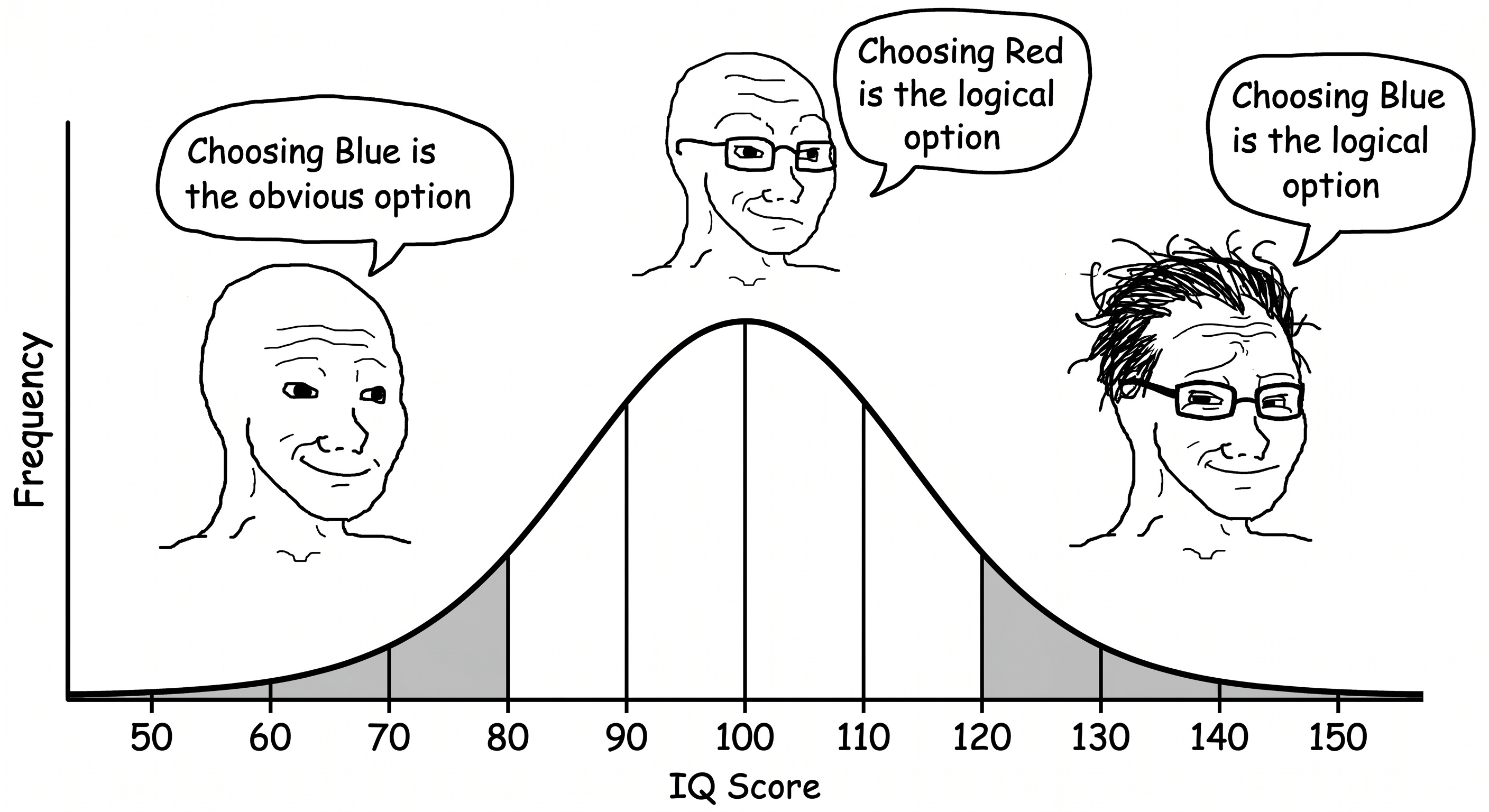
“...soo...umm...by this diagram that means over half are pushing red.” - u/mortemdeus
I. Which Button Will You Press?
Sometime in 2023, a thought experiment surfaced on the r/polls subreddit. It was simple and immediately polarizing.
The rules of the “Red Button vs. Blue Button” dilemma are as follows:
Every single person in the world is presented with a choice between two buttons.
If more than 50% of the population presses the Red Button, everyone who pressed the Blue Button dies.
If more than 50% of the population presses the Blue Button, everyone survives.
Three years later, in late April 2026, it experienced a massive viral resurgence.
Commentators have split into two distinct, fiercely opposed camps.
People who choose the Red Button, Team Red, point out that everyone who presses the Red Button has a 0% chance of death. If nobody presses Blue, nobody dies. Therefore, the only reason anyone is at risk is because people voluntarily opt into the risky Blue Button.
The Team Red argument is one of boundary-setting and non-participation: I did not create this death trap, I will not engage with the mechanics of the death trap, and I will not increase my personal risk to try and save a tiny minority.
People who choose the Blue Button, Team Blue, argue that reaching a 100% consensus for Red across eight billion humans is impossible. Through ignorance, fat-fingered misclicks, or chaotic malice, some people will press Blue.
The Team Blue argument is rooted in active moral duty: The trap exists and vulnerable people will fall into it. To stand by and watch them die when you have the power to absorb their risk is an act of evil or moral complicity.
One might note the self-fulfilling prophecy of Team Blue. The only people in danger in this scenario are the people pressing Blue. Team Blue is effectively creating the risk they are trying to mitigate.
If only 40% of the population presses Blue to save the 0.1% of errors, the Red majority triggers and 40.1% of the population dies instead of just 0.1%. While complex empirical defenses can be engineered, there is no clear, parsimonious utilitarian argument to be made in Blue’s favor.
Much of the choice comes down to a psychological framing of the initial conditions. Team Blue views the dilemma as a rescue mission: Everyone is on the tracks; will you jump off and save yourself at the expense of others? Team Red, however, looks at the exact same scenario and sees a pointless hazard: No one is on the tracks; why on earth would you jump on?
II. The Indeterminate Action
There is no payoff to choosing Blue beyond personal survival—a baseline state that is already guaranteed by pressing Red. If humanity could perfectly coordinate and unanimously press either color, the outcome is identical: nothing happens, and everyone goes home.
In a scenario where everyone can coordinate, there is no dilemma.
Because of this dynamic, a major fallacy plagues the discourse: the temptation to map the Button Dilemma directly onto the Prisoner’s Dilemma. In this flawed framework, commentators cast the Blue Button as Cooperate and the Red Button as Defect. But this misunderstands the payoff matrix. In a classic Prisoner’s Dilemma, mutual cooperation yields a tangibly better reward than mutual defection. Here, mutual “cooperation” (all Blue) and mutual “defection” (all Red) yield the exact same result. The tension is not actually about cooperation at all.
Discussions about dominating strategy often fall into the same trap. Team Red is quick to point out that Red is the strictly dominant choice regarding personal survival. While true, this only wins the argument if the actor is a rational egoist. For those with a utilitarian framework, the expected positive utility of pressing Blue (padding the vote to save fractions of a statistical life lost to errors) can outweigh the expected negative utility (the fractional risk of your own singular death) for a given set of weights.
Because the crux of the problem is about acting on uncertain information rather than mutual cooperation, the Button Dilemma shares far more philosophical DNA with Newcomb’s Paradox.
In Newcomb’s Paradox, a player must choose between a dominant bet (taking two boxes of money) or a leap of faith (taking one box) based entirely on the opaque predictions of an infallible entity. The core anxiety of the Button Dilemma is the same: it is about predicting an opaque state. In both scenarios, the dominant, safe option—Two-Boxing or Pressing Red—can feel intuitively wrong.
Notice further how in both problems, your initial assumptions reinforce your final conclusion, making the opposing side look insane. Because the ‘Predictor’ (whether an infallible alien or an opaque human crowd) cannot be directly influenced by your singular choice, players are forced to act on their underlying worldview. If you believe your actions exist in a vacuum, Red is the only logical choice. If you believe your actions are inextricably linked to a collective whole, Blue is the only moral choice.
The Button Dilemma, however, doesn’t require faith in an omniscient Predictor. The Predictor in this case is simply the opaque, collective outcome of the global vote and whether it manages to cross the 50% mark.
The entire thought experiment hinges on this indeterminate action. The dilemma breaks if we introduce empirical certainty. For example, if a live tracker showed us that 70% of the population had already locked in Blue, the tension evaporates. The safety net is built, and you can press whichever button you please. Conversely, if 70% locked in Red, pressing Blue becomes an act of intentional suicide. The trap only springs because the outcome is hidden.
This is why pressing the dominant, safe button (Red/Two-Boxing) feels like you are cynically betting against the box, while pressing the risky button (Blue/One-Boxing) requires a leap of faith into the dark.
III. The Value of Hypothetical Questions
The polls surrounding the Button Dilemma are heavily clouded by their initial framing. When commentators map the problem onto Trolley Problems or Prisoner’s Dilemmas, they bring all the baggage of those frameworks with them. It is tempting to dismiss the entire exercise as meaningless—after all, the stakes are completely hypothetical, and no one is actually facing a life-or-death button press.
Nevertheless, these abstract questions are valuable because they reveal the underlying models people apply to their moral perceptions.
Take, for instance, the sheer volume of people who choose the Blue Button. This represents a failure of the Rational Egoist model. If humans were purely self-interested, rational actors maximizing their own guaranteed survival, the Red Button would win in a landslide. The fact that a large chunk of the population opts for Blue reveals that most people do not view themselves as rational egoists—even if that doesn’t preclude the possibility that they might act as such in a real life.
Internet polls do not measure survival instincts; they measure aspirational identity.
Since we cannot measure why, we consider Evidential Decision Theory (EDT) as a way of understanding why people can fall into either camp and stick to their choices once made.
Under EDT, an agent treats their own decision as evidence of what other, similar agents will do. A Blue voter reasons: I am a relatively normal person. If I feel compelled to press Blue to save people, that is strong evidence that millions of other normal people will also feel compelled to press Blue. Their choice is also their diagnostic tool to predict the behavior of the crowd.
This provides the empirical certainty that we previously noted would collapse the dilemma. Team Blue is utterly convinced that Blue is the right choice. Team Red is equally convinced that Red is the right choice.
This is why the initial psychological framing—whether you view humanity as already on the tracks or safely off the tracks—is so crucial. If your brain’s default framing is “We are already in danger,” EDT leads you directly to Blue. If your brain’s default framing is “We are completely safe until we act,” EDT leads you directly to Red.
Because neither framing is objectively “more true” than the other in a vacuum, both sides view the opposing camp as irrational.
But game theory and risk assessment only make up half of the discourse. The other dimension we have so far neglected is the ethical one.
“Act only according to that maxim whereby you can, at the same time, will that it should become a universal law.” — Immanuel Kant
The Categorical Imperative is perhaps the most famous moral law of all time. Interestingly, both sides of the button debate can satisfy the Categorical Imperative.
Universalizing Red: If it becomes a universal law that every single human presses Red, what is the outcome? Zero deaths.
Universalizing Blue: If it becomes a universal law that every single human presses Blue, what is the outcome? Zero deaths.
(Strictly speaking a Kantian analysis wouldn’t actually care about the zero deaths outcome, focusing instead on the intrinsic duty of the act, the logic holds.)
However, while the “Absolute” (strictly logical) version of the Categorical Imperative favors neither side, the “Narrative” (practical) version decisively favors Blue.
You can imagine the world managing to scrape together a 51% Blue majority. You absolutely cannot imagine a world where not a single person makes an error and presses Blue. This mirrors Kant’s distinction between a Contradiction in Conception (a logical impossibility) and a Contradiction in the Will (a practical impossibility), which he famously used to argue for the duty of charity.
Why talk about Kant?
We can look at ethical theories in two ways: normative (how people should act) and descriptive (how people actually act and reason). The discourse surrounding the Button Dilemma is a showcase of ordinary people applying moral theory in the wild.
And it isn’t just deontology. Some of the discourse also bleeds into Virtue Ethics. Take this paraphrased sentiment by Team Blue in the comment sections:
“Would you really want to live in a world where only the people who pressed Red survived?”
This argument isn’t about mathematical outcomes, and it isn’t about universal duties. It is an argument about character. It asks what kind of people we are, and what kind of society we are building based on our virtues or vices.
Moral philosophy is real, and it is all around you.
IV. The Edge Cases
Is there anything special about some number that currently floats at around eight billion that we call the population of the world? Perhaps with a smaller number, the mechanics of this moral dilemma will become more clear.
Let us start at the absolute bottom: a two-person game.
If there are only two people in the world, the dilemma is entirely trivial. To achieve “more than 50%” of the vote, both players must press the exact same button. If one presses Red and the other presses Blue, it is an exact 50/50 tie, meaning neither threshold is crossed. Depending on how strictly you interpret the rules, either nothing happens, or the trap simply fails to trigger. Trivial Case. Dismissed.
However, the three-person game is entirely different.
Imagine you are in a room with two other people. You need two votes to trigger a majority. Which button do you press?
You press Red.
The rationale here is clear: the foundational argument for Team Blue—that a statistically significant number of people will press the wrong button through ignorance or chaotic malice—evaporates in a tiny population. Once you can look the other two players in the eye, it is no longer believable that anyone will accidentally participate in the death trap, meaning everyone can safely opt out.
There is also a mathematical penalty hidden in small, odd-numbered groups. If you press Blue to save your peers, but the other two press Red, the Red majority triggers and you alone are executed. By trying to absorb the risk of the group, you ensure your own destruction.
In this light, Red reveals itself as a trust-less solution.
Up until the population size N becomes large—large enough that statistical noise, misclicks, and bad actors become an inevitability rather than a hypothetical—the moral calculus overwhelmingly favors Red. Furthermore, if explicit coordination is possible, Red is the only logical consensus. It guarantees universal survival without ever having to test the loyalty, competence, or psychological state of the rest of the group.
This is consistent with our earlier observation in Part II: if perfect coordination exists, the dilemma collapses. But looking at the edge cases clarifies how it collapses. It inevitably collapses into Red, because Red lacks the need for trust.
We can borrow another mechanic from game theory: the iterated game.
The Prisoner’s Dilemma was famously extended into the Repeated Prisoner’s Dilemma, where players face the matrix multiple times. In a repeated PD, the dominant strategy often shifts; players learn that mutual cooperation over time yields a higher total payout than constant defection.
If we map this onto the Button Dilemma—imagine humanity is forced to press the buttons once a year—the correct move leans into Red.
Over multiple rounds, players would observe the historical outcomes. They would see that pressing Blue carries an uncontrollable risk of punishment. A single round of bad luck, a minor shift in public sentiment, or an organized trolling campaign could result in death for Team Blue. Red, on the other hand, carries an absolute, guaranteed safety rate across infinite iterations. Over time, survival conditioning would take over. Humanity would realize that relying on the coordination of a global Blue vote is a suicide pact, while Red remains the only sustainable, long-term equilibrium.
V. The Human Context
We have arrived at a contradiction. The exploration of the edge cases pushes us toward the Red Button. Yet, moral philosophy pulls us back toward the Blue Button. How do we reconcile the two?
Let us take a detour into the Human Context.
As we established earlier, hypothetical questions are diagnostic tools that reveal the hidden narratives and biases we hold about reality. The Button Dilemma exposes exactly where we believe individual agency ends.
Who picks the Red Button? It is easy to dismiss them simply as the risk-averse or the rational egoists. But their choice is rooted in a specific psychological framing: the Small World.
The Small World narrative is one of personal agency, strict boundaries, and isolation. It operates on the assumption that society is a collection of individuals making independent choices. If everyone minds their own business and follows the simplest rule (Press Red), the system works perfectly. This is accompanied by a “we are safe until we act” attitude, assuming that the default state of the universe is neutral and harmless.
Who picks the Blue Button? It is equally easy to dismiss them as irrational altruists or performative virtue signalers. But their choice is rooted in the Large World narrative.
The Large World narrative assumes that eight billion people are not isolated actors, but a deeply interconnected, chaotic ecosystem. In a Large World, you cannot rely on individual agency because scale guarantees statistical failure. This pairs perfectly with a “we are already in danger” attitude, assuming the default state of the universe is fundamentally hostile and mercurial.
The color framing of this thought experiment—Red versus Blue—is hardly subtle.
Political Red (Conservative/Libertarian) prioritizes personal responsibility, negative rights (the right to be left alone), self-reliance, and a deep skepticism of systemic intervention. Political Blue (Liberal/Progressive) prioritizes systemic thinking, positive rights (the duty to help), social safety nets, and collective responsibility.
As a descriptive view of modern society, the Blue narrative is arguably more correct. We do live in a deeply interconnected world where massive scale practically guarantees inevitable failures and bad actors. However, as we observed with the Iterated Prisoner’s Dilemma in Part IV, Blue loses over time.
Playing Blue means the altruistic are constantly paying a tax—in this case, taking on mortal risk—to subsidize the egotistic, the ignorant, and the malicious. Over time, any system that relies on the perpetual self-sacrifice of its most responsible actors to survive will eventually collapse. The Blue actors literally get culled from the population. (This is perhaps why, in the real world, so many cling to the mere aesthetic of charity; actual altruism is evolutionarily exhausting, if not fatal).
How, then, are we to reconcile a Large World reality with the Small World necessity of the Red Button?
We must make the Large World Small.
If we hand the button to eight billion people at once, we get an opaque, chaotic tragedy. But if we break the population down and give the button to a hundred people at a time, the dynamics shift entirely. We return to the clear-eyed logic of the edge cases. The opaque Large World becomes a transparent Small World. Everyone can look around the room, confirm the consensus, and press Red. No one dies, and there is no risk.
We solve the dilemma by making individual agency matter again. Through compartmentalization, we restore the feedback loop and create local agency out of global chaos.
This, fundamentally, is what institutions are for. A well-designed institution takes a massive, unmanageable societal dilemma and structures it so that the selfish choice and the correct choice come into alignment.
VI. The Cost of Insurance
When institutions fail to compartmentalize the world, we are thrown back into the chaos of the Large World. And if there is one variable we have so far neglected in that chaotic state, it is the cost of risk.
Up to this point, the life-or-death framing of the Button Dilemma has obscured an economic reality. When the consequence of an action is a binary absolute—utter survival or immediate death—it becomes difficult to discuss premiums or deductibles. But if we take away the hypothetical mortality and apply the dilemma to a grounded context, what we are actually looking at is a massive, un-underwritten insurance market.
This is an aspect that Team Blue needs an answer for. If you believe in the Large World narrative—that we are inextricably bound to the eight billion strangers, and that we are already “on the tracks”—you are describing a state of perpetual, exhausting anxiety.
Psychological safety is a finite, highly valuable resource. It cannot be dismissed or taken for granted. You cannot demand that a population live in a state of constant, high-alert vulnerability just to subsidize the chaotic elements of the system.
In a real-world scenario, pressing the Blue Button is the equivalent of paying an insurance premium. Team Blue is demanding that everyone buy into a global policy to cover the inevitable “errors” and “misclicks” of the broader population. The premium you pay is both the personal risk you absorb by engaging with the trap and the hit to your psychological stability of knowing your fate is in the hands of strangers.
Every insurance market, no matter how noble its intent, has a breaking point.
If the cost of coverage becomes too steep, or if the pool of insured people becomes too reckless, the math stops working. When the premium (the danger of a Blue failure and the emotional stress) outweighs the cost of simply opting out, people will refuse to buy in. They will withdraw their capital, secure their own borders, and let the broader system fail. The risk pool dries up, and the market collapses.
The Button Dilemma reveals how we view our duties to one another. It asks us where we draw the line between collective salvation and individual preservation. It asks how much tax we are willing to pay to insure a deeply flawed world.
And just in case you couldn’t wait to find out:
I would press Red.
The comparison to insurance appears apt. But real insurance policies vary in value. For some the blue fees may not be worth avoiding the red dangers, whilst for others the scale of the red dangers is so large you would always pay the blue.
How would our decisions change if only 1/2 of the blue pressers died when red majority was triggered? Or 1/4, 1/100 or 1/10^6? Or any other model of similar games, e.g. with a green button which acts as abstaining from the vote - no risk, no reward.
So drawing conclusions from these style of theorical problems risks not paying attention to the real life, complex variables.
Perhaps the most interesting bit of the debate is the personal responses individuals give, rather than which hypothetical solution is mathematically or philosophically more correct?