
I. Setting the Terms
The entire premise of a space datacenter rests on an economic triad: cheap semiconductors, expensive terrestrial power, and a plunging cost per kilogram to orbit. If any one of those three breaks, the idea falls apart.
This immediately raises further questions.
Take semiconductors. When we say “cheap” compute, what are we actually launching? Putting leading-edge 3nm silicon in orbit raises questions due to the ionizing radiation dense environment. Older, larger nodes are naturally more resistant to single-event upsets. It takes a bigger hit to flip a larger transistor. On the flipside, they are also easier to hit due to their size. They are cheap, but their power inefficiency defeats the entire purpose of escaping Earth’s grid. They also require more heat dissipation per compute, which is a running problem we will encounter over and over again.
If we try to use radiation-hardened chips, we are working with hardware that lags commercial tech by a decade and costs a fortune. The alternative is fixing it in software, but that eats up a percentage of your compute capacity. There are hard limits to how much overhead you can take on before the datacenter stops being useful.
If software mitigations eat too much overhead, the alternative is waiting for material science to catch up. Gallium Nitride (GaN) comes to mind. Aside from its electrical benefits, GaN can operate at much higher temperatures, which is critical when you have no air to carry heat away. Photonics might be another possible leap, bypassing the radiation problem because cosmic rays don’t flip photons the way they flip electrons.
Setting the orbital hardware aside for a moment, how expensive and constrained does ground infrastructure have to get to make orbit the better financial choice?
We view grid limits, permitting hell, and NIMBYism as absolutes, but those are developed-world problems. What happens when a hyperscaler decides to bypass the US or European grids entirely? They strike a deal to build a solar-powered facility in the Sahara, or partner with a Gulf state. Those regions have high solar irradiance, cheap land, massive sovereign wealth, a desire for post-oil industries, and minimal regulatory friction. A space datacenter doesn’t just have to beat the cost of building in Silicon Valley or Virginia; it has to beat the cost of an unregulated desert. It has to compete against the whole world.
If we do go to space, the positioning creates another trade-off. To avoid the weight penalty of carrying battery banks into orbit to keep the servers alive while passing through the Earth’s shadow, we would have to haul these datacenters into a dawn-dusk Sun-Synchronous Orbit (SSO). This gives us continuous sunlight and gets us further away from the Earth’s own thermal radiation (albedo).
But reaching SSO requires a lot more energy. You can’t ride the momentum of the Earth’s rotation to get there, and the rocket equation is unforgiving. And launch cost is only half the equation anyway. What about the lifecycle? In space, a broken fan or a fried motherboard is a crisis. The cost of maintenance, hardware replacement, and eventual de-orbiting has to factor into the baseline. The only logical architecture is separating the power production and heat dissipation systems from the datacenter block entirely—building a persistent utility grid in orbit where compute modules can dock, burn out, and be replaced without wasting the solar arrays.
Then there is the data flow. Who is actually going to use these datacenters? When you factor in the latency and the steep asymmetry in bandwidth—space communication is heavily skewed, often 20x more downlink than uplink capacity—the use cases narrow significantly.
Some of these questions are about future engineering. They are speculative, but we can model them. We know the bounds of thermodynamics and the trajectory of launch costs.
But some of these assumptions are about human industry, regulatory thresholds, and the future progression of AI itself. These are not remotely predictable, and the variance here completely swallows the engineering details. Depending on how you weigh these human factors, space datacenters look either entirely absurd or absolutely inevitable.
Scenario A (Pie in the clouds): AI algorithmic efficiency takes a massive leap. Smaller, highly optimized local models become the norm, reducing the brute-force compute requirement. Meanwhile, terrestrial grids manage to build out enough nuclear or geothermal capacity to handle the remaining load. Space datacenters remain a niche, sci-fi concept.
Scenario B (The no-brainer): Scaling laws hold true indefinitely, demanding gigawatt-scale compute clusters that just keep growing. Terrestrial governments, panicked by the localized grid strain and massive climate impact, heavily tax or outright ban hyperscale datacenter expansions. Orbit suddenly becomes an economic and regulatory haven—an offshore tax shelter, but for energy and heat.
Scenario C (Edge Compute) Scenario D... We could go on, creating as many scenario’s as we like. But let’s stop here to examine the SpaceX’s current proposal as an example of the physical limitation space datacenters are working against.
II. The Fundamentals of Space Datacenters
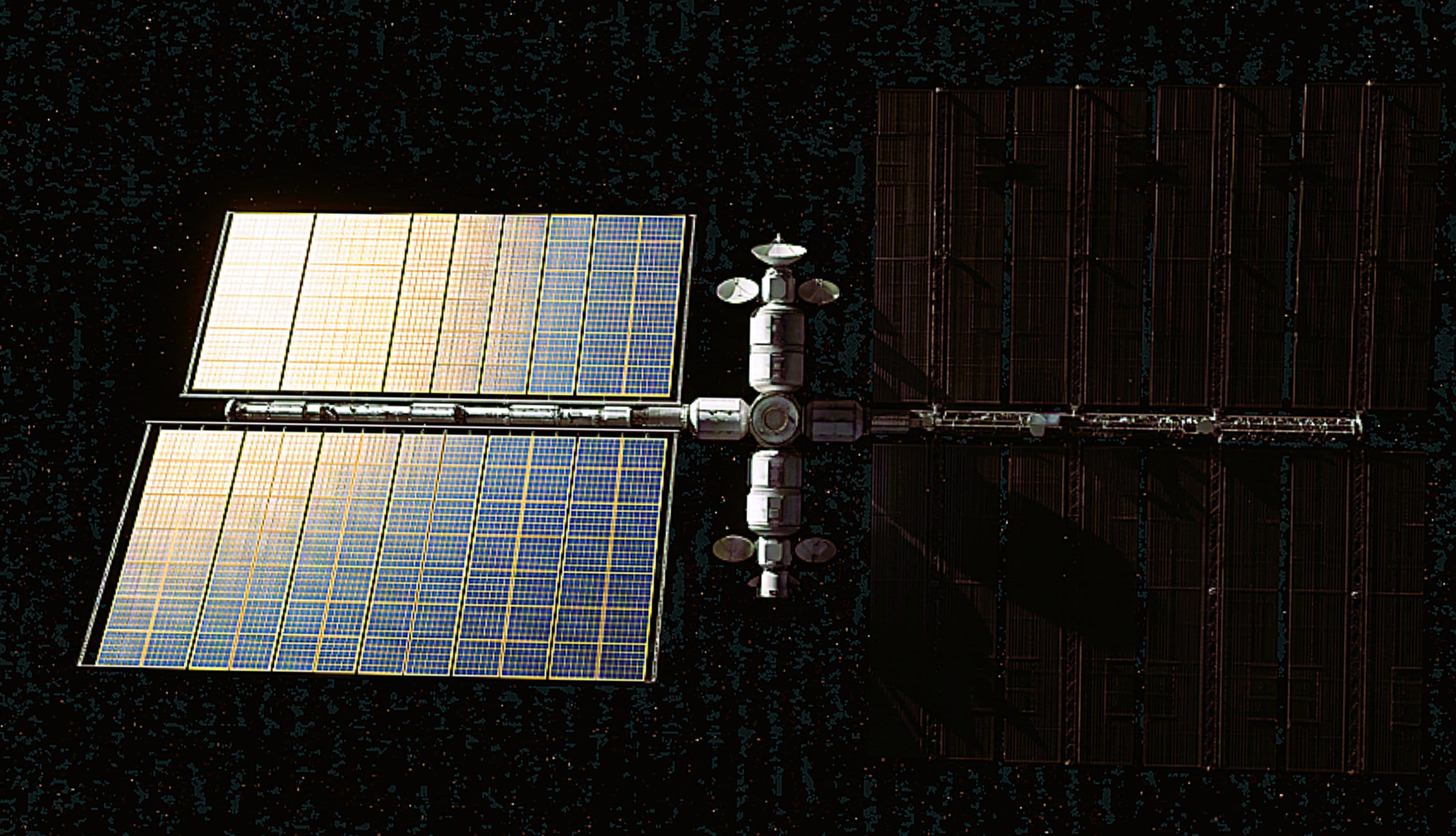
SpaceX recently posted photos of its proposed satellite datacenters prior to its IPO. Their filing details a 150 kW payload wrapped into a 2.14-ton satellite, featuring a 110-square-meter liquid radiator for cooling. For context, 150 kW is just shy of what you’d need to power an Nvidia Vera Rubin NVL72 rack, and comfortably enough for a Blackwell GB200 NVL72.
Let’s do a sanity check on those numbers to understand the constraints of putting compute in orbit.
First, power generation. The “solar constant” (AM0 irradiance) at Earth’s distance from the sun is roughly 1367 W/m². To generate 150 kW with an implied solar array size of 600 square meters, you’re looking at a required efficiency of roughly 18.3%. Standard commercial earth panels hover between 15% and 22%, while advanced multi-junction space solar cells can hit 28% to 30%. That part of the math checks out; the power generation is completely plausible.
The real bottleneck is thermodynamic. Datacenters convert 100% of their electrical power into heat. If your solar array pulls in 150 kW of power, you have to reject 150 kW of thermal energy into the vacuum of space.
Assuming the 110-square-meter radiator has both sides facing into deep space and radiates from both sides, this gives us an effective area of 220 m². Assuming a radiator coating with an emissivity of 0.85, we can use the Stefan-Boltzmann law to find the required surface temperature:
That converts to roughly 70°C. On paper, a 70°C radiator surface temperature might look reasonable for server hardware. But if the radiator surface is 70°C, the coolant returning to the server rack can’t be any cooler than that. For standard hardware, the liquid entering the cold plates generally has to be between 35°C and 45°C.
To bridge that gap, you have three options:
Change the hardware to operate at higher temperatures.
Introduce heat pumps, which costs additional power and weight.
Build bigger radiators.
There is a fourth alternative: run the processors at 100°C. Running silicon that hot spikes leakage current and causes the metal traces inside the chip to slowly degrade. But if chips become cheap enough, maybe it’s possible to just replace them every other year? It feels unlikely, but it’s something to keep in mind.
Then there is the weight budget. Let’s look at a hypothetical breakdown for a 150 kW satellite.
Solar Arrays: Cutting-edge Roll-Out Solar Arrays (ROSA) achieve a specific power of roughly 100 W/kg. For 150 kW, that is about 1,500 kg.
Radiators: Lightweight deployable space radiators typically have a “density” of 6 to 15 kg/m². For 110 m², that is roughly 660 kg at the lowest end.
Just adding the currently lightest solar panels and radiators together gives us 2.16 tons. We have already exceeded the 2.14-ton total weight limit—and I suspect this is exactly how SpaceX arrived at their numbers.
There is no weight allocated here for a modern liquid-cooled AI rack, which comes in around ~1.5 tons. No weight for the propellant and reaction wheels/control systems to maintain attitude and orbit against atmospheric drag and solar radiation pressure.
(I briefly considered the use of an Electrodynamic Tether, but this is not a useful tool to maintain SSO orbit)
At this point, we can just ignore SpaceX’s stated weight. Realistic estimates with current technology put the actual weight closer to 6 tons. Maybe they are banking on experimental ultra-thin film panels that push past the 100 W/kg of current ROSA tech, but the margins are nonexistent.
Notice what else is missing from this weight budget: batteries.
A battery bank capable of keeping a 150 kW cluster running through the darkness of a standard orbit would shatter any mass constraint. So where does SpaceX plan to place their datacenters to avoid the dark?
In Sun-Synchronous Orbit (SSO).
III. An Orbit Staring at the Sun
If we place a satellite at ~600 km altitude and have it ride the terminator line (the dividing line between day and night on Earth), the Earth’s shadow is almost entirely out of the picture.
You can fix the solar panels to constantly be facing the sun, and align your radiators edge-on to the sun so they only ever “see” the void of deep space. Because human presence isn’t required, you can design the structure to warp to deal with the thermal stresses. The simplest way is to have it be modular rather than a single massive hull.
To achieve a Dawn-Dusk SSO, the orbit must be slightly retrograde, requiring an inclination of about 97.8 degrees. This means the rocket has to launch slightly “backward” against the Earth’s natural rotation, losing the free speed boost you get from a standard eastward launch. When launching into a standard Low Earth Orbit (LEO) eastward—around a 28.5-degree inclination from Cape Canaveral—the rocket gets a free velocity boost from the Earth’s rotation of roughly 0.4 km/s.
Standard LEO Delta-v: ~9.3 km/s
Dawn-Dusk SSO Delta-v: ~9.8 km/s
The Tsiolkovsky rocket equation dictates that fuel requirements scale exponentially with delta-v. This extra delta-v penalty is paid for by reducing the maximum payload capacity. A rocket variant that can deliver 150 metric tons to a standard low-inclination LEO can typically only deliver around 100 metric tons to an SSO. Even if costs decrease as launch systems mature, we can assume this 50% markup persists, since the same technology and reusability profiles affect both launch trajectories equally.
There is a great deal of bad extrapolation regarding cost to orbit that people repeat in verbatim. Assuming a commercial Starship contract settles at a market price of around $90 million, rather than SpaceX’s internal marginal cost targets:
Standard LEO Cost: $90,000,000 / 150,000 kg ≈ $600/kg
Dawn-Dusk SSO Cost: $90,000,000 / 100,000 kg ≈ $900/kg
And then comes the operating environment. At 600 km, especially crossing the poles in a highly inclined SSO, the satellite will be bombarded by ionizing radiation and solar protons.
Much of the research on this topic conflates LEO with SSO. Satellites orbiting near the equator are largely protected by the Earth’s magnetosphere, which deflects Galactic Cosmic Rays (GCRs) and Solar Proton Events (SPEs). Because SSO is a nearly polar orbit, the satellites fly over the Earth’s magnetic poles on every single 90-minute orbit. At the poles, the magnetic field lines funnel radiation directly down into the atmosphere.
Therefore, a datacenter in SSO is subjected to a constant barrage of high-energy solar protons—experiencing polar fluxes that can exceed 1,000 particles/cm²s during solar events—that an equatorial satellite never sees due to the Earth’s magnetic shielding. Furthermore, its high inclination means it regularly slices through the South Atlantic Anomaly (SAA)—a dip in the magnetic field where the inner Van Allen belt drops unusually low.
Finally, if we get past all the other thermodynamic, launch, and radiation problems, we hit a physical limit. Space may be infinite, but Dawn-Dusk SSO is prime, finite real estate. Unlike a standard LEO shell where you can spread satellites across various orbital planes, all Dawn-Dusk satellites are crammed into the exact same 97.8° plane to ride the shadow line.
IV. The Future in Chips
Are we ever going to reach the point of “cheap” semiconductors, or will bleeding-edge silicon always be reserved for Earth?
AI hardware requirements have changed at a blistering pace. Each time the model structure changes—moving from standard CNNs to Transformers, and now toward state-space models, liquid networks, or sparse Mixture-of-Experts architectures—the underlying architecture shift to accommodate. This makes it abundantly clear that space datacenters must be built around modular payload bays, where compute blades can be swapped out as architectures evolve.
But if we assume power stops being a limiting factor (via uninterrupted solar) and launch costs plummet, the entire paradigm of chip design flips. The primary reason the semiconductor industry relentlessly shrinks transistors is to pack more compute into a smaller physical footprint while keeping power consumption strictly capped. If you remove the power cap, you no longer need microscopic, hyper-efficient nodes. (Though you still have to deal with yield and cost per transistor, the other reason the semiconductor industry shrinks transistors)
Instead, we could design massive silicon dies or stitch together arrays of large chiplets. We could even revisit older, larger nodes and apply cutting-edge manufacturing techniques to them. Consider Huawei’s current work on 3D LogicFolding. Locked out of Western EUV lithography machines, Huawei is bypassing the need to shrink circuits on a 2D plane by folding logic gates vertically in 3D. By optimizing signal propagation delay rather than physical size, they are attempting to match 1.4nm density limits using much older manufacturing equipment.
The drawback to 3D stacking is the concentration of heat in a tiny volume. On Earth, that requires direct-to-chip dual-phase liquid cooling. In space, dealing with that concentrated thermal load is still firmly in the realm of future technology.
But it proves a point: the astronomical cost of a modern GPU isn’t just about the silicon itself. It’s heavily inflated by advanced packaging constraints (like TSMC’s CoWoS), the necessity of High Bandwidth Memory (HBM), and high profit margins. Some of these are real competitive moats, while others are more porous than at first glance. Perhaps the biggest hurdle and the one SpaceX’s valuation is closest to directly overcoming is the economies of scale required to overcome the non-recurring engineering costs of building a “cheap” orbital chip.
The Radiation Problem
The catch to sending silicon to space is cosmic radiation. True radiation-hardened chips—like the Microchip PIC64-HPSC being developed for NASA, or AMD’s space-grade Versal SoCs—absolutely exist. But they survive in part because they use older, physically larger manufacturing nodes. A larger transistor requires more energy from a cosmic ray to flip its state.
However, rather than relying on physically larger transistors at all, modern orbital compute leans heavily into software, using redundancy to correct errors on the fly. Nvidia’s newly announced Space-1 Vera Rubin module is an example of this philosophy, pushing hyperscale-class AI computing directly into orbit while utilizing software and system-level mitigations rather than depending on legacy rad-hardened silicon.
The classical playbook involves three layers of defense:
Triple Modular Redundancy (TMR): Critical calculations run simultaneously across three identical logic blocks. If a high-energy particle causes a Single Event Upset (SEU) and flips a bit in one block, a voting circuit compares the three outputs. The two that agree instantly outvote the anomaly.
ECC Memory: Error-Correcting Code memory acts as a constant proofreader for RAM, mathematically identifying and fixing single-bit errors as they happen.
Software Checkpointing: For the rare, catastrophic multi-bit flips that crash a system entirely, software continuously saves the exact state of the machine at microsecond intervals. If a node goes down, it simply reboots from the last checkpoint.
Thinking about the overhead, these techniques make orbital computing feel impossible. But there is a crucial factor to consider, AI workloads make radiation mitigation vastly easier. If a cosmic ray flips a bit in a banking ledger, the transaction is corrupted. But AI matrix multiplication is highly probabilistic. In a sea of billions of parameters, a few flipped bits are completely swallowed by the noise without meaningfully degrading the model’s output. You can then save TMR for key features like the control logic and instruction schedulers.
Future Paradigms
If we look into beyond the current decade, material science offers two possible game-changers for orbit.
The first is Gallium Nitride (GaN). GaN is notoriously difficult to shrink due to lattice mismatches when grown on silicon substrates, making nodes highly prone to defects. As a result, stable GaN nodes today are massive by modern standards, typically sitting in the 130nm to 250nm range. But GaN possesses an advantage: it can run incredibly hot.
If your chips can comfortably operate at 150°C instead of 75°C, your required radiator surface temperature can be much hotter. Because thermal radiation scales to the fourth power of temperature (as dictated by the Stefan-Boltzmann law), raising your operating temperature allows you to drastically shrink the size, weight, and cost of your orbital radiators.
The second leap is photonics. Traditional chips move data by pushing electrons through copper wiring, which inherently generates resistive heat. This is bottleneck for transistor density on Earth just as much as it is a bottleneck for overall heat dissipation in space.
Photonics replaces these electrical pathways with optical waveguides, moving data via light. Beyond the reduction in power consumption and heat generation, photonics offer a unique advantage in orbit: ionizing radiation immunity. Photons carry no electrical charge. When a solar proton passes through a photonic optical link, it does not induce the voltage spikes or bit flips that plague electronic transistors.
Since optical inter-satellite links (lasers) are already the standard for space communication. If you build a fully photonic datacenter, you eliminate the need to constantly convert incoming laser data from another satellite back into electrical signals for the processor. The data stays as light from the moment it leaves Earth, right through the compute matrix, and back down again.
V. The Story on the Ground
The entire premise of orbital compute rests on a fragile economic moat: terrestrial energy is expensive and capped by regulations, while space energy is boundless. But what happens if cheap terrestrial power overcomes its hurdles?
If utility-scale solar and battery storage costs continue to drop, or if small modular reactors (SMRs) and next-generation geothermal clear regulatory hurdles in the 2030s, the cost of clean power on Earth could plummet.
Water is often cited as a hard limit, but this is an engineering choice, not a problem per se. The industry relied on evaporative cooling because it is energy efficient. But if energy becomes abundant, datacenters can transition entirely to closed-loop cooling systems.
All industrial processes, including agriculture, have always been a trade-off between water and energy. At a high level of abstraction this is ultimately due to entropy. And while datacenters do consume a lot of water locally, their total usage is a rounding error compared to the rest of the economy.
On the issue of heat dissipation, it is far simpler to imagine using the spare heat for industrial processes, desalination plants, or transmitting it via HVDC lines to colder climes than it is to loft thousands of tons of radiators into a vacuum.
This raises an obvious question: If space is such a hostile environment, why put the fragile, heavy compute hardware up there at all? Why not keep the datacenters on Earth and simply beam the boundless space energy down?
The Physics of Power Beaming
We essentially have two ways to get power through the vacuum of space and the Earth’s atmosphere: microwaves or optical lasers. Neither is economically viable for powering hyperscale compute.
If you use microwaves, the energy must be converted from direct current to RF microwaves, beamed through the atmosphere, and captured by a ground antenna (a rectenna) to be converted back to direct current. Due to the Airy disk effect, electromagnetic waves spread out over distance. Even a focused microwave beam from orbit will spread into a footprint several kilometers wide by the time it hits the ground, meaning four fifths of the energy simply misses the target.
Lasers can maintain a much tighter beam, but they are absorbed and scattered by the Earth’s atmosphere, especially by water vapor, clouds, and thermal turbulence. The physical limitations here are stark. In 2025, NTT and Mitsubishi Heavy Industries conducted a ground test of optical wireless power transmission. They fired a 1,035 W laser through one kilometer of turbulent air. Despite using advanced beam-shaping optics specifically designed to counteract atmospheric distortion, the receiving panel was only able to extract 152 W of electrical power. That is a 15% end-to-end efficiency over a single kilometer.
By the time you account for conversion losses at the source, atmospheric scattering over 600 kilometers, and conversion losses at the receiver, beaming power from space to Earth wastes 80% to 90% of the collected solar energy. At that point, you might as well just build the solar panels on the ground.
It is drastically more efficient to beam data than it is to beam power. The physics heavily favor computing at the source of generation.
Glasses for Geopolitical Myopia
Finally, when we model the regulatory hurdles that supposedly make space attractive, we have to look outside the US and Europe. We view grid limits, permitting hell, and NIMBYism as absolutes, but those are largely developed-world problems.
A space datacenter doesn’t just have to beat the cost of building in Virginia; it has to compete against the whole world.
Consider China, which is already building massive energy infrastructure in Xinjiang and pushing forward with next-generation nuclear power plants specifically to power its AI ambitions.
Or consider the Gulf States. The Gulf has high solar irradiance, cheap land, massive sovereign wealth to build the infrastructure, and a lack of democratic regulatory friction. There is a massive drive there to invest in post-oil alternative sources of income. The spare heat from a 1 GW datacenter, which is a liability in California, is an asset in the Gulf, where it can be piped into the thermal desalination plants the region already runs.
If hyperscalers begin bypassing the US grid to build unregulated, sovereign-backed mega-projects in the desert, the US government is unlikely to maintain its current regulatory course. If by 2030, China succeeds in building 1.4nm-equivalent AI silicon domestically using older fabrication tools, and pairs it with their massive, unregulated energy buildouts in places like Xinjiang, the U.S. will not sit idle.
The regulatory friction that makes space look appealing today could vanish overnight if it becomes a matter of national security.
VI. Demand on the Edge
Space datacenters have a data flow problem. Even if we solve the thermodynamics, the launch costs, and the radiation hardening, we still have to get the data up and down.
We could just build massive arrays of ground stations to catch the transmission, but the industry has largely exhausted that route. Physics imposes a hard ceiling on the available radio spectrum. Traditional X-band and Ka-band downlinks max out in the hundreds of megabits per second. Compounding this limit is orbital geometry: a satellite only has a direct line-of-sight to a specific ground station for about five to ten minutes per orbit.
Optical laser downlinks are an alternative. They offer hundreds of gigabits per second, but lasers are blocked by water vapor and thick clouds. Relying on an optical downlink means you need a highly redundant network of ground stations scattered across arid, desert regions just to ensure a statistically probable clear path to the ground at any given moment.
Because a direct, clear downlink is never guaranteed, orbital networks rely on a ‘store-and-forward’ architecture. Data is routed across an optical inter-satellite mesh—like the Starlink laser network, which in 2024 was already routing over 42 Petabytes of data per day in orbit—and held until a satellite passes over an available ground station.
This introduces inherent, unavoidable latency. So, if bandwidth is heavily constrained and latency is baked into the architecture, what workloads are these space datacenters actually meant to process?
The immediate, highly practical use case for orbital compute—and the reason at least a few of these facilities will be built—is data reduction for Earth observation.
Right now, imaging constellations generate petabytes of raw radar, hyperspectral, and optical imagery. They waste hours waiting to downlink those massive raw files to Earth just so terrestrial computers can parse them. If you put the compute on the edge, right next to the sensor in orbit, you flip the paradigm. Instead of spending an hour downlinking a 10-gigabyte raw image of the ocean, the orbital datacenter processes the image locally and downlinks a 10-kilobyte text alert: Illegal fishing vessel detected at these exact coordinates.
This also enables constellation survival. Rather than waiting for a ground operator to calculate an orbital maneuver, uplink the command, and wait for execution, an orbital compute cluster can act autonomously. It can make mission-critical decisions in real time—altering orbits to dodge sudden debris or instantly retasking sensors based on cloud cover—without waiting on the terrestrial bottleneck. For these agentic, asynchronous tasks, orbit is the perfect environment.
Standard AI inference is a much tougher sell. Running consumer-facing models or real-time enterprise algorithms in orbit suffers heavily from both the latency and the downlink bottleneck. Modern workflows demand fast-as-possible, streaming token generation. It isn’t even necessarily the user that needs it so much as the next AI tool in the workflow. Waiting for a prompt to bounce up through an uplink, get processed, and store-and-forward its way back down through a cloud-free laser link breaks the expected experience.
Another angle is absolute physical security. Processing highly classified government intelligence or immensely valuable commercial intellectual property in an orbital datacenter provides a physically secure, jurisdictionless airgap. The data never has to touch a foreign-owned terrestrial fiber network. It never has to pass through competing regulatory zones or hostile borders before being encrypted and digested. For certain sovereign or corporate actors, the guarantee that a server is physically untouchable at 600 kilometers up is a premium worth whatever latency penalty the network imposes.
However, there is only one class of workload that scales efficiently in orbit: autonomous ones. Agentic workflows can continue to scale, will continue to scale because they lack the human bottleneck. They can spawn sub-agents, parallelize tasks, and run continuously. The demand for compute to power agentic workflows is essentially unbounded. It will use up as much compute as you can give it. Agentic workflows are also asynchronous. They do not care about latency. In fact there is no reason for the data to be beamed down. The task can remain within the satellite mesh until fully completed.
Most important among these tasks is model training. We have hit the data wall and the only viable path forward for capability scaling is post-training reinforcement learning (RL) and synthetic self-play. A base model can be launched once, and then left to grind through billions of self-play iterations in the quiet of orbit, downlinking only the final, optimized weights.
If there is one variable the orbital datacenter will not lack, it is demand.
VII. The Bounds of the Plausible
It all just feels slightly outside the bounds of the plausible.
The technology exists and the math is only slightly exaggerated in the best case scenarios. The puzzle pieces are present but they don’t feel like they make a whole picture. So let’s try to imagine what it would really take for space datacenters to become economically viable.
If you ever look up and see a datacenter in orbit, it means something went wrong on Earth.
For the math to work, Earth-bound energy initiatives have to fail. Next-generation geothermal and small modular reactors need to get permanently bogged down in regulatory hell or fail on their own technical merits.
Elon Musk has a personal history of pitching highly speculative infrastructure, the Hyperloop, right when projects like California High-Speed Rail were struggling. Not that California’s rail project needed much help failing, but the tactic goes beyond Musk. Industry has a long tradition of looking to the stars precisely when logistics get boring or legally complicated. Urban planners refer to this as “tech-washing” or predatory delay—proposing a highly speculative, futuristic solution to siphon political and financial capital away from a pragmatic, boring solutions.
You would also have to assume that the evolution of AI chips slows to a crawl. If the focus remains on the silicon, then the grid doesn’t become the insurmountable bottleneck. Implicitly that means model architecture also stops evolving.
For space data centers to work, we need an era of SuperDataCenters, not SuperFabs. If TSMC, ASML, and Nvidia continue to drastically improve performance-per-watt via architectural breakthroughs, like photonics, GaN, or 3D logic folding, then a hyperscaler can simply buy next-generation chips to get 10x the compute using the exact same amount of terrestrial power. The bottleneck stays inside the fabrication facility. Many of the same hardware breakthroughs that make space more viable would simultaneously solve the terrestrial energy crisis that makes space appealing in the first place.
Space datacenters require algorithmic and architectural stagnation. The entire concept only makes sense if hardware hits a hard wall, leaving brute-force scaling as the only way to make AI smarter. You have to envision a future where the only path forward is plugging in tens of millions of chips across hundreds of square miles of orbital solar arrays. To justify the staggering launch costs, you have to explicitly root for a stall in semiconductor innovation.
You also need AI’s demand on compute to keep ballooning. We can’t hit a plateau where small, highly efficient local models become “good enough” for most of the economy. We need models to remain bloated in size and power-hungry, enough that commercial hardware simply can’t handle them.
Finally, AI itself has to become increasingly regulated. Space datacenters favor a world of a few centralized, highly expensive, closed-source models reliant on brute-force scaling rather than architectural elegance. If the open-weight ecosystem currently being championed by developers like DeepSeek and Qwen continues to thrive, AI will likely trend toward algorithmic efficiency. Developers will run highly capable, optimized models locally on cheap, distributed hardware. For orbit to win, the regulatory walls have to close in, forcing AI into massive, untouchable off-planet silos.
It is all a bit bleak, really.
Summary and Postscript - An Apologia
The Core Tradeoffs: We examine the economic triad of cheap silicon, expensive terrestrial power, and falling launch costs required to make orbital computing viable.
Thermodynamic Reality: We deconstruct SpaceX’s proposed payload limits, revealing that current space cooling and power systems leave no mass budget for the servers themselves.
Orbital Compromises: We navigate the physics of Sun-Synchronous Orbits, where the benefit of constant solar energy is offset by punishing launch fuel penalties and intense polar radiation.
Silicon Evolution: We explore how the boundless power of space could shift semiconductor design away from microscopic nodes toward larger architectures, software redundancy, and photonics.
Terrestrial Resilience: We contrast the supposed regulatory limits of the West with the rapid, sovereign-backed infrastructure and energy buildouts happening globally.
Data Bottlenecks: We identify autonomous agentic workflows and long-term model training as the only workloads capable of thriving under the constraints of orbital networks.
A Bleak Bet: We conclude that placing datacenters in orbit requires a pessimistic assumption that earthly energy solutions and semiconductor innovation will stagnate.
Postscript
The astute among you might have noticed I avoided answering the question: Are space datacenters actually viable?
This is a hard question. I have my answer, but I don’t feel justified stating it. I will furthermore assert that anyone who claims a definitive binary answer right now is selling you something.
To demonstrate why this is so difficult, I offer this apologia—a patch job of lingering variables I noticed while writing this essay that must be resolved before even a minimally satisfactory answer can be reached.
From Part 3 - An Orbit Staring at the Sun
I brushed off the more utopian launch cost projections earlier, but they deserve a fair hearing. If we take the most aggressive Starship projections at face value—where rapid reusability drives the price down to the marginal cost of fuel, hitting say $10 million a launch or ~$100/kg to LEO—many of the weight and thermodynamic constraints soften. You can suddenly afford dead weight.
But the spatial challenges deserve further consideration too. Cramming thousands of massive datacenter satellites, each with 70-meter radiator wingspans, into a single orbital plane dramatically spikes the risk of Kessler Syndrome. While they can be stacked at different altitudes, the orbital intercept paths mean the bottleneck remains. The regulators are already watching. The FCC and the ITU are tightening de-orbit requirements, and with multiple sovereign nations competing for the same shadow-line orbits, it could easily turn into a geopolitical gridlock before the first server rack is deployed.
From Part 4 - The Future in Chips
Putting liquid cooling in space is a headache. Pumping fluids in microgravity is a nightmare because you lack buoyancy. Gas bubbles generated by boiling coolant don’t float away from the hot silicon; they stick to the chip, causing localized overheating. Building two-phase pumped fluid loops requires complex fluid separators that are highly prone to failure. The non-liquid alternatives—advanced heat pipes, phase change materials like paraffin wax, or highly conductive pyrolytic graphite sheets—have zero moving parts and weigh significantly less, but their total heat-carrying capacity is a fraction of what liquid can handle.
And that is assuming the hardware survives the ride up. Sustaining 3 to 4 Gs is the easy part; racks can be designed to take unidirectional force. The real hardware killers are vibration and high-frequency shock. Terrestrial hardware has to be ruggedized for launch—potting electronics in epoxy, bolting and locking every single connector, and stiffening the chassis. All of this adds dead weight.
From Part 5 - The Story on the Ground
The involution (neijuan) of power. Wright’s Law curves for solar and lithium-ion batteries have been miraculous, but raw material costs represent a hard floor. Are batteries and photovoltaics really going to continue getting cheaper? The current price crash is heavily driven by Chinese state-subsidized overcapacity. Once that market consolidates and the weaker manufacturers die, the surviving giants will naturally raise prices to achieve profitability.
There is also the question of whether terrestrial “heat repurposing” is actually real. Can low-grade datacenter heat efficiently power industrial desalination, or is it mostly greenwashing outside of a few highly specific geographies? Ironically, if we push for GaN or higher-temperature silicon to make space radiators smaller, it might just make terrestrial waste heat hot enough to be genuinely useful to heavy industry on Earth.
From Part 6 - Demand on the Edge
Maybe we are thinking too conventionally by staying in orbit. It is a long shot—though much much easier than building a city on Mars—but putting datacenters on the Moon solves several problems simultaneously. You get radiation shielding by burying the hardware under the regolith. You get a geological thermal sink for cooling. And with zero atmosphere to scatter light, beaming energy or data via laser suddenly becomes much more efficient.
From Part 7 - The Bounds of the Plausible
Finally, this entire premise assumed space remains an unregulated haven. That is a temporary phenomenon. Humans regulate what they can reach. Under the 1967 Outer Space Treaty, the launching state is internationally liable for whatever the payload does. The legal framework already exists; it just hasn’t been aggressively applied to orbital compute yet.
This is far from a complete list and one that is likely to change in the coming years.