
I. The End of Cheap Energy
The situation since the 2022 Russian invasion of Ukraine and the 2026 conflict in Iran has made it clear that Western nations have exhausted their tolerance for high energy prices.
Data indicates that production in Germany’s most energy-intensive sectors—namely chemicals, metals, and glass—has fallen by over 15 percent since the onset of the Ukraine war. With sovereign debts spiraling upward across the developed world, Western governments can no longer absorb further economic hollowing and the job losses that accompany sustained energy price spikes.
During the 2022–2023 gas crisis, European states expended hundreds of billions of euros to shield households and businesses from utility bills. However, socializing the costs of energy wars has constrained incumbent governments, as adding to already unsustainable debt burdens is no longer a viable policy lever. The consequence is the emergence of a widespread greenlash—where voters punish politicians who attempt to mandate the adoption of high-cost consumer technologies, such as electric vehicles and residential heat pumps.
As the World Bank recently highlighted regarding the 2026 Iran conflict, these shocks arrive in waves. A surge in energy prices cascades into a food crisis—driven by spikes in fertilizer costs—before calcifying into broad-based inflation. Consequently, central banks are compelled to maintain higher interest rates for longer durations, stifling domestic growth. Even the United States, despite its position as a net energy exporter, is experiencing consumer distress at the fuel pump, a dynamic poised to influence the upcoming November 2026 midterm elections. (and many subsequent elections .”it’s the economy stupid”)
In this environment, clean energy infrastructure is no longer evaluated strictly through an environmental or climate-centric lens; it is now priced and prioritized as vital national security infrastructure. However, the pursuit of friendshoring supply chains carries economic costs. Attempting to swap a reliance on Russian natural gas and Iranian crude oil for solar photovoltaics, advanced batteries, and critical minerals means trading a dependence on the Middle East and Russia for a dependence on China. This pivot arrives at precisely the moment when fiscal austerity and national security concerns are dominating Western policymaking.
Viewed through a historical lens, the current endeavor is unprecedented. Humanity has successfully navigated multiple energy transitions: from biomass to coal during the early Industrial Revolution, to oil in the twentieth century, and more subtly to natural gas in recent decades. Yet, this represents the first instance since the departure from biomass that civilization is attempting to transition away from natural gas toward renewables—which, ironically, includes a return to industrial biomass.
Every historical energy transition from biomass, to coal, to oil, and to natural gas was a move toward higher energy density and lower relative cost. By shifting toward diffuse renewable generation, we are moving backward in terms of energy density while imposing upfront capital burdens onto the consumer.
II. The Geopolitics of Substitution
It is no exaggeration to say that the American fracking boom, which began in earnest in 2008, killed Ayatollah Ali Khamenei on February 28, 2026. The United States and Israel could only execute a decapitation strike against Iran’s leadership because Washington no longer feared the domestic fallout of a Middle Eastern oil shock. By unlocking vast reserves of domestic shale, the United States achieved a degree of geopolitical autonomy that altered the calculus of global conflict.
While the United States insulated itself through domestic hydrocarbons, China remains acutely vulnerable to the exact type of energy shock Washington no longer fears. Herein lies the root of their diverging national energy strategies.
China is the largest producer and consumer of coal in the world. Despite aggressive investments in renewables and a localized decline in coal-fired electricity generation, the reality is intractable: China will produce and consume billions of tonnes of coal annually for decades to come. By contrast, United States coal consumption peaked nearly twenty years ago, largely replaced by cheap, domestically abundant natural gas, while petroleum reliably maintains a third of the U.S. energy mix.
This discrepancy highlights the limits of substitution. Coal can generate electricity, but it is vastly inferior for synthesizing the derivatives of crude oil. China still requires millions of barrels of oil every day to sustain its petrochemical industry, manufacture plastics, produce fertilizers, and fuel its military aviation. These are critical domains where coal cannot substitute for the molecular versatility and energy density of oil.
This reliance exposes China’s most glaring strategic vulnerability: the overwhelming majority of its imported oil must transit through maritime chokepoints, most notably the Strait of Malacca (Coined as the Malacca Dilemma in 2003 by then-President Hu Jintao). In any major geopolitical confrontation—such as a naval blockade responding to an invasion of Taiwan—this supply line becomes a fatal liability.
Consequently, China’s energy transition is not merely an environmental endeavor; it is a defensive military doctrine. Beijing’s massive state subsidies for electric vehicles are explicitly designed to compress domestic civilian oil demand, freeing up liquid fuels for military and industrial necessity. Simultaneously, China has amassed the world’s largest strategic petroleum reserve—stockpiling over a billion barrels along its eastern and southern coasts to cushion the blow of a potential embargo.
This explains a decade of investment into overland infrastructure, such as the ESPO pipeline, designed to siphon Russian oil directly across a shared, unblockable land border. It also explains the existence of China’s Coal-to-Liquids (CTL) and Coal-to-Olefins (CTO) sector in Ningxia and Inner Mongolia. The process is exorbitantly expensive, fiercely water-intensive, and emits vastly more carbon than standard oil refining. Economically and environmentally, it is a disaster; strategically, it exists because the Chinese state is desperate for a workaround. The green transition in China, therefore, is driven not by the reduction of carbon, but by the politics of national survival.
III. The Reality of Obstinate Demand
It has become fashionable to blame the surge in global energy demand on the proliferation of AI data centers. While hyperscale server farms command the headlines, focusing on silicon obscures a much larger, more intractable macroeconomic shift. We are witnessing a collision between the green transition and the re-industrialization of the West.
It is impossible to separate energy prices from industrial competitiveness. Post-COVID supply chain shocks and the Ukraine war—where the expenditure of munitions like the 155mm artillery shells vastly outstripped Western production capacity—have shattered the long-standing consensus around globalized, just-in-time manufacturing. Western nations are now actively attempting to reverse decades of de-industrialization to secure supply chains and generate high-wage employment.
However, heavy manufacturing—steel, munitions, and chemicals—is inherently energy-intensive. You cannot mandate a domestic industrial renaissance without securing power generation. Consider semiconductor manufacturing: TSMC consumes roughly 9 percent of Taiwan’s total electricity to run its foundries. As the United States and Europe attempt to reshore advanced fabrication plants via the CHIPS Acts and European equivalents, they are importing zero-tolerance baseload demand that cannot survive micro-second voltage drops, let alone rolling blackouts.
Compounding this industrial demand is the relationship between water and energy. In heavy industry, there is almost always a zero-sum trade-off between the two: optimizing a system to be highly energy-efficient frequently requires continuous, water-intensive cooling. Conversely, installing on-site water-recycling and treatment systems to preserve local aquifers drives up power consumption. The deeper reason are Thermodynamic. There is no way around Entropy.
Furthermore, as global temperatures rise, the demand for cooling and water spikes, making consistent water supply increasingly expensive to acquire. Securing that water requires immense power. Even modern, highly efficient seawater desalination (Reverse Osmosis) demands roughly 3.5 to 5.0 kWh of electricity to produce a single cubic meter of fresh water, with thermal desalination in the Middle East requiring significantly more. There is no escaping this Water-Energy integration fork without massive capital expenditure.
Yet, at the exact moment industrial and environmental demands on the power sector are peaking, the state is actively moving new burdens onto the grid. By mandating the transition from internal combustion engines to electric vehicles, and from natural gas furnaces to electric heat pumps, governments are taking sectors of primary energy consumption—transportation and home heating—and pushing them squarely onto the electrical grid.
This demand is colliding with a lagging infrastructure. The temporal mismatch of renewables is well documented: solar generates when the sun shines, wind generates when it blows, resulting in the infamous Duck Curve of oversupply at noon and steep shortages at dusk. But the spatial mismatch is equally paralyzing. Grid-scale storage and the transmission links between regions are behind the needs of the system. The blackouts in Spain in April 2025 illustrate this. Spain experienced solar curtailment (wasted energy) alongside severe grid stress because its high renewable generation could not easily cross the bottleneck of the Pyrenees to connect with the rest of Europe’s electrical grid.
Another reality of renewable energy is that the areas of the world endowed with the best wind and solar resources are rarely the areas that contain the infrastructure or population density to utilize them. While technocrats draft proposals for transcontinental High-Voltage Direct Current (HVDC) lines linking Saharan solar fields or Australian wind farms to industrial centers, these remain pipe dreams. In an era of heightened great-power competition and asymmetric warfare, stringing thousands of miles of highly exposed, critical energy arteries across the globe is not just an engineering hurdle—it is an unacceptable geopolitical liability.
At this stage of the debate, certain aspects of demand are well understood. We know where the bulk of the power goes: transportation, industrial and residential heating and cooling, and global agriculture.
While steady efficiency gains exist in these sectors—better aerodynamics, more efficient compressors, precision agriculture—these improvements are inherently marginal. Without radical changes in consumer behavior, technology alone cannot engineer a massive reduction in net energy use. And as established earlier, energy prices are the bedrock of domestic politics. We cannot expect elected officials to execute policies that are politically unfeasible. Asking a populace to endure sustained reductions in their standard of living is electoral suicide.
The European Union offers an example of this political cognitive dissonance. Brussels simultaneously deploys aggressive carbon taxes while dispensing massive subsidies to high-carbon agricultural and industrial sectors the moment farmers blockade highways or manufacturers threaten to offshore.
Attempts to artificially price carbon into the broader economy have repeatedly collided with the complexity of global supply chains. Proposals to implement a Value-Added Tax (VAT) equivalent for energy have largely stalled because calculating the origin-traced energy input into every consumer object is a bureaucratic impossibility.
The EU championed the Carbon Border Adjustment Mechanism (CBAM), designed to tax the carbon footprint of imported goods. As one might expect, CBAM is a bureaucratic labyrinth and highly vulnerable to loopholes. Consider the ‘Scrap Loophole,’ an example of broader phenomenon known as resource shuffling. Foreign exporters realized they could blend high shares of recycled scrap into the steel and aluminum exports destined for the EU, lowering the reported emissions of those specific batches to dodge the tariff, while routing their highly polluting, virgin-ore metals to un-taxed markets.
The physics of energy—entropy, energy density, baseload requirements—are absolute. The policies attempting to constrain them—carbon tariffs, emissions trading schemes, ESG mandates—are artificial, porous, and easily gamed by state actors and multinational corporations. When a crisis hits, political survival will always override long-term climate planning.
Furthermore, the downstream macroeconomic effects of these policy interventions are nearly impossible to accurately measure. The friction of substitution, qualitative shifts in consumer behavior, and the distorting gravity of state subsidies all clash, creating chaotic market signals. Demand cannot be legislated away; it must be understood for what it is: an obstinate, globally compounding force.
IV. Cost, Autonomy, and Scalability
Only after examining the politics of high energy prices, the enduring strategic gravity of oil and coal, and the obstinate reality of global demand can we honestly evaluate sustainable energy.
The traditional Energy Trilemma championed by international institutions evaluates energy systems based on security, equity, and environmental sustainability. We propose an alternative that better dictates whether an energy solution can actually displace hydrocarbons at civilizational scale: Cost, Autonomy, and Scalability.”
1. Cost (The Whole-System Reality)
Sustainable energy must be cheap, otherwise, no rational actor will adopt it. But cheap in this context is widely misunderstood due to an accounting error in modern energy economics.
Proponents point to the plummeting Levelized Cost of Energy (LCOE) to argue that solar and wind are now cheaper than coal or gas. But LCOE only measures the cost of a solar panel or wind turbine at the factory gate or the point of generation. It is a useless metric for a modern grid. Cheap must mean the cost of the entire system. A true accounting must include the costs of grid-scale backup batteries, the construction of High-Voltage transmission lines, the overbuilding of capacity to compensate for low-yield days, and the economic cost of industrial shutdowns when the wind stops blowing. If the system is expensive, the energy is expensive.
(The IEA introduced the VALCOE (Value-Adjusted Levelized Cost of Electricity) metric in its 2018/2019 World Energy Outlook. VALCOE subtracts Energy Value, Capacity Value and Flexibility Value from LCOE to give a more holistic view of the costs of energy generation. However, this introduces the problem of False Aggregation. LCOE, for all its flaws, measures something mathematically tangible: capital deployed over energy generated. By attempting to compress non-commensurate variables—like the localized value of grid flexibility—into a single number, VALCOE obscures more than it reveals. You cannot collapse the multi-dimensional physics of a power grid into a single line item on an accounting sheet.)
2. Autonomy (The Geopolitical Mandate)
Sustainable energy must substitute for what a nation lacks geographically; otherwise, it offers no strategic value.
If a nation lacks domestic oil and gas, its alternative must actually liberate it, not tether it to a new vulnerability. Swapping a dependence on the Strait of Hormuz for a dependence on Chinese-dominated critical mineral supply chains is not autonomy. True energy security requires at least a partially localized supply chains or reliance on phenomenally dense fuels—like uranium—where a multi-year supply can be stockpiled on domestic soil in a footprint no larger than a warehouse.
3. Scalability (The Baseload Imperative)
Sustainable energy must solve the demands of the future economy, otherwise, it will be outcompeted by whatever fuel can.
Scalability does not just mean rolling out more solar panels; it means providing the baseload reliability and absolute energy density required to run heavy industry. You cannot run an Electric Arc Furnace or a TSMC semiconductor foundry on the promise of average annual wind yields. These industries require uninterrupted power. If a green energy grid cannot guarantee that baseload, industrial capital will flee to jurisdictions that burn natural gas and coal to guarantee it.
V. The Fallacy of Flexible Supply
Only now do we have the terms of the debate for sustainable energy. With Cost, Autonomy, and Scalability established as our baseline, we can categorize sustainable energy solutions into three tiers of viability.
Tier Three encompasses technologies that are unlikely to contribute in a way that makes macroeconomic sense, even on a localized level. These solutions fail the first two pillars of our framework. Included in this tier are wave energy, advanced hydrogen, geographically constrained geothermal, and, controversially, land-bound wind.
Consider the recent developments in deep-water wave power. In May 2026, Peter Thiel’s $140 million investment in Panthalassa’s Ocean-3 project made headlines. The premise is audacious: abandoning the electrical grid entirely to deploy AI data centers in the middle of the Pacific Ocean, powered directly by deep-water wave generators to eliminate transmission losses. The fact that billionaires are willing to bet on computing in the open ocean illustrates our previous point: transmission bottlenecks and grid integration hurdles have become so insurmountable that moving off-grid into a hostile marine environment is viewed as a possible alternative.
Yet, wave energy suffers from unforgiving engineering limits. The energy generated by a wave is proportional to the square of its amplitude: small waves produce practically zero power, while the storm-driven waves will destroy the equipment. When coupled with the corrosive nature of salt water and the inherent intermittency of oceanic weather, wave power remains an economic sinkhole.
Hydrogen—whether labeled green or blue—suffers from a different physical constraint: it is a thermodynamic penalty box. Hydrogen fails the trilemma because it is less a primary fuel and more a highly inefficient battery masquerading as one. To create green hydrogen via electrolysis, you lose roughly 30 percent of the initial renewable energy separating the water molecules. You lose another 10 to 15 percent compressing or liquefying it for transport. Finally, you lose an additional 40 percent converting it back into electricity in a fuel cell. Furthermore, hydrogen molecules are so small they embrittle standard steel pipelines and leak through almost any conventional seal. Moving it economically requires liquefaction at -253°C. By the time the fuel reaches its destination, the Energy Return on Investment (EROI) has been thoroughly decimated. To add insult to injury, even as a cryogenic liquid, hydrogen is incredibly un-dense compared to oil or LNG, meaning ships and storage tanks must be massive, further destroying the economics of transport.
Geothermal energy, while possessing the holy grail of baseload density, is currently tethered to Tier Three due to geographic and technological limits. Enhanced Geothermal Systems (EGS), such as those pioneered by Fervo Energy, draw directly from fracking technology. While traditional hydrothermal requires natural heat, fluid, and permeability, EGS artificially creates permeability. However, it still requires highly specific lithology: hot crystalline basement rock, like granite, that is brittle enough to be predictably fractured. Furthermore, the fracking process induces micro-seismicity, which severely limits where EGS can be legally and politically deployed near population centers. Until millimeter-wave drilling technology pioneered by the likes of Quaise Energy, matures enough to make ultradeep, Superhot Rock Geothermal economically viable anywhere on the crust, geothermal remains a geographically isolated luxury.
This brings us to land-bound wind. In regions like the U.S. Great Plains, Northern Europe, and Western China, onshore wind consistently boasts some of the lowest Levelized Cost of Energy (LCOE) of any generation source. It achieves this primarily through massive scale—building taller turbines with wider sweep areas. But again, LCOE obscures the system cost.
What modern grid can actually run on intermittent power? The standard answer is a grid backed by Battery Energy Storage Systems (BESS). These systems are capable of smoothing out the predictable daily fluctuations of solar power. But consider a multi-day wind drought, weather is chaotic, and as the climate changes, historical wind patterns are shifting. If a national grid requires tens of terawatt-hours of long-duration storage to survive a two-week winter wind drought—known in Germany as Dunkelflaute—the theoretically cheap LCOE of onshore wind instantly becomes astronomically expensive.
The overreliance on wind and solar reveals a deeper error in modern energy policy: the assumption that demand can be made to dictate to supply.
The current political push for renewables assumes we can transition to a grid where heavy industry, civilian infrastructure, and data centers will agree to power down, or flex, when the wind stops blowing. This is the fallacy of flexible supply. A steel mill, a munitions factory, or a continuous chemical manufacturing plant cannot be paused because a high-pressure weather front stalled over the North Sea. Demand is obstinate. It expects power on demand.
Consider the case of AI inference as an example of the fallacy. Because data loads can be routed globally, the proponents suggests that AI data centers can dynamically shift their computation to wherever the sun is shining or the wind is blowing. This software flexibility, however, collides violently with the reality of capital depreciation.
The Capital Expenditure (CapEx) of a modern AI cluster—packed with GPUs that easily cost upwards of $40,000 each—dwarfs the Operating Expenditure (OpEx) of the electricity required to run it. Silicon obsolesces rapidly. NVIDIA’s product cycles render previous generations of chips economically uncompetitive within 24 to 36 months. To recoup that CapEx, those chips must run at 100 percent utilization. You do not idle a billion-dollar data center because the local wind farm is underperforming.
To solve this, planners point to High-Voltage Direct Current (HVDC) lines to connect disparate weather systems. In theory, if the wind isn’t blowing in the UK, hydropower is flowing in Norway, and regional interconnects can act as a buffer. But this purely engineering-based solution ignores a massive geopolitical shift.
Countries are realizing that exporting energy is a strategic error. If Norway possesses cheap, reliable hydropower, exporting those raw electrons to Germany or the UK squanders a strategic advantage. It makes infinitely more geopolitical and economic sense to keep the power domestic and force German chemical companies and American data centers to physically co-locate their facilities inside Norway, bringing the high-paying jobs, capital investment, and tax revenue with them.
In the 20th century, nations exerted global power by exporting energy in the form of oil and gas. In the 21st century, the equation has flipped. Because modern industry requires vastly less human labor, global shipping remains relatively cheap and companies have grown increasingly multi-national, nations exert power by hoarding reliable domestic energy and forcing global industry to come to them.
Back of the Envelope Math on Wind Droughts - (May 2026)
In Northern Europe, high-pressure blocking systems cause significant wind lulls lasting 5 to 14 days almost every winter, exactly when solar output is at its annual minimum and heating demand peaks.
Demand: Germany consumes approx. 500 TWh annually (approx. 1.37 TWh daily).
The Gap: A 14-day winter wind drought requires approx. 19 TWh of storage.
The Cost: At an optimistic $50/kWh, 19 TWh of battery storage costs roughly $1 Trillion ( 25% of Germany’s GDP).
The Cycle: Because chemical batteries degrade and must be replaced every 10–15 years, attempting to back up a wind-based grid creates a GDP drag well in excess of 1%.
Further Consideration on Wind and Climate
Wind is driven by the temperature differential between the poles and the equator. Because climate change causes Arctic amplification (the Arctic warms much faster than the equator), this temperature gradient is weakening. A weaker gradient means weaker jet streams and slower surface winds.
This phenomenon is known as Global Stilling—a empirical confirmed decline in average surface wind speeds—though the precise connection with Artic Amplification is still being debated. The weaker thermal gradient is also strongly linked to a wavier polar jet stream. This allows the jet stream to plunge deeper north and south, creating persistent blocking weather systems
VI. Geographic Limits and Capital Burdens
Tier Two encompasses solutions that are proven and economically viable—but only locally. They generate actual power or permanently reduce demand, clearing the first two pillars of our framework (Cost and Autonomy). However, they fail the final pillar: Scalability. They cannot be expanded at the rate required to power a global industrial economy because they eventually collide with geographic ceilings or localized bureaucratic friction.
It is a common refrain among the lay public: why not just build more dams? The reality of hydroelectricity is that geography is finite. In the developed world, broadly speaking, every river where it is physically and politically viable to build a dam has already been dammed.
Tidal power technically generates reliable energy, but it faces an even narrower geographic window and arguably bleeds into Tier Three unviability. Projects like the Rance Tidal Power Station in France demonstrate that barrages trap massive amounts of sediment, requiring millions in perpetual dredging costs to keep the water flowing. More critically, hydroelectricity trades reservoir water for power, while tidal energy trades navigability for power. Major tidal zones are almost always vital shipping arteries, and no nation will voluntarily sacrifice its maritime logistics for a marginal power plant.
The Global South—the Congo River basin and parts of South America—still possesses untapped hydroelectric potential. Yet, these civilization-altering mega-projects are frequently stalled by Western capital enforcing strict Environmental, Social, and Governance (ESG) standards. It is a textbook example of kicking away the ladder: the West fully exploiting its own waterways, but now denies developing nations the capital to do the same. Consequently, when Western banks refuse to finance dams in the Congo or Brazil, those sovereign governments pivot to China’s Belt and Road Initiative (BRI).
If hydroelectricity is capped by topography, offshore wind is capped by the violence of the ocean. Moving turbines offshore theoretically solves the land-use conflicts and wind droughts that plague onshore wind, but it trades them for much of the same engineering challenges faced by wave power.
The ocean is actively trying to destroy everything placed within it. When a gearbox fails fifty miles offshore in the North Sea during a winter gale, you cannot simply dispatch a service truck. You must send a specialized vessel crewed by skilled workers. The factory-gate LCOE routinely underestimates these life-cycle OpEx blowouts caused by saltwater corrosion and marine fatigue.
Furthermore, offshore wind faces physical and logistical ceilings. Conventional seabed foundations—monopiles or jackets—become economically and technically unviable past roughly 60 meters of depth. Venturing further out requires floating platforms, which increases the capital cost, the complexity of underwater grid connections, and the vulnerability to extreme weather. Offshore wind requires specialized, multi-billion-dollar jack-up installation vessels. Because the industry is expanding turbine sizes past 15 megawatts to capture more energy, legacy jack-up vessels are too small to lift them. This has created a massive global shortfall in capable vessels, driving up CapEx and delaying deployment.
We saw the breaking point of these capital burdens in early 2024, when giants like Ørsted canceled massive projects off the U.S. East Coast, taking billions in write-downs. Inflation, supply chain bottlenecks, and higher interest rates made their Power Purchase Agreements (PPAs) which were negotiated years in advance in a zero-interest-rate environment, economically suicidal. Ultimately, the rigid requirements of shallow water depth, proximity to the coast, and specific weather patterns mean offshore wind is only a viable macroeconomic strategy for a limited handful of countries.
The final Tier Two solution operates not by generating grid power, but by removing demand from it. Ground-source heat pumps—which pipe fluid underground to leverage the earth’s stable ambient temperature—are an elegant way to heat and cool a structure. Environmentally, they are innocuous; once installed, they are little more than pipes running under a garden.
However, they fail the scalability test. You cannot mass-deploy ground-source geothermal like a centralized power plant. To scale it, you must fight millions of localized, hand-to-hand battles against municipal zoning boards, homeowner associations (HOAs) enforcing aesthetic or excavation covenants, and individual household budgets.
The upfront capital cost to the middle-class homeowner acts as a severe barrier to entry, while municipalities impose strict setback distances, drilling depth regulations, and chemical approvals for open-loop systems. It is a localized technology utterly paralyzed by hyper-localized friction.
VII. The Reality of Tier One
Tier One encompasses the technologies that, without requiring any further theoretical breakthroughs, are actively reshaping the global energy landscape today. Because the fundamental economics are increasingly in their favor, their deployment is often bottlenecked more by regulatory friction than by a lack of viability. Crucially, they are the only solutions that imperfectly—but sufficiently—satisfy the three pillars of our framework: Cost, Autonomy, and Scalability.
Leaving aside the fascinating but currently economically unviable realm of multi-layer perovskite cells, silicon photovoltaic technology is approaching the limits of efficiency. The frontier of solar innovation has shifted away from raw power conversion and toward longevity, resilience to temperature variations, and driving down the cost of manufacturing.
Despite these advances, solar retains its inherent geographic and temporal constraints. It is highly predictable compared to wind, but it still suffers from cloud cover and deep seasonality. Furthermore, a spatial mismatch remains: the regions endowed with the greatest solar irradiance and cheapest land—such as the Sahara or the Australian Outback—are entirely disconnected from the industrial centers that demand the power.
But the most pressing constraint on solar is an economic phenomenon known as Price Cannibalization. Because solar panels produce power simultaneously across an entire region during peak daylight, they flood the grid, routinely driving wholesale electricity prices to zero or even into negative territory. Consequently, the more solar capacity a grid adds, the less profitable the next solar panel becomes. Thus Solar can no longer be evaluated as a standalone generating asset; it is no longer marginal. It must now be calculated alongside the capital cost of the batteries required to warehouse its output and shift it to the evening demand peak.
This brings us to the reality of the global storage market. As of 2026, Lithium Iron Phosphate (LFP) has decisively won the utility-scale grid storage war, accounting for roughly 90 percent of new global battery deployments. Grid operators have traded the energy density of traditional lithium-ion (NMC) batteries for LFP’s cheaper cost, superior thermal stability—drastically reducing the risk of catastrophic thermal runaway—and its longevity, which routinely exceeds 4,000 to 5,000 charge cycles. Standardized, 5-megawatt-hour containerized LFP blocks have become the backbone of modern grid firming.
This reliance violates the pillar of Autonomy. China currently exercises near-total dominance over the global LFP supply chain and a commanding leading in the entire energy storage business. Competitors like South Korea remain a distant second, having focused on the higher-margin, higher-density NMC batteries that sell well to the electric vehicle market. They are attempting to set up their own LFP supply chains now but they cannot compete with China on scale. While theoretical advancements like solid-state batteries loom on the horizon, it is difficult to imagine them achieving the economies of scale required to undercut LFP pricing anytime in the near future.
Nuclear power offers the ultimate baseload density, yet its viability is entirely bifurcated. The cost and safety of nuclear energy are extremely high, or extremely low, depending entirely on who you ask.
If you look at the historical rollout in France, or modern deployments in China and South Korea, nuclear is a proven, reliable, and highly scalable solution. If you look at the United Kingdom—from the legacy of the Windscale fire to the agonizing financial sinkhole of Hinkley Point C—or recent projects in the United States, nuclear appears to be a multi-decade capital bonfire. Ultimately, building traditional nuclear reactors is test of a nation’s state capacity. This severely limits its viability to countries that still possess the institutional machinery to execute sophisticated infrastructure projects without drowning in bureaucratic sclerosis.
The perception of nuclear danger is similarly polarized, which paralyzes deployment in nations with entrenched environmental lobbies. Nuclear uniquely suffers from a global contagion effect: an accident in one nation (such as Fukushima) instantly halts projects worldwide, regardless of whether the local geology is entirely different or the reactor technology shares zero engineering similarities with the failed plant.
Yet, the true, unspoken cost of nuclear power is not waste management or decommissioning. If a nation possesses the engineering prowess to construct a reactor, managing a concrete-encased dry cask of spent fuel is a trivial logistical hurdle. The true cost is time. The demand from AI data centers and industrial reshoring is arriving now, but even the best state-backed builders in the world require five to seven years to bring a traditional plant online.
To solve this, the industry has pivoted to Small Modular Reactors (SMRs). SMRs attempt to bypass the bespoke, multi-billion-dollar CapEx and timeline nightmares of traditional nuclear by shifting construction from on-site mega-projects to standardized factory assembly lines. Yet, while governments are desperately accelerating funding to power the AI boom—evidenced by the U.S. Department of Energy’s aggressive May 2026 push to secure Gen III+ supply chains—the industrial reality of SMR manufacturing still severely lags behind the political rhetoric.
If SMRs represent the high-tech frontier of the transition, the final Tier One solution represents its cynical reality. Globally, bioenergy remains the largest source of renewable energy. In the developing world, burning biomass—wood and dung—is the baseline poverty they are desperately trying to escape.
In the European Union, however, biomass is heavily subsidized and legally classified as green energy. This has resulted in the surreal, highly controversial practice of harvesting forests in the American South and Eastern Europe, processing the timber into wood pellets, shipping them across the Atlantic on diesel-burning freighters, and incinerating them in converted coal plants.
It emits massive amounts of carbon at the smokestack, but through bureaucratic carbon-accounting loopholes, it is classified as a zero-emission renewable. It is the hidden Tier One solution because it is the punchline to the joke that the energy transition is about climate change. When the grid is stressed and political survival is on the line, governments will quietly abandon atmospheric idealism to keep the lights on—even if it means civilization goes right back to burning sticks.
The Case of Drax Power Station
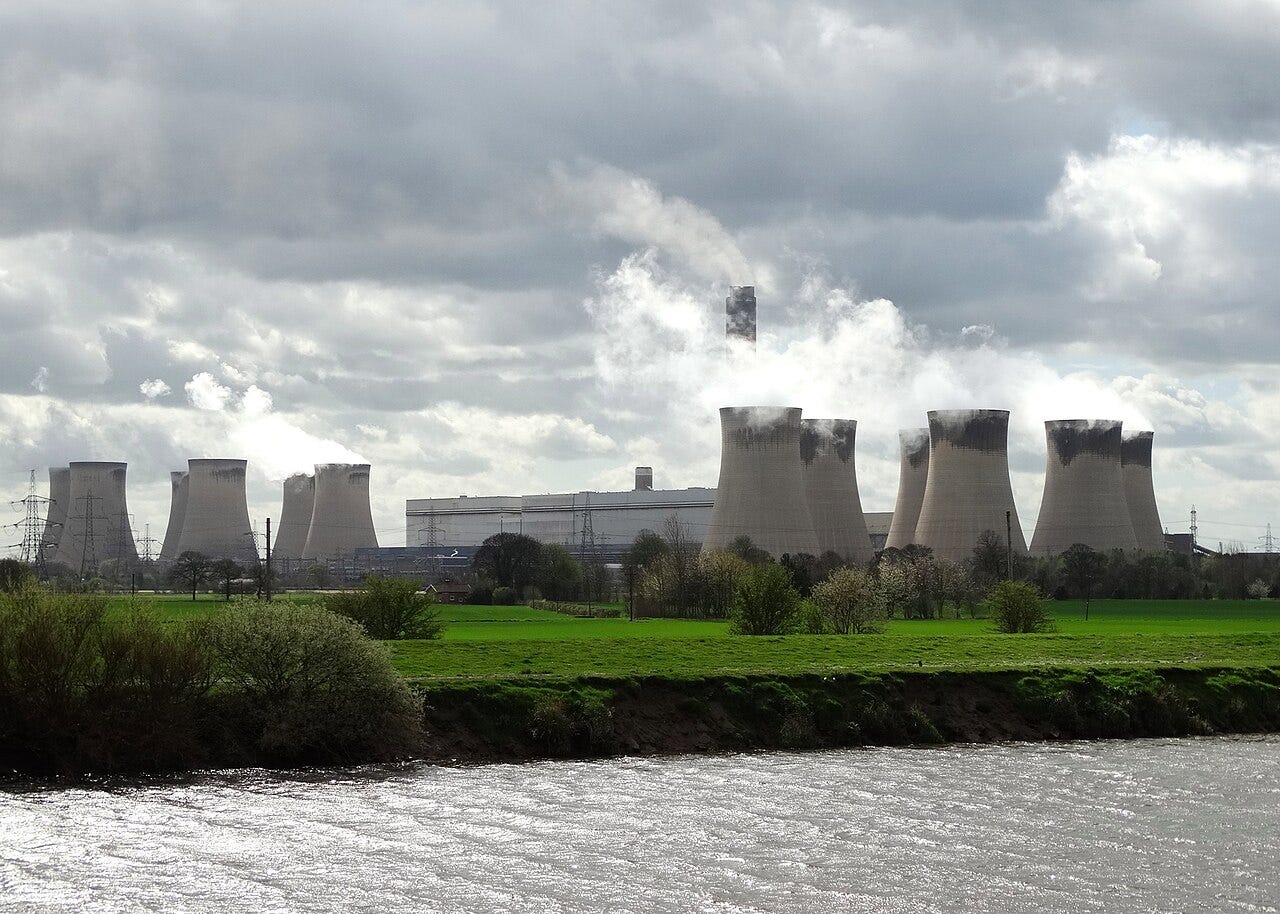
Located near Selby in North Yorkshire, the Drax Power Station supplies approximately 6 percent of the United Kingdom’s electricity. With its twelve cooling towers stretching 114 meters into the sky, it possesses the monolithic, concrete architecture of the atomic age. But step inside, and you will find a facility executing the energy policy of the Iron Age: burning wood.
Following nearly five decades of coal generation, Drax officially retired its final coal-fired units in 2021. Today, it stands as the largest biomass power plant in the world, generating power via the massive incineration of compressed wood pellets. This single facility now accounts for roughly 10 percent of the UK’s entire renewable electricity supply.
To feed its boilers, the station consumes millions of tons of biomass, primarily imported across the Atlantic from forests in the United States and Canada on diesel-burning freighters. For this effort, Drax has become the largest single recipient of green subsidies in the UK under the Renewable Obligations Scheme.
Under the UN IPCC framework, biomass emissions are accounted for in the land-use sector of the country where the trees are chopped down. Consequently, the importing nation gets to log the combustion as zero emissions at the smokestack.
Yet, the absurdity of this system is only accelerating. Drax is currently developing a commercial-scale Bioenergy with Carbon Capture and Storage (BECCS) project. Slated as a cornerstone of the UK’s East Coast Cluster and Zero Carbon Humber initiative, the project is almost entirely reliant on government support. Drax has successfully secured post-2027 subsidy frameworks to fund these updates, though ongoing haggling with the state over exact profit margins and guaranteed returns on investment has caused the company to carefully pace its capital allocation.
This is the terminus of the policy-push energy transition. Drax is proposing to attach a parasitic technology—carbon capture, which requires power to run its solvents and compressors—to a plant that already burns a low-density fuel. The combination will reduce the plant’s net energy output even further, yet it is being paid billions by the public to do so.
But in the current political economy, the technology does not have to make thermodynamic sense. It just has to satisfy the bureaucratic requirements to unlock the next tranche of government capital.
VIII. Externalizing the Transition
Throughout this examination of the global energy landscape, one term has been conspicuously absent: climate change.
This omission is deliberate. The push to electrify the globe and replace fossil fuels is an energy infrastructure problem, whereas climate change is a subset of anthropogenic environmental degradation. Conflating the two produces disastrous, highly distorted policy.
A hyper-focus on atmospheric carbon dioxide frequently blinds policymakers to the localized ecological destruction required to build clean infrastructure. You cannot construct a green grid without the environmental toll of copper mining, the toxic runoff generated by rare-earth mineral processing, and the massive land-use requirements of global battery supply chains.
This brings us to the true mechanism of the current energy transition: externalization. The reason China exerts near-monopoly control over the processing of the critical minerals required for this transition—cobalt, lithium, polysilicon—is not solely due to superior geological endowments. It is because Beijing has historically been willing to absorb the localized, toxic environmental degradation that Western regulatory bodies effectively outlawed decades ago.
The same dynamic of externalization applies to the nuclear sector, albeit for economic rather than environmental reasons. Russia maintains a stranglehold on the global processing of nuclear fuel—specifically the High-Assay Low-Enriched Uranium (HALEU) required for next-generation reactors—because the West allowed its domestic, heavy-industrial enrichment capacity to atrophy in favor of cheap, post-Cold War Russian imports. In both the renewable and nuclear supply chains, the West did not eliminate the industrial burden; it merely outsourced it to strategic rivals.
This externalization extends beyond environmental degradation into pure economics, particularly when viewing the transition from the perspective of the Developing World.
For the Global South, energy demand is strictly additive. These nations are not looking to decarbonize an existing baseline; they are desperate to generate new power just to reach the necessities of human survival—refrigeration, clean water desalination, and basic industrialization. For a nation suffering from severe energy poverty, securing cheap, reliable baseload power is a matter of immediate life and death.
Fossil fuels possess a low upfront Capital Expenditure (CapEx) but a high Operational Expenditure (OpEx). A developing nation can afford to build a coal or natural gas plant and simply pay for the fuel month-to-month.
Conversely, renewable energy is almost entirely an upfront CapEx investment. The fuel (wind and sunlight) is free, but the infrastructure to capture and warehouse it is expensive to build. Consequently, the financial viability of a renewable grid is sensitive to interest rates. In the Developing World, where sovereign risk is high and the cost of capital is punishing, high interest rates destroy the economic viability of solar and wind. The West’s demand that developing nations leapfrog fossil fuels is effectively a demand that they take on insurmountable sovereign debt.
This brings us to the final, fatal conflation in modern energy policy: the divide between Renewable and Sustainable.
Renewable energy dominates common usage, media narratives, and the tracking metrics of global organizations like the IEA and IRENA. But renewable is a physical definition: it means the energy source replenishes on a human timescale. As the burning of wood pellets at Drax Power Station illustrates, renewable does not necessarily mean eco-friendly, carbon-neutral, or economically viable.
Sustainable, on the other hand, is a holistic definition. It dictates that an energy system can be maintained indefinitely without depleting vital resources, causing unacceptable environmental and social damage, or triggering systemic economic collapse.
The transition away from cheap energy is constrained by the obstinacy of human demand, the unyielding limits of physical geography, and the brutal realities of Cost, Autonomy, and Scalability. All of these constraints govern sustainable energy, not renewable energy. Ignoring them in favor of atmospheric idealism yields a brittle grid, outsourced geopolitical leverage, and entrenched global poverty. To build a system that actually works, we must stop chasing the illusion of a renewable grid, and begin the work of building a sustainable one.