
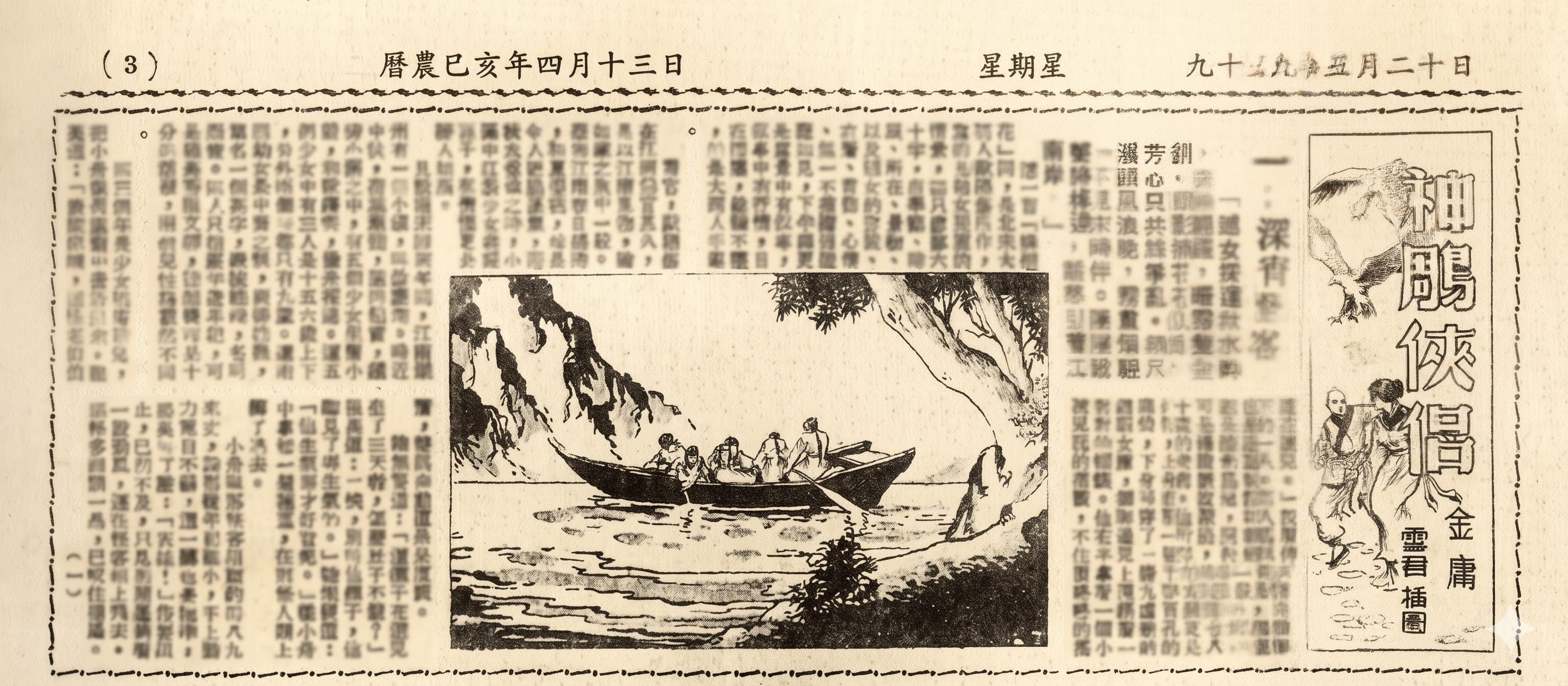
I. The Birth of the New School
Unlike sprawling genres like science fiction or romance, which have evolved continuously over the decades, New School Wuxia possesses a strangely condensed lifespan. It exploded into existence in the mid-1950s, reached a culturally dominant zenith in the 1960s and 70s, and experienced a precipitous decline by the late 1980s.
This raises the question, why?
In 1954, a highly anticipated, real-life martial arts bout took place in Macau between two rival masters: Wu Gongyi, a practitioner of Tai Chi, and Chen Kewen, a master of the White Crane style. The fight itself was considered clumsy, ending in a bloody draw after only a few minutes. Yet, the public frenzy leading up to the match was unprecedented.
Looking to capitalize on this soaring public interest, the Hong Kong newspaper New Evening Post needed a martial arts serial. They tapped an editor named Chen Wentong to draft one. Writing under the pen name Liang Yusheng, he produced The Dragon and Tiger Fight in the Capital. The following year, his colleague Louis Cha, writing as Jin Yong, penned The Book and the Sword. With those two publications, New School Wuxia was officially born.
Because it was born in the newspapers, serialization is the genre’s DNA. Writers like Jin Yong were tasked with delivering daily installments of 1,000 to 2,000 words. This forced the inclusion of constant cliffhangers, sprawling ensemble casts, and rapid, episodic pacing. These defined the rhythm of New School Wuxia, making the texts inherently serialized and perfectly primed for the television adaptations that would later dominate Asian pop culture.
While a newspaper gimmick was the spark, the engine behind this literary explosion was the conclusion of the Chinese Civil War in 1949. Millions of refugees, intellectuals, artists, and martial artists fled mainland China, seeking haven in the British colony of Hong Kong and the island of Taiwan.
For these millions of displaced people trapped in crowded, modernized colonies or living under martial law, the Chinese mainland was suddenly rendered physically inaccessible and politically fraught. In this vacuum, the Jianghu—the Lakes and Rivers, a term for the martial arts underworld that is both invisible and ubiquitous, think of the assassin society in John Wick—evolved into a psychological substitute for the lost homeland. It provided a vast, romanticized, pre-Communist China where traditional values of loyalty, righteousness, and filial piety still reigned supreme.
The duality of this existence was literalized in print. Jin Yong’s own newspaper, Ming Pao (founded in 1959), would routinely run his wuxia serials on one page, while the adjacent pages carried harrowing news reports about the Great Leap Forward and refugees swimming across the bay to escape the mainland.
Meanwhile, in Taiwan, the genre served a different psychological need. During the White Terror—a period of severe martial law under the Kuomintang—writing contemporary political fiction was incredibly dangerous. Wuxia, safely cloaked in the aesthetics of centuries past, offered a sanctuary for writers and readers to explore themes of power, corruption, and alienation without risking arrest.
Example Works
Jin Yong’s The Legend of the Condor Heroes (1957–1959) Follows the journey of Guo Jing, the protagonist of Jin Yong’s most iconic work. A slow-witted but fiercely righteous Han Chinese boy, Guo Jing is born in exile and raised among Genghis Khan’s Mongol tribes during the Jin-Song wars. His destiny is locked in place before his birth: he must avenge his murdered father and face off in a fateful duel against his sworn brother, Yang Kang, who was raised as a privileged prince by the very Jurchen invaders who destroyed their families.
Guided by eccentric mentors like the Seven Freaks of Jiangnan and the beggar king Hong Qigong and accompanied by the heroine Huang Rong, Guo Jing must navigate a devastating moral dilemma. He is torn between his loyalty to the Mongols who raised him and his duty to defend his ancestral Han homeland from their conquest. To readers in Hong Kong, Guo Jing’s struggle mirrored their own Cold War anxieties, asking profound questions about patriotism, exiled Han identity, and what it means to be Chinese when your nation has been conquered.
Liang Yusheng’s Seven Swords of Mount Heaven (1956–1957) Set generations later during the early Qing dynasty, Liang Yusheng’s epic centers on the brutal suppression of martial artists and Han rebels by the Manchu government. The narrative kicks off with the death of the hero Yang Yuncong, who entrusts his infant daughter, Yilan Zhu, to his ally Ling Weifeng to be hidden in the remote, icy sanctuary of Mount Heaven.
Eighteen years later, Ling Weifeng and a now-grown Yilan Zhu emerge into a fractured Jianghu. They unite a diverse cast of wandering warriors, former outlaws, and rebel fighters to form the Seven Swords, waging a guerrilla war against the overwhelming forces of the Qing empire. Beyond its themes of tragic romance and political resistance, Liang pioneered the practice of intertwining real historical poetry and classical literature into the prose. This elevated the genre from mere pulp, creating something that displaced intellectuals felt proud to read.
Example Tropes
The Burden of the Blood Debt (Baochou): The Jianghu runs on a karmic cycle of violence. In Condor Heroes, Guo Jing’s entire martial education is catalyzed by a bet made by his masters to train him to avenge his father’s murder. In Seven Swords, Yilan Zhu spends eighteen ascetic years training for the sole, consuming purpose of avenging her father against a Qing prince. This trope elevates personal revenge to a sacred duty, but it also traps characters in a cycle of violence that they must spiritually outgrow to become true heroes (xia). Ultimately, baochou operates as a profound allegory for inherited historical trauma.
Descending the Mountain (Xia Shan): In the wuxia mythos, martial and spiritual purity cannot be cultivated in the corrupted, political centers of society. It requires the isolation of the fringes—a desert, a secluded island, or an ice-capped peak. However, a hero’s training remains meaningless until they undergo xia shan (descending the mountain), leaving their sanctuary to confront a morally compromised world. Guo Jing comes of age in the harsh isolation of the Mongolian steppes before traveling south to the treacherous Central Plains. Likewise, Ling Weifeng and Yilan Zhu spend two decades removed from society before descending to face the agonizing realities of the Qing conquest. The mountain represents pure, untainted potential; the descent is where chivalry is forced to survive the real world
II. The Sudden Departure
Before the New School, there was the Old School. Thriving in the Republic of China from the 1910s to the 1940s, early wuxia generally polarized into two extremes. On one end was high fantasy, epitomized by Huanzhulouzhu’s Legend of the Swordsmen of the Mountains of Shu (1932), where martial artists lived for centuries, rode mythical beasts, threw flying swords with their minds, and battled demons. On the other end were the gritty, structurally messy tales like Pingjiang Buxiaosheng’s Legend of the Strange Swordsmen (1922)—highly episodic, rambling accounts of local street thugs, bodyguards, and rival dojos that lacked overarching literary themes.
In 1949, the newly established People’s Republic of China banned Old School wuxia. The Communist Party viewed the magical branch as feudal superstition and the gritty street-level branch as promoting violent, anti-social behavior.
This ban forced the genre’s evolution across the straits. The New School writers, who were highly educated mainland exiles, deliberately grounded the genre. They fused traditional Chinese history, poetry, and philosophy with Western literary techniques like complex psychological realism and linear, novelistic plotting. They stripped away the gods and demons, replacing magic with internal alchemy and pseudo-scientific pressure-point strikes based on traditional Chinese medicine. The jianghu was no longer a realm of immortals, but a heightened mirror of the mortal world.
As the New School matured, the geographic split of the Chinese diaspora birthed two distinct literary philosophies. In the colonial space of Hong Kong, Jin Yong used the jianghu to explore sweeping themes of Chinese nationalism, cultural identity, and the corrupting nature of absolute power. His later works are frequently read as direct allegories for the tumultuous, violent political campaigns ravaging the mainland, such as the Cultural Revolution.
Conversely, under the suffocating grip of Taiwan’s martial law, authors like Gu Long adopted a more existential and cynical tone. Stripping away Jin Yong’s historical nationalism, Gu Long focused on flawed wanderers navigating a treacherous, morally bankrupt world. It was a bloody reflection of the paranoia and alienation felt by many citizens living under the post-war White Terror.
The New School burned brilliantly, but its lifespan was violently compressed. In 1972, at the zenith of his popularity, Jin Yong finished The Deer and the Cauldron. It was an anti-wuxia deconstruction starring Wei Xiaobao—an illiterate, cowardly, brothel-born protagonist who succeeds entirely through lying, bribery, and sycophancy rather than martial arts. Instead of facing punishment, he acquires grand material wealth and a harem of seven wives before deliberately fading into obscurity. Having dismantled the very mythos he helped build, Jin Yong abruptly retired from writing fiction. Liang Yusheng retired shortly after. In 1985, Gu Long drank himself to death at the age of 47.
Simultaneously, television and cinema technology was rapidly advancing. Throughout the 1970s and 80s, the rise of Shaw Brothers Studio and TVB in Hong Kong shifted the primary consumption of wuxia from serialized newspaper reading to visual media. The evocative, literary imagination required of the reader was replaced by the visceral thrill of wire-fu choreography on the screen. The golden age of the text had ended.
Example Works
Jin Yong’s The Smiling, Proud Wanderer (1967) This novel represents a sharp pivot from the clear-cut nationalistic heroism of Jin Yong’s earlier works into a bleak political allegory. The story follows Linghu Chong, a carefree, heavy-drinking swordsman who unwittingly becomes caught in a vicious power struggle between the orthodox Five Mountains Sword Sects alliance and the demonic Sun Moon Holy Cult.
Here the traditional morality of the jianghu is inverted. The self-proclaimed righteous leaders are revealed to be power-hungry hypocrites willing to sacrifice their own disciples for dominance. Meanwhile, the marginalized members of the demonic cults often display genuine honor and loyalty. Written during the onset of the Cultural Revolution, the novel operates as a political critique, exploring how performative purity and ideological fanaticism are used to mask grotesque grabs for power.
Gu Long’s The Sentimental Swordsman, Ruthless Sword (1969) If Jin Yong’s later works deconstruct political systems, Gu Long’s deconstruct the hero himself. The novel follows Li Xunhuan, a former scholar who has retreated to the fringes of the jianghu. Suffering from tuberculosis and drinking constantly, his entire arc is driven by a twisted sense of noble sacrifice. He deliberately alienated the only woman he ever loved so that his sworn brother could marry her instead, a decision that ultimately destroys all three of them.
Gu Long strips away grand historical narratives of saving the nation, focusing entirely on existential dread and alienation. In a world where every smile hides a betrayal, Li Xunhuan’s signature weapon—the flying dagger that never misses—becomes a metaphor. It represents the only reliable truth left in a treacherous, unpredictable reality.
Example Tropes
The Pursuit of the Manual (Bi Ji) as a Poisoned Grail In early wuxia, finding a hidden martial arts manual (bi ji) in a cave was a straightforward power-up, enabling the hero to defeat foreign invaders. By the late 1960s, this trope evolved into a destructive obsession. In The Smiling, Proud Wanderer, the central conflict revolves around the Sunflower Manual, a text of unimaginable power that requires its practitioner to undergo self-castration to master it. The manual acts as a poisoned grail (a comparative critique might note the inversion of the Fisher King and the Grail Myth). The pursuit of power inevitably strips away the seeker’s humanity, honor, and physical completeness. It suggests that the very act of trying to rule the jianghu corrupts the ruler completely.
The Righteous Hypocrite (Wei Junzi) As the authors of the New School matured, they began to distrust the very institutions they had built up in their earlier novels. This gave rise to the wei junzi (the fake gentleman or hypocrite). These are the leaders of the orthodox, White Path sects—often Wudang, Shaolin, or prominent sword schools—who quote Confucian morality, demand absolute filial piety from their students, and present themselves as the unquestionable pillars of society.
Behind closed doors, however, they are Machiavellian schemers driving the violence of the underworld. The trope mirrors the anxieties of its readership: Hong Kong refugees watching the ideological purges of the Cultural Revolution, and Taiwanese citizens living under the paranoid, moralizing strictures of martial law. The true danger was no longer the invading barbarian army, but the smiling, well-read father figure who commanded your absolute loyalty.
III. The Standardization of Imagination
Jin Yong was explicit about why he stopped writing fiction after The Deer and the Cauldron in 1972. He stated repeatedly in interviews that he had simply written everything he had to say. He felt he had explored every permutation of the martial arts hero, dismantled his own tropes, and had no interest in repeating himself merely to print money. Besides, his day job was demanding: as the founder and chief editor of Ming Pao, he was increasingly drawn toward writing political editorials, studying history, and engaging in the high-stakes arena of real-world politics.
Liang Yusheng echoed these exact sentiments a decade later. Formally announcing his retirement in 1984, Liang stated that his later novels were becoming painfully derivative of his earlier masterpieces. He claimed he wanted to step aside to make room for a new generation of writers.
That generation never truly materialized.
The exhaustion of tropes makes for a dignified retirement speech, but it feels like a polite fiction. Literary genres do not simply run out of permutations and stop dead in their tracks. They mutate; they spiral into familiar territories from slightly different, often weirder angles. The Western didn’t end when John Ford made his final film; it bled into the revisionist grit of Sam Peckinpah and the spaghetti-soaked cynicism of Sergio Leone.
The literary jianghu did not die of natural exhaustion. It was crowded out by the screen.
By the late 1970s and 1980s, the center of Chinese pop culture had shifted from the printing press to the cathode-ray tube. Studios like Shaw Brothers and TVB in Hong Kong had perfected a dazzling visual shorthand for the genre. Why commit to a 2,000-page serialized novel when a television series could deliver the visceral thrill of wire-fu choreography, performed by beautiful actors in vibrant costumes, piped directly into your living room?
Writers like Ni Kuang—a prolific sci-fi and wuxia author who famously ghostwrote sections of Jin Yong’s Demi-Gods and Semi-Devils when the latter went on vacation—became the chief screenwriters for the Shaw Brothers studio. The literary genre stagnated because the fastest writers, the most lucrative paychecks, and the cultural prestige had migrated to the studio lots.
This migration inadvertently walled off the genre. Jin Yong and Gu Long had not just written popular books; they had created mythologies so massive that television studios realized they never needed to buy new IP again. The endless re-adaptations of Jin Yong’s works created a closed, profitable loop. The public just wanted the familiar classics rendered with increasingly better special effects, leaving no oxygen for new authors. Visual media had standardized the imagination.
But there was a deeper reason for the genre’s literary death, tied directly to the thawing of geopolitics. If the New School was born from the trauma of exile in 1949, what happened when the borders finally began to open in the 1980s?
If the mainland was suddenly accessible, the diaspora generation could finally go home. Yet, they moved further away.
Liang Yusheng formally retired and emigrated to Sydney, Australia in 1987, living there until his death. Jin Yong briefly stepped into the arena of realpolitik, helping to draft the Basic Law for Hong Kong’s looming 1997 handover. However, the stark realities of modern Chinese politics—shattered permanently by the events of Tiananmen Square in 1989—caused a irreconcilable disillusionment. He eventually retreated to academia, pursuing advanced degrees at Cambridge in the UK in his 80s.
The mainland was no longer an inaccessible, romanticized dream; it was a complicated, often terrifying reality. Furthermore, as the 1997 handover of Hong Kong approached, the exiled generation realized a bitter truth: they weren’t going back to the China of their memories. The new China was coming to them. The psychological need for the jianghu evaporated because the phantom homeland they had been grieving no longer existed in reality or in memory. Moving to the UK or Australia was a final, quiet admission that the true China they were writing about was a fiction all along.
Example Works
TVB’s The Legend of the Condor Heroes (1983) Starring Felix Wong and Barbara Yung, this specific television adaptation was a cultural earthquake. When it aired in mainland China in 1985, it supposedly caused urban crime rates to plummet because entire cities were indoors huddled around television sets. Barbara Yung’s portrayal of the mischievous Huang Rong became so iconic that future writers and directors effectively stopped adapting Jin Yong’s novel. Instead, they began adapting her performance. The simulacrum had replaced the original text.
Example Tropes
Visualizing the Invisible (The Neon Qi): In the literary New School, neigong (internal energy) was philosophical and rooted in traditional Chinese medicine. A reader had to imagine the flow of energy through invisible meridian points, described through abstract poetry or physical sensations of heat, cold, or spiritual weight. The 1980s TV studios faced a mechanical problem: how do you put internal philosophy on a screen? To solve this, qi was transformed into a visual and auditory special effect. It became glowing neon hands, animated laser beams shooting from palms, dry ice fog machines, and a very specific library of stock synthesizer “whoosh” sound effects. Once the audience actually saw a qi blast, the genre lost a layer of its mysticism; they no longer needed to imagine how it felt.
The Soundstage Jianghu: In Part I, we explored Descending the Mountain, where the jianghu was a vast, sprawling geographical space representing an exiled, infinite homeland. By the 1980s TVB era, that boundless geography collapsed into a box. Constrained by television production schedules and budgets, the majestic peaks of Wudang, the harsh Mongolian steppes, and the bustling taverns of the Central Plains were all filmed on the exact same reusable studio soundstages in Hong Kong. The lighting was flat and aggressively artificial; the sweeping mountains were obviously painted foam boulders. The jianghu stopped being a margin that characters traveled through, shrinking instead into a claustrophobic, theatrical backdrop.
IV. Rebirth in Cinema
In the late 1980s and early 90s, directors like Tsui Hark took the exhausted ashes of New School wuxia and birthed the New Wave wuxia film. Adaptations like Swordsman II (1992)—based on Jin Yong’s The Smiling, Proud Wanderer—and New Dragon Gate Inn (1992) shattered the mold of the preceding decade.
The genre needed this new wave. Television was cheap, brightly lit, shot on claustrophobic soundstages, and visually flat. To convince audiences to leave their homes and buy a movie ticket, cinema had to offer a radically different visceral experience. Films like New Dragon Gate Inn replaced the slow, theatrical pacing of television with kinetic editing, gravity-defying choreography, and stylized violence.
Meanwhile, Wong Kar-wai’s Ashes of Time (1994) approached the genre through sensory impressionism. Taking characters from Jin Yong’s The Legend of the Condor Heroes, Wong discarded both the original narrative and traditional action cinematography to create a postmodern, noir wuxia. In doing so, he proved that cinema could successfully replicate the abstract, poetic descriptions of qi and emotion that had originally made the literary texts so compelling.
The audience watching these films had fundamentally changed. It was no longer the 1950s refugee generation yearning for a clear-cut, righteous Han hero to save a fractured nation. The 1990s Hong Kong audience was a capitalist, cosmopolitan society staring down the barrel of the 1997 handover. They required a different kind of protagonist.
Nowhere is this shift more evident than in Tsui Hark’s Swordsman II and its sequel, The East is Red.
In Jin Yong’s original novel, the villain Dongfang Bubai (The Invincible East) castrates himself to master a supreme martial art. Jin Yong wrote him as a grotesque, secondary antagonist meant to represent the unnatural, corrupting power of absolute ambition. However, Tsui Hark and actress Brigitte Lin completely inverted the text. They transformed this character into a tragic, intoxicating, gender-fluid anti-hero whose charisma entirely overshadows the traditional male lead (Jet Li).
As the 1990s progressed into the 2000s, the budget for these cinematic spectacles grew exponentially. Hong Kong’s local box office alone could no longer support the genre. The financial survival of wuxia required an injection of transnational capital.
To secure this funding and make back their massive budgets, directors had to strip away the specific Chinese political allegories of Jin Yong. In their place, they inserted universal themes—love, duty, existential freedom—that could sell in Taiwan, Japan, and eventually the West.
This culminated in global blockbusters like Ang Lee’s Crouching Tiger, Hidden Dragon (2000) and Zhang Yimou’s Hero (2002). In these films, the martial arts are expressions of psychological states and magical realism. A sword fight is rarely just combat; it is a profound conversation about suppressed desire, societal duty, and freedom. This is the exact psychological depth that Jin Yong and Gu Long were pioneering on the page, finally fully realized on the screen. Crouching Tiger, in particular, was a calculated transnational product: directed by a Taiwanese filmmaker, starring a pan-Asian cast, and specifically calibrated for a Western audience. Ironically, this global triumph actually marked the end of an era.
If Crouching Tiger was the genre’s global coronation, Hero was its state-sponsored funeral.
The entire underlying philosophy of the jianghu is about existing on the margins and defying the corrupt center. Yet, in the climax of Hero, the nameless assassin realizes that the emperor he is trying to kill—the ultimate symbol of the Mainland and the authoritarian Center—must be spared for the sake of Tianxia (All Under Heaven). Hero represents the literal cinematic death of the jianghu; the margin voluntarily surrenders to the center.
To the funeral of Hero, Stephen Chow’s Kung Fu Hustle (2004) is the loving, comedic wake. The jianghu in Chow’s film isn’t a vast mountain range or a sweeping bamboo forest; it is a dilapidated, walled-in slum (Pig Sty Alley) where retired masters hide from modern gangsters in tailored suits. This is an inversion of xia shan. The masters haven’t descended the mountain to save the world; the world has encroached on them, demanding rent. It is a melancholy acknowledgment that the era of the sword is over, replaced by guns, capitalism, and eventually, the CGI-heavy spectacles of the mainland that would fill the next decade.
Example Tropes
The Ancient Modernity of the Nü Xia (Female Knight-Errant): The tradition of the female warrior traces all the way back to the 1st-century text The Spring and Autumn Annals of Wu and Yue, which details the legend of the Sword of the Yue Maiden, who authored the earliest-known exposition on swordplay. Because of this deep historical root, the Nü Xia wasn’t so much incorporated into the genre as she was one of its guiding principles. This allowed writers and filmmakers to explore complex gender dynamics and feminine power without it ever being anachronistic.
From ethereal, stoic heroines like Xiaolongnü (the Little Dragon Maiden) to tragic villains like Li Mochou or Lian Nichang (the White-Haired Maiden), the Nü Xia operates outside traditional Confucian structures. To a western audience, this ancient archetype felt incredibly modern, providing a vehicle to explore themes of feminist rebellion and societal restriction, notably through Zhang Ziyi’s portrayal of Jen Yu in Crouching Tiger.
The Aerial Duel as Psychological Dialogue (Wire-Fu): In the original texts, qinggong (light-footedness) was largely a practical martial skill used for travel or evasion. In the 1980s television era, it was a cheap visual trick. But in the cinematic New Wave and the global films that followed, qinggong was elevated into cinematic poetry.
Combat left the grounded, muddy earth and moved to the swaying tips of bamboo forests, the surface of placid lakes, and the sweeping rooftops of the Forbidden City. Through the use of wire-fu, the physical weight of gravity was replaced by the emotional weight of the characters. When Li Mu Bai and Jen Yu clash in the bamboo forest, or when Nameless and Broken Sword duel on the mirrored surface of a lake in Hero, they aren’t trying to hack each other to pieces. They are having an unspoken conversation about suppressed desire, ideological differences, and the weight of their choices. The wire-fu allowed the subtext of the novels to finally take literal flight.
V. The Global Diaspora and Reinterpretation
If the 1949 diaspora fueled the creation of New School wuxia, one cannot ignore where millions of those refugees actually went. Hong Kong and Taiwan were the undisputed writing hubs, but the consumption hubs lay further south. The jianghu packed its bags and fled to Singapore, Malaysia, Vietnam, Thailand, and Indonesia.
Wuxia exports perfectly if the target region possesses a shared cultural memory or a significant Chinese diaspora. In fact, the Nanyang (Southeast Asian) market was so incredibly lucrative that it bankrolled the Golden Age of Hong Kong publishing and the subsequent Shaw Brothers cinematic boom. Jin Yong himself co-founded the Shin Min Daily News in Singapore in 1967 specifically to serialize his own novels.
In Vietnam, the martial arts genre—known locally as Kiếm hiệp—became a massive cultural obsession. During the chaotic, life-or-death politics of South Vietnam in the 1960s and 70s, politicians and journalists would hurl Jin Yong character names at each other in the press as devastating political smears. To call a political rival Nhạc Bất Quần (the Vietnamese translation of Yue Buqun, the quintessential Righteous Hypocrite from The Smiling, Proud Wanderer) was an instantly understood insult. The fictional jianghu had become the active political vocabulary of a foreign nation.
Further south, Indonesia proved a radical thesis: you do not actually need to write in Chinese to write wuxia. Localized Indonesian wuxia, known as Cerita Silat (or Cersil), was pioneered by authors like Asmaraman S. Kho Ping Hoo, an Indonesian of Chinese descent. Kho Ping Hoo did not speak or read Chinese. He wrote his sweeping martial arts epics entirely in Bahasa Indonesia, drawing purely on the cultural memory of the diaspora and translated comic books.
Japan, however, did not import wuxia literature in the mid-20th century. They didn’t need to; they had already constructed a highly developed, native equivalent based on the samurai and the ninja. Furthermore, Japan had already paid off its cultural translation tax decades earlier through cinema. Akira Kurosawa’s samurai films (Seven Samurai, Yojimbo) had been heavily exported, studied, and eagerly cannibalized by Hollywood into Westerns (The Magnificent Seven, A Fistful of Dollars) and space operas (Star Wars).
Here Japan achieved something the Chinese New School could not: global ubiquity. By fusing the martial arts with supernatural magic systems, author Futaro Yamada laid the direct foundation for Japanese Shonen battle manga. The chakra systems in Naruto, the Nen in Hunter x Hunter, or the breathing styles in Demon Slayer are the descendants of Yamada’s literary ninja fiction. Japan proved that when you divorce the magical realism of martial arts from dense, impenetrable dynastic history, it becomes a highly exportable, globally dominant pop-culture force.
South Korea did what the mainland Chinese wuxia market was politically prevented from doing: they took the classic tropes, deconstructed them, and rebuilt them for a modern and eventually digital audience. In Korea, the genre is known as Muhyup (the Korean pronunciation of 武俠), and the martial underworld is called the Murim. Throughout the 1980s, Koreans were mostly consuming translations of Jin Yong and Gu Long. But in the 1990s, the Shin Muhyup (New Martial Arts) movement exploded. Because South Korea was rapidly democratizing and highly capitalist, authors could easily write the kind of noir, cynical wuxia that was impossible under the state-mandated positive energy of the PRC. This deconstruction was in turn rapidly abandoned in the 2000s for a reconstructive literary movement that incorporates elements of fantasy.
Today, Muhyup has transitioned into the digital age through the webtoon and webnovel explosion. Works like The Return of the Mount Hua Sect, Legend of the Northern Blade, and Nano Machine dominate the market. They have stripped away the heavy, inaccessible historical grief that limits Chinese wuxia’s exportability, leaning instead into fast-paced action, reincarnation tropes, and highly readable, scrollable art.
Example Works
Jwa Baek’s Daedo-oh (1995) Widely considered the novel that launched the Shin Muhyup movement, Daedo-oh (Great Thief Oh) rejects the noble, historically burdened heroes of Chinese wuxia, while still being set in the Middle Country. Oh is a low-class street thief conscripted into an orthodox sect’s penal military unit—serving as disposable cannon fodder.
Asmaraman S. Kho Ping Hoo’s Bu Kek Siansu Series (1973) Spanning over a dozen interconnected novels and multiple generations, this series creates a massive, sprawling Indonesian jianghu. The overarching narrative begins with the tragic origins of Sie Liong (the titular Hunchback Swordsman). After his parents are murdered in a home invasion, the traumatized, physically disabled boy survives by mastering martial arts in extreme isolation. Kho Ping Hoo blends the traditional tropes of classic wuxia with localized Indonesian values and Hokkien cultural memory, creating a hybrid mythology.
Example Tropes
The Hokkien Underworld (The Phonetic Jianghu): The immigrants who settled in Indonesia, Malaysia, and Vietnam were largely working-class laborers speaking southern dialects like Hokkien, Teochew, or Cantonese—not the standardized Mandarin of Beijing. Consequently, the local Cersil novels used phonetic spellings of these dialects. Shaolin became Siauw Lim. Wudang became Buh Tong. A martial arts manual wasn’t a biji; it was a pikip. This linguistic localization proves that the diaspora were actively rebuilding the jianghu using their own marginalized mother tongues. The underworld literally spoke the language of the exile.
The Blue-Collar Swordsman (The Pragmatic Xia): In classic Chinese wuxia, you rarely see a hero worry about paying the rent. They are often wandering aristocrats, funded by wealthy patrons, or just magically possess a pouch of silver to pay for their beef and wine. When the genre moved to South Korea via Shin Muhyup, this trope was inverted. The Blue-Collar Swordsman emerged. The protagonist is an escort guard calculating risk versus reward, a tavern bouncer, or a debt collector. In Return of the Mount Hua Sect, the resurrected hero’s primary motivation is saving his sect from financial bankruptcy.
Cyberspace and the Neon Jianghu
In 1999, the Wachowskis translated the ancient martial underworld into cyberspace with The Matrix.
Stripped of its cyberpunk leather and mirrored sunglasses, The Matrix is a new spin on the Descending the Mountain (xia shan) narrative. In classic Wuxia, a disciple leaves the pure, secluded mountain monastery to enter the corrupt, earthly jianghu. The Matrix flips this geographical trajectory while preserving its spiritual core. Neo leaves the corrupt earthly simulation (the Matrix) to reach the secluded, pure mountain (Zion and the real world), but as a digital warrior, he must constantly descend back into the simulation to wage his war.
To populate this world, the Wachowskis mapped classic Wuxia archetypes directly onto their science-fiction dystopia.
Morpheus is the Shifu (Master), he is the wandering master who identifies the prodigy with “rare bone structure”—or, in this case, the anomaly in the machine code. It is Morpheus who initiates Neo into the secret martial world and guides his early cultivation. The Oracle plays the role of the eccentric elder living in obscurity. Rather than providing direct martial instruction, she imparts cryptic, philosophical wisdom that the hero must decipher on his own path to enlightenment. Agent Smith and his fellow agents mirror the corrupt eunuchs and imperial enforcers that have served as Wuxia antagonists since before the genre was even codified, antagonists that appear in literary classics like the Water Margin.
By hiring legendary Hong Kong choreographer Yuen Woo-ping, the Wachowskis successfully rationalized wire-fu for a Western audience. Qinggong was no longer a mystical expression of inner qi, but a manipulation of the simulation’s code.
Remarkably, the vessel for this Western iteration, Keanu Reeves—of mixed Native Hawaiian and Chinese heritage—would return fifteen years later to cement the second great Hollywood translation of the genre in John Wick.
If The Matrix translated the action and archetypes of Wuxia, John Wick translated its societal structure. The society of assassins in John Wick is identical in nearly every attribute to the traditional Wuxia underworld. It exists invisibly alongside orthodox society, governed by an absolute, unbreakable code of honor. The High Table is the ruling alliance of orthodox martial sects. The Gold Coins are the unquestioned, universal currency of the realm. The Continental Hotel is The New Dragon Gate Inn—a neutral, heavily guarded tavern where swordsmen are strictly forbidden to shed blood.
More importantly, John Wick executes one of the most foundational tropes of Wuxia literature: the absolute impossibility of tuiyin (washing one’s hands of the martial world). In the jianghu, retirement is a myth. A warrior can bury their sword, take a civilian spouse, and attempt to live in peace as a peasant, but the karmic cycle of violence cannot be broken. The underworld always comes to collect. It arrives either in the form of a blood debt or owed favors—represented in John Wick by the Marker, a physical manifestation of Yi (the martial code of loyalty, brotherhood, and debt).
John Wick’s narrative arc is the plight of the weary xia. He is a god of death who simply wants to grieve his wife and walk his dog, only to be dragged back into a marginalized society that does not allow its denizens to leave. Through Reeves’s performance, the modern American action film embraces the existential dread of the wandering swordsman.
VI. The Involution of the Mainland
In a normal literary lifecycle, a genre that has been thoroughly deconstructed eventually reconstructs itself. We saw this in South Korea, where the cynical Shin Muhyup movement evolved into modern webnovels, and in Hollywood, where wuxia was digitized into The Matrix. Under natural conditions, a new generation of Chinese writers would have taken the deconstructed jianghu of the late 20th century and built a post-modern, perhaps cyberpunk or noir-infused wuxia movement upon it.
Cyberpunk is inherently about corporate overreach, high-tech societal decay, and rebels operating in the neon margins. Noir is fundamentally cynical about human nature and institutional corruption. But applying these lenses to a distinctly modern Chinese setting immediately runs afoul of the state censorship apparatus, which strictly mandates “positive energy” (正能量, zheng neng liang) and an absolute respect for authority.
Because wuxia cannot safely evolve into these darker, speculative, or highly critical modern subgenres, it had nowhere to grow. Ideologically, the Chinese Communist Party claims a total monopoly on justice, violence, and moral authority. You cannot write a story about an underground society of martial vigilantes operating outside the law in modern Beijing—that is inherently subversive.
Consequently, questioning authority is strictly quarantined to the past. Modern wuxia effectively hits a brick wall in 1949. The narrative timeline ends the moment the Communists gain control over China, because the genre is incapable of discussing what comes next.
Denied the future and locked out of the present, the genre was forced to regress. It retreated past the New School, all the way back to the Old School roots of Shenmo (Gods and Demons fiction), mutating into what we now know as Xianxia (Immortal Heroes).
At a glance, Xianxia is a fantasy genre based on Daoist alchemy, where characters absorb spiritual energy (Qi) to evolve their physical bodies and achieve immortality (known as Cultivation). However, underneath a very thin coat of paint, Xianxia paints modern China’s cultural sophistication in a rather grim light. Traditional Chinese philosophy—Daoism, Buddhism, Confucianism—is entirely stripped of its moral and ethical weight. It is reduced to a video game leveling system. A character doesn’t achieve enlightenment by understanding the harmony of the universe; they achieve it by murdering a rival, stealing a rare glowing herb, and consuming it to level up their spiritual core.
The Xia in wuxia stands for chivalry, altruism, and self-sacrifice. Heroes fight for the nation, for the weak, or for honor. In Xianxia, altruism is frequently portrayed as a fatal weakness. The protagonist’s sole motivation is usually immortality, absolute power, or simply avoiding being crushed by those higher on the food chain. If you are a lower-tier cultivator, a higher-tier master can kill you with a flick of their wrist, and the universe will not care. The only law is power.
This endless, sociopathic power-scaling is the literary mirror for the modern Chinese concept of neijuan (内卷, involution). Neijuan describes the exhausting, hyper-competitive rat race of modern China, the 996 work culture (9 AM to 9 PM, 6 days a week), and the zero-sum pressure of the education system. The brutal universe of Xianxia, where you must constantly cultivate to a higher realm or be destroyed by your peers, is a fantasy reflection of the relentless pressure felt by the modern Chinese working class.
While male-oriented web literature devolved into the neijuan of Xianxia, the visual medium of prestige television underwent a different mutation, largely driven by the rising economic power of the female gaze. The tropes of wuxia were hijacked and repurposed as vehicles for intense romance, Danmei (Boys’ Love, like The Untamed or Word of Honor), or high-stakes Palace Dramas.
The true modern successors to Jin Yong’s sprawling historical epics are prestige Chinese TV dramas like Nirvana in Fire (Langya Bang) or Joy of Life. These shows maintain the magical realism and the martial arts tropes—assassins with qinggong light-footwork, hidden sects, poison masters—but they anchor them in devastatingly complex political, psychological, and factional warfare. The martial arts become a beautiful, tragic backdrop for emotional and relational drama rather than the primary mechanism of conflict resolution.
However, political works are always teetering on the edge of the censor’s blade, even with their historical contexts acting as a shield. In 2019, the Chinese government cracked down on two seemingly unrelated pieces of media: Palace Dramas and brutal Xianxia webnovels. This synchronized censorship reveals the ultimate tragedy of the modern mainland jianghu.
Example Works
Prestige Court Drama: Nirvana in Fire (2015) The protagonist, Mei Changsu, suffers from a devastating poison that has completely stripped away his martial arts, leaving him physically frail, constantly freezing, and coughing up blood. Because he cannot physically fight his way out of injustice, he has to out-scheme it. This represents a complete, claustrophobic shift away from the physical freedom of the jianghu. The sweeping mountains and bamboo forests have been replaced by the suffocating, intellectual warfare of the royal court. The hero’s mind is his only weapon, and the battlefield is a chessboard of imperial succession.
The Palace Drama: Story of Yanxi Palace (2018) Palace Dramas center on the Emperor’s massive harem of consorts and concubines during imperial dynasties (usually the Qing). Because the Emperor’s favor determines a woman’s survival, wealth, and family standing, the harem becomes a bloodthirsty political battleground. Characters cannot use physical violence; instead, they use poisoned tea, forged letters, weaponized etiquette, and psychological manipulation to destroy their rivals and climb the hierarchical ladder. Despite being a massive global hit, Yanxi Palace was censured and pulled from broadcast by state media in 2019 for promoting “scheming,” disrupting social harmony, and failing to showcase the positive aspects of socialist core values.
The Xianxia Webnovel: Reverend Insanity (2012–2019) The protagonist, Fang Yuan, is a pure, unadulterated sociopath. Reincarnated 500 years in the past, he rejects all societal bonds, morality, and loyalty in his singular pursuit of eternal life. He views every other human being merely as a stepping stone or a resource to be harvested for his cultivation. In 2019, the novel was banned by the Chinese government because it was deemed too cynical and horrific, running violently afoul of the mandate for “positive energy.”
Example Tropes
The Unified Theory of Scheming (The Institutional Rat Race): At first glance, a historical Palace Drama and a brutal Xianxia webnovel have nothing in common. One is a grounded historical drama about women constrained by imperial etiquette; the other is a high-fantasy power fantasy about men shooting magic out of their hands.
Yet, the endless, vicious backstabbing of the imperial harem in Yanxi Palace is the exact same survival-of-the-fittest rat race as the power-scaling cultivation in Reverend Insanity. Both genres depict a hopelessly zero-sum world where individuals are trapped in a suffocating hierarchy, forced to cannibalize their peers just to survive. The state media banning both of them for promoting “scheming” and lacking “positive energy” proves a fatal point: you cannot escape the censors just by setting your story in the Qing dynasty or a magical Daoist realm. The government recognized that both the imperial harem and the magical cultivation sect were just thinly veiled metaphors for the neijuan of modern Chinese capitalism.
Quantifiable Ascension (The Progression Engine)
Chinese literary scholars often point to Huanzhulouzhu’s Legend of the Swordsmen of the Mountains of Shu as the direct progenitor of modern Xianxia. But while this foundational text provides the visual vocabulary—the flying swords, the secluded peaks, the Daoist alchemy—this aesthetic is ultimately just the paint. In modern webnovels, the classical Daoist philosophy of cultivating harmony with the universe is entirely hollow, serving merely as a skin for the mechanics of the rat race.
Because internet fiction operates at a breakneck, daily publishing speed, the reconstruction and deconstruction cycle of the genre is hyper-accelerated. A cynical, deconstructive response to a popular webnovel will often begin serialization before the original work has even concluded. This rapid mutation proves that the aesthetic is secondary to the substance, a fact best illustrated by the rise of Xuanhuan (Mysterious Fantasy). Works like the massive hit Lord of the Mysteries completely abandon the Chinese Daoist trappings in favor of Victorian steampunk and Lovecraftian cosmic horror. Yet, the core Xianxia engine remains perfectly intact: characters must ruthlessly scheme and advance through rigid, sequential power pathways simply to avoid being crushed by higher-tier entities.
This mechanical continuity proves that involution (neijuan) is hardly a uniquely Chinese anxiety. The crushing weight of modern hyper-capitalism, stagnant social mobility, and exhausting work cultures has birthed parallel literary movements across the globe. You can find the exact same structural DNA in Western LitRPGs, Japanese Isekai, and South Korean Regressor System webnovels.
What unites all of these global genres is the psychological need for perfectly quantifiable effort. In the real world, endless hard work rarely guarantees stability, let alone a house. But in these stories, the universe rewards effort mathematically. If you grind the levels, exploit the system, or consume enough spiritual cores, you will ascend. It is the ultimate modern fantasy of perfect, absolute autonomy—an existence that does not depend on a failing society, operating completely beyond morality, and ultimately, beyond death itself.
The Universality of Involution
One can draw a direct line between the sociopathic hierarchies of Xianxia and modern deconstructions of the Western superhero. While they wear different aesthetic skins, both genres violently dismantle their foundational moralities.
In The Boys, Homelander is a translation of Xianxia’s ‘Arrogant Young Master’—a sociopath born into an untouchable corporate sect who treats mortals as ants, indulging his most grotesque sexual and violent impulses with absolute impunity. The way he treats the other members of the Seven is very much how an Young Master treats other sect disciples. It is the same deeply insecure, small minded bullying.
Meanwhile, Invincible abandons the static power levels of Golden Age comics, forcing its Mark Greyson through a brutal, physical progression curve. His Viltrumite DNA forces him to scale in power after near-death experiences. Mark getting beaten to a pulp by his father is thematically if not mechanically his Heavenly Tribulation. Furthermore, the overarching plot reveals that the Orthodox Sect of the universe (the Viltrum Empire) is actually a ruthless, imperialist force and that Viltrumite physiology renders one nearly immortal and stronger with age, physical trauma and extreme exertion.
Western superhero deconstructions overturn the morality of the Golden Age—Viltrum serves as a complete, brutal denial of Krypton. Meanwhile, Xianxia reduces the Daoist pursuit of harmony to a grand hypocrisy. Both genres arrive at the exact same cynical terminus: the only truth is power, and the ruling sects are run by sociopaths.
The Secret Manual of Progression Fantasies
Do characters in Xianxia or Western LitRPGs actually progress? If we measure progress by the traditional metrics of narrative—the Hero’s Journey, moral revelations, or psychological maturation—the answer is almost universally no. The numbers get bigger and the attacks get flashier, but the protagonist’s underlying psychology remains entirely static.
This reveals a crucial hypocrisy at the heart of the genre. These stories pretend to be about the glory of meritocracy and quantifiable effort. But the hidden truth is that even perfectly quantified effort is too hard. The fantasy of winning fairly is dead. If the system is fundamentally rigged against you, the only logical way to win is to acquire an unfair advantage and rig it in your favor.
In Xianxia, this trope is known as the Gold Finger (Jinshouzhi). It is the mystical artifact, the reincarnated memory, the system interface, or the uniquely overpowered bloodline that grants the protagonist a massive, unearned multiplier to their effort. It acts as the escape velocity required to break free from the gravity of involution. The ultimate fantasy of works like Solo Leveling is being the only person in the universe who gets to cheat.
It remains an open secret because the text cannot admit it’s a cheat, because doing so destroys the psychological reward of the fantasy. Thus the tacit agreement between author and reader remains unexamined and buried.
VII. The Water Margin
If we zoom all the way out from the neon wire-fu, the webnovels, and the claustrophobic television soundstages, the entire sprawling genealogy of wuxia leads back to a single, 14th-century text: The Water Margin (Shuihu Zhuan).
Attributed to Shi Nai’an, The Water Margin is a foundational epic of the Sinosphere, one of the Four Great Classical Novels. It tells the story of the 108 Stars of Destiny—a band of outlaws, disgraced military officers, and marginalized outcasts who gather at the Liangshan Marsh to rebel against the corrupt Song Dynasty. It is the literal and etymological birth of the jianghu. The Rivers and Lakes were not originally an abstract concept; they were the actual swamps and waterways of Mount Liang, the treacherous geography where the Emperor’s cavalry could not ride and the Emperor’s law could not reach.
The core premise of The Water Margin established the gravitational pull of the genre: the outlaw hero only exists because the orthodox center has failed.
When we view the 20th century through this lens, the geographic puzzle of the New School snaps into place. Wuxia did not survive in Hong Kong and Taiwan by accident. Those colonized, island territories were the modern Liangshan Marsh. They were the physical water margins of the Cold War—safe havens just beyond the reach of the mainland’s authoritarian center. The diaspora writers were the modern outlaws, penning tales of righteous rebellion from the sanctuary of the swamps.
To survive in this margin, the xia (chivalrous hero) requires a highly specific philosophical alchemy. The narrative demands a confluence of China’s three great teachings: Confucianism, Buddhism, and Daoism. Villains in wuxia are almost always those who hold to the extremes of these philosophies—from the hypocritical Confucian scholar who values etiquette over human life, to the sociopathic Daoist cultivator who views humans as mere resources, to the detached Buddhist monk who refuses to intervene in worldly suffering.
The evolution of Jin Yong’s bibliography is essentially the slow, deliberate abandonment of Confucian order. In his early masterpiece, The Legend of the Condor Heroes, the protagonist Guo Jing is a rigid Confucian patriot. His morality is defined by his loyalty to the Han nation and his filial piety. But by his later work, The Smiling, Proud Wanderer, the ultimate Confucian scholar (Yue Buqun) is revealed to be the narrative’s most repulsive, hypocritical villain. The hero, Linghu Chong, survives purely through Daoist detachment and a blatant disregard for orthodox rules.
The true xia must synthesize all three. They possess the Confucian desire to protect the weak, tempered by Buddhist mercy and an understanding of impermanence, but executed through Daoist independence. Daoism allows the hero to flow like water around the corrupt, rigid structures of society rather than being broken by them.
Ultimately, New School Wuxia was far more than a serialized newspaper distraction born from a clumsy 1954 brawl in Macau. For the millions of displaced people living through the Cold War, the genre offered a psychological survival mechanism. It was a philosophical synthesis that mirrored their lived reality: it validated the Confucian moral duty they still felt toward their lost homeland, it offered the Buddhist grief required to accept its impermanence, and it provided the Daoist freedom to survive as individuals in a new world.
Whether consumed in a Hong Kong newspaper, an Indonesian Cersil paperback, or a Hollywood blockbuster, wuxia remains a testament to the endurance of the xia—the eternal, romantic belief that when the orthodox center collapses into corruption, righteousness will always survive on the margins.
Post-Credits: The Digital Liangshan
If the cinematic wuxia funeral was held in the early 2000s, and mainland television has devolved, where does the jianghu go next?
The answer lies in the newest medium, and ironically, it might be the only one capable of solving the genre’s oldest problem.
For decades, Chinese filmmakers attempted to export wuxia by paying a Translation Tax. To appeal to Western audiences, they stripped away the dense dynastic history and complex internal alchemy, resulting in visually stunning but culturally hollow co-productions like The Great Wall (2016) or Disney’s live-action Mulan (2020), both of which were critical and commercial failures.
The future of the genre is bypassing the film industry entirely. It is happening in video games.
Titles like Where Winds Meet (released in November 14, 2025) represent a radical shift. Set during the chaotic Five Dynasties and Ten Kingdoms period, the game is attempting to export authentic, historically grounded wuxia to the West without compromising on the Translation Tax. It is steeped in the dense, traditional lore of the New Schools.
How does it get away with this? Because interactivity is the universal translator.
A film has two hours to dump centuries of Daoist philosophy onto an audience through clunky exposition. A video game allows the player to inhabit it. You do not need to explain the abstract concept of qinggong (light-footwork) in dialogue; the player simply presses a button and feels the thrill of running across water. You do not need a voiceover to explain the mechanics of internal qi; it is translated into a stamina and cultivation tree. The player learns the rules of the jianghu by bleeding in it.
Currently, the Chinese video game industry is producing the country’s most vital, unrestrained media. Buoyed by international capital and global hits like Genshin Impact and Black Myth: Wukong, the gaming industry operates slightly outside the rigid, traditional bounds of the domestic television and film censorship apparatus.
Just as the animators of the recent Chinese animation boom found freedom in a medium the state didn’t take entirely seriously, game developers are quietly building the next iteration of the martial underworld. Code and interactive servers are the new Liangshan Marsh. The jianghu is doing what it has always done: flowing like water, abandoning the corrupted centers of print and television, and finding a new margin in cyberspace to draw its sword.