
The Hand That Does Not Hold
How trauma takes a father baking his daughter's rapists into a pie—and the apocalyptic vengeance of the five exiled brothers—from cheap melodrama into profound tragedy.
I. The Theatre of Cruelty
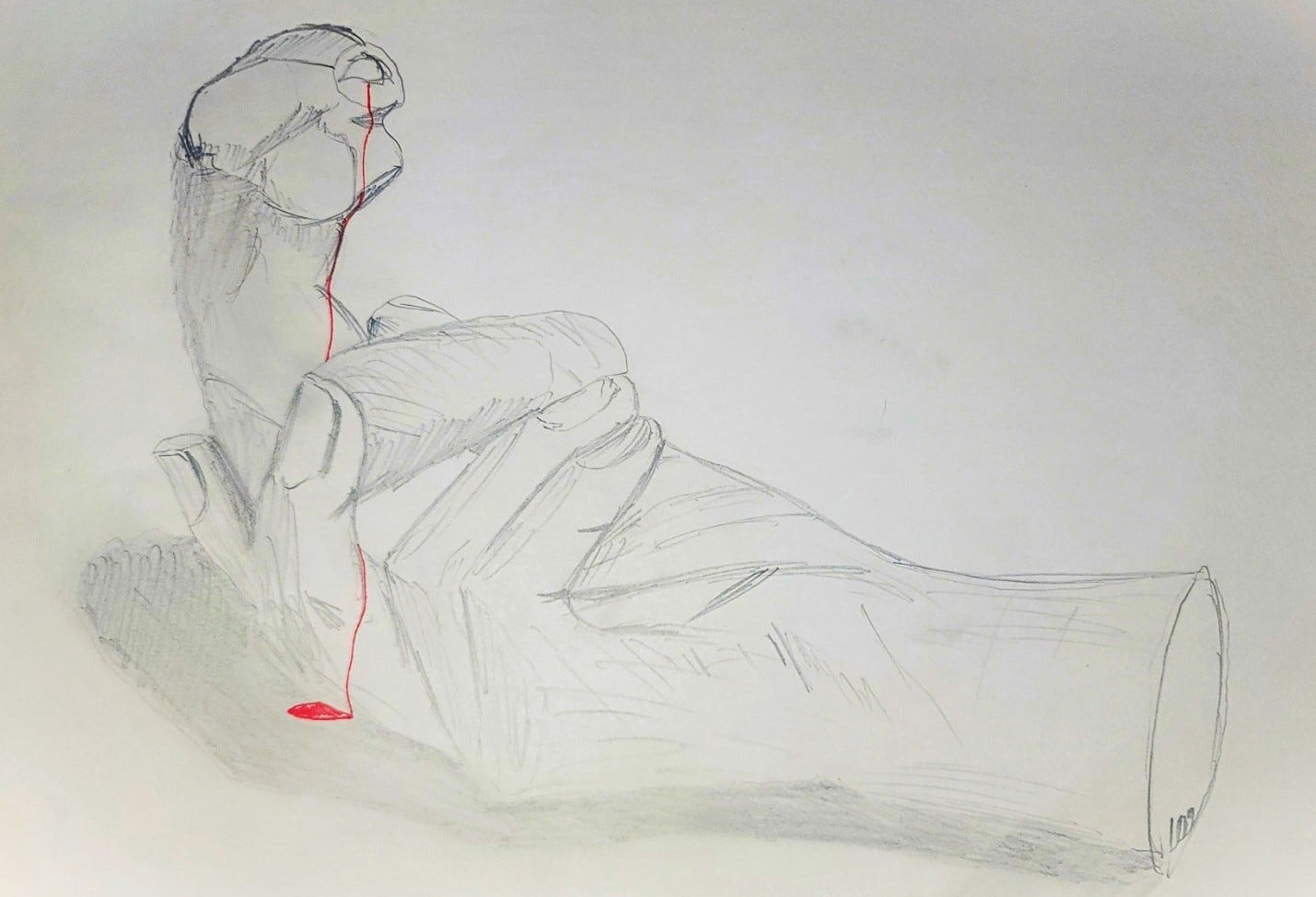
Post-WWII theatre saw the rediscovery of Shakespeare’s Titus Andronicus, largely championed by director Peter Brook’s 1955 production. Brook was heavily influenced by Antonin Artaud’s Theatre of Cruelty, a philosophy arguing that theatre should assault the audience’s senses to break down their psychological defenses. This was vividly realized in Brook’s Titus, where he famously used scarlet ribbons trailing from Lavinia’s mouth and wrists to represent blood.
Thirty years later, in 1985, Brook applied this scope to his landmark nine-hour stage adaptation of the Mahabharata, an epic thought to be inspired by an ancient Iron Age war. To Brook, the scale of the Indian epic was unparalleled:
“I would not compare ‘Mahabharata’ to a single play of Shakespeare but to the complete works of Shakespeare. There is a claim that everything that exists is in ‘Mahabharata’ - that what isn’t in ‘Mahabharata’ doesn’t exist anywhere.”
Brook staged this epic during the height of the Cold War, giving the ancient text urgent modern relevance. Contemporary audiences explicitly viewed the Brahmastra—the epic’s ultimate, world-destroying weapon—as a metaphor for nuclear weapons. Furthermore, Brook deliberately used an international cast featuring actors from Africa, Asia, and Europe to emphasize that the Mahabharata was not just an Indian story, but “the poetical history of mankind.”
While Brook’s modern stagings highlight their universal cruelty, looking at the eras in which these texts were born reveals striking parallels in their underlying anxieties despite their vast cultural differences.
Titus was written in the late 16th century when an aging, unmarried, and heirless Queen Elizabeth I left the English public terrified of a succession crisis and civil war. This anxiety directly mirrors the opening of the play, where Rome is fracturing over the choice of a new emperor. Conversely, the Mahabharata’s Kurukshetra War marks a cosmic shift: the transition into the Kali Yuga, the final and darkest age of moral decline.
Both systems are designed to maintain civilized order. Yet, in both narratives, these very systems become the ultimate justification for apocalyptic violence. In both cultures, the physical violation of the woman is treated as the ultimate desecration of the patriarchal family’s honor, serving as a catalyst for total war. Whether looking at the devastated survivors at the end of the Kurukshetra War or Lucius ascending as Emperor over a completely decimated Rome, the thematic conclusion is the same: Justice is served, but heaven has fallen.
These striking thematic parallels exist despite being rooted in completely different worlds. The Mahabharata is grounded in Vedic philosophy, cosmic cycles, and divine avatars like Krishna, while Titus Andronicus is built upon Elizabethan political anxieties, drawing heavily from Senecan tragedy and Roman history.
II. The Architecture of Brotherhood and Loyalty
The remaining sons of Titus Andronicus—Lucius, Quintus, Martius, and Mutius—are fiercely protective of one another and their sister, Lavinia. Their defining trait is a loyalty so absolute that Mutius dies at his father’s hand to defend his siblings, while Quintus unhesitatingly throws himself into Aaron’s trap to try and save Martius. This devotion makes their subsequent framing and execution all the more heartbreaking. Similarly, the Pandavas—Yudhishthira, Bhima, Arjuna, Nakula, and Sahadeva—serve as the mythological archetype of fraternal unity. Despite possessing vastly different skills and personalities, they never break rank, enduring thirteen years of exile together without fracturing.
Both brotherhoods are bound to a central female figure whose violation fuels their path forward. Led by Yudhishthira, the younger Pandavas are driven by Draupadi’s humiliation, with Bhima acting as the visceral instrument of her physical revenge by tearing Dushasana apart to fulfill her vow. Similarly, Lavinia’s rape and mutilation become the inescapable center of the Andronici’s grief.
In Rome, the surviving Andronici begin the play as the pride of the state before the system turns on them, leaving them whittled down and executed. This forces the lone surviving son, Lucius, to leave his homeland and raise a foreign army of Goths to cleanse the rot that destroyed his sister and his house. This mirrors the Pandavas having to assemble allied kingdoms to destroy their own blood relatives, the Kauravas; in both epics, the quest for justice requires a perversion of natural alliances.
The familial structures underlying these brotherhoods are forged by isolation and distinct cultural codes. Without a wife or mother figure to anchor a domestic sphere, the Andronici function less as a traditional family and more as a military platoon. Decades of fighting, bleeding, and dying together in the trenches of the Gothic wars have flattened the traditional father-son hierarchy into a bond resembling a seasoned commander and his loyal lieutenants. Yet, this brotherhood fatally clashes with Roman law: when Titus kills Mutius, he is exercising paterfamilias—the absolute, legal life-and-death power over his children—while Mutius is operating under the protective loyalty of a Roman Legionnaire.
Conversely, the Pandavas do have a mother, Kunti, but she is largely separated from them during their forest exile and the war, leaving the five men isolated and bound intimately by their shared trauma and devotion to Draupadi. Their hierarchy is dictated by Vedic and Kshatriya traditions, where the death of their patriarch, Pandu, elevates the eldest brother into an absolute surrogate father to his siblings. This explains their unwavering loyalty to Yudhishthira during the infamous dice game. According to Kshatriya Dharma, it would be a massive cosmic sin for Bhima or Arjuna to override their eldest brother, even as they must silently watch him gamble away their freedom and their wife.
III. The Tyranny of the Head
At first glance, Titus—the blood-soaked, pie-baking Roman general—and Yudhishthira—the calm, philosophical Son of Dharma—appear to be complete opposites. However, beneath the surface, they suffer from the exact same fatal flaw: a toxic, unyielding adherence to the rules. Titus cannot fathom why the empire turns on him after he gave it everything, while Yudhishthira is constantly paralyzed by his own rigid moral logic.
This shared flaw stems from the absolute extremes of their respective cultural codes. In ancient Rome, Pietas was the highest virtue, demanding absolute duty and devotion to the gods, the state, and the family—strictly in that order. Titus’s ultimate failing is an over-abundance of this Pietas. Similarly, Yudhishthira is the literal, mythological son of the god Dharma (Righteousness and Cosmic Order). For him, adherence to this code is not merely a choice; it is his fundamental ontological nature.
Consequently, Titus’s downfall is entirely of his own making. When offered the emperorship, he hands it to the tyrannical Saturninus simply because Saturninus is the elder brother, adhering blindly to strict Roman tradition. He even kills his own son, Mutius, for rightfully defending Lavinia’s pre-existing betrothal, famously shouting, “Bar my way in Rome?” Ultimately, Titus worships the abstract idea of Rome far more than the actual lives of his children.
Yudhishthira’s ruin follows a similar, devastating trajectory of rigid compliance. When challenged to a dice game by Duryodhana and Shakuni, he agrees because his code as a Kshatriya king strictly forbids him from refusing. In Vedic times, Dyuta (gambling) was a formalized, ritualistic challenge between kings; to decline an invitation was tantamount to refusing a duel or conceding defeat in war. Trapped by this protocol, Yudhishthira systematically wagers his wealth, his brothers, himself, and finally, Draupadi. He allows his wife to be dragged into the royal court and humiliated because, under the strict letter of the law, he had technically lost her in a bet.
IV. The Violation of the Central Node
Taking a step back from the specific cultural contexts of the texts, the differences between them become far less interesting than their structural similarities. In both epics, the central patriarch—whether the father, Titus, or the eldest brother and king, Yudhishthira—represents the system itself. They are the ultimate arbiters of the very laws, be it Roman pietas or Kshatriya Dharma, that are supposed to protect their families. Consequently, their downfalls reach an apocalyptic scale precisely because the protector becomes the enabler of the abuse.
The tragedy does not begin when Chiron and Demetrius attack Lavinia, or when Dushasana violently drags Draupadi; it begins the moment Titus hands the empire to Saturninus, and with it, his daughter, and when Yudhishthira wagers his wife in a dice game.
When these patriarchs fail, the political and social honor of their entire families is transferred onto, and subsequently violated through, the bodies of the central women. In both narratives, the physical violation of the woman serves as the ultimate casus belli. Because the epic scale of both stories requires an apocalyptic war, a standard border dispute or political insult simply is not enough to ignite the necessary devastation. Narratively, the concept of patriarchal honor must be concentrated into a single, undeniable focal point to generate this explosive, world-ending force.
This dramatic necessity explains Draupadi’s polyandry—having five husbands—which is highly unusual in the context of ancient Indian epics. While the brothers have other wives, Draupadi is the only shared wife. As the Samragni (Empress), she acts as the literal, physical glue that binds the five Pandavas together into a single, unstoppable unit. If there were two daughters or multiple central wives who suffered in these stories, the resulting male vengeance would fracture. The men would be forced to split their forces, negotiate, or prioritize one woman’s trauma over another’s, inevitably leading to political maneuvering and compromise.
By concentrating the entire honor of the Andronici into Lavinia, and the entire honor of the Pandavas into Draupadi, the narrative constructs an absolute zero-sum game. There is no middle ground, no compromise, and no moving on. The singular violation demands a singular, absolute response: the total annihilation of the enemy.
V. The Hand That Does not Hold
The recurring motif of the number five in both epics is no coincidence; it serves as a profound physical metaphor representing a complete, functioning body—specifically, a head and four limbs, or a thumb and four fingers.
In Shakespeare’s era, the Body Politic was a dominant metaphor where the monarch served as the head of the state, while the citizens and soldiers functioned as the hands and feet. This imagery becomes literal in a play obsessed with severed hands and heads. Similarly, in Hindu philosophy, the five Pandavas are frequently interpreted not merely as brothers, but as the fragmented incarnations of a single divine organism. Yudhishthira acts as the governing head or mind of Dharma, Bhima embodies physical strength, Arjuna provides martial skill, and the twins Nakula and Sahadeva represent beauty and wisdom.
The horror lies in the systematic, agonizing attrition of this unified body. Yudhishthira does not lose his family all at once during the fateful dice game. Instead, he metaphorically amputates his own limbs one by one. By wagering Nakula, then Sahadeva, then Arjuna, and finally Bhima, he strips himself down until he is entirely alone. Only then does he wager himself, and ultimately, the binding force of Draupadi.
Titus undergoes a similarly grueling amputation. Forced to watch his foundational unit of five be whittled down to nothing, the system first turns on its own when Titus kills Mutius with his own hands. Next, Quintus and Martius are framed, thrown into a pit, and beheaded, before the last remaining son, Lucius, is banished from Rome entirely. When Aaron the Moor tricks Titus into literally severing his own hand in a futile attempt to save Quintus and Martius, the overarching political metaphor collapses into physical reality.
Ultimately, when the head—whether Yudhishthira or Titus—submits blindly to a corrupt ideological system, the body is systematically dismembered. It is only when this body is completely broken—when Lavinia is permanently mutilated, when Draupadi is publicly humiliated, and when the vital sons and limbs are entirely gone—that the head finally wakes up from its paralyzing ideological stupor. Only in the wake of total dismemberment do they abandon the rules that destroyed them and choose apocalyptic vengeance.
VI. The Taint of Blood
Though denied her voice and her hands, Lavinia refuses to be erased. By taking a staff in her mouth and guiding it with her stumps to write Stuprum and the names of her attackers, Chiron and Demetrius, in the dirt, she forces the truth into the light. Her agency culminates in the moment when Titus slits the throats of her rapists, and Lavinia holds the basin between her stumps to catch their blood. Draupadi exhibits a parallel resolve. Following her attempted disrobing, she refuses to tie her hair until she can wash it in the blood of Dushasana. During the catastrophic war, Bhima rips open Dushasana’s chest, drinks his blood, and brings it to Draupadi so she can finally fulfill her visceral vow.
In Titus Andronicus, the gods are utterly silent; therefore, shame is no longer a sin addressed by divine justice. Throughout the play, Titus constantly appeals to the heavens—even having his family shoot arrows into the sky with letters begging the gods for intervention—but the sky remains quiet. Because the divine order has abandoned Rome, Titus must become the author of his own mythological order. Shakespeare weaves the Roman myth of Lucretia—whose suicide after her rape was viewed not as a pathetic end, but as the ultimate political catalyst that birthed the Republic—throughout the narrative. Right before Titus kills Lavinia, he explicitly asks the Emperor if Virginius was justified in killing his daughter, Virginia. By invoking these specific histories, Titus is not hiding Lavinia away in shame; he is elevating her suffering to something more powerful than any man: myth.
Titus wraps her tragedy in the myth of Virginia because myth is the only language left that can give her suffering any weight in a broken universe. Her death at his hands is not a punishment, but an act of paternal lamentation.
Furthermore, Titus orchestrates the final banquet knowing perfectly well it is a suicide mission. Because he is serving the Empress her own sons baked in a pie in front of the Emperor, he knows he will be struck down seconds later. Therefore, killing Lavinia is not about protecting his surviving reputation; he has none. He kills her so she dies by his hands alone and ceases to suffer in a cruel world.
Elizabethan revenge tragedies relied heavily on the model of the Roman playwright Seneca, as seen in Thyestes or Medea, where the act of revenge is a corrupting disease. Lavinia must die not merely because she is a victim, but precisely because she too has become part of the revenge cycle. By catching the blood of her rapists, she has been transformed into a monster of vengeance herself.
Conversely, the gods are not silent in the Mahabharata. Krishna is literally driving Arjuna’s chariot, meaning the Pandavas are actively enacting divine will while Titus is forced to invent his own myth. Yet, both scenarios lead to the exact same apocalyptic bloodshed and spiritual decay. The Pandavas win the war, but they are spiritually corrupted in the process: Yudhishthira is forced to lie, and Bhima commits war crimes by striking Duryodhana below the belt. The Senecan-style disease of revenge taints everyone, continuing when Ashwatthama slaughters the sleeping Upapandavas—the five sons of Draupadi—in the dead of night. Both victories are revealed to be entirely Pyrrhic. Ultimately, both women achieve their total, absolute vengeance, but are left with absolutely no future.
VII. The Anatomy of Vengeance
Archetypal criticism is not particularly popular in contemporary literary studies, which often rejects universalism in favor of specific cultural and historical contexts. This comparative reading serves as my counterargument.
Despite a two-millennia gap and vastly different philosophical and cultural foundations, these two epics reveal striking structural similarities in their shared anatomy of vengeance. The specific formula—a narrative driven by revenge, anchored by a central Patriarch or Eldest Brother, and executed by a fiercely bonded Brotherhood—inherently implies a strict separation of the sexes.
When this patriarch embodies the very law that governs the system, and the brotherhood operates isolated from the female domestic sphere, any violation of the central woman forces a brutal zero-sum game. In this paradigm, no political compromise is possible; total annihilation becomes the only logical outcome.
It is no coincidence that the prominence of both texts is deeply tied to periods of immense destruction. The Mahabharata is thought to have been forged in the crucible of an apocalyptic Iron Age war, while Titus Andronicus was profoundly re-discovered by modern audiences in the traumatized wake of World War II.
This shared foundation of devastation illuminates perhaps why director Peter Brook was so drawn to adapting both texts. He understood that extreme, theatrical violence is sometimes the only adequate language a culture possesses to process profound collective trauma. Ultimately, the comparison of these two epics proves that the architecture of tragedy is universal.
Whether the gods are entirely silent, as they are in Rome, or actively driving the chariot on the battlefield of Kurukshetra, the human machinery of revenge inevitably burns the world to the ground.