
The Cost of Normalization
Trauma, Memory, and the Evolution of Japanese Military Science Fiction
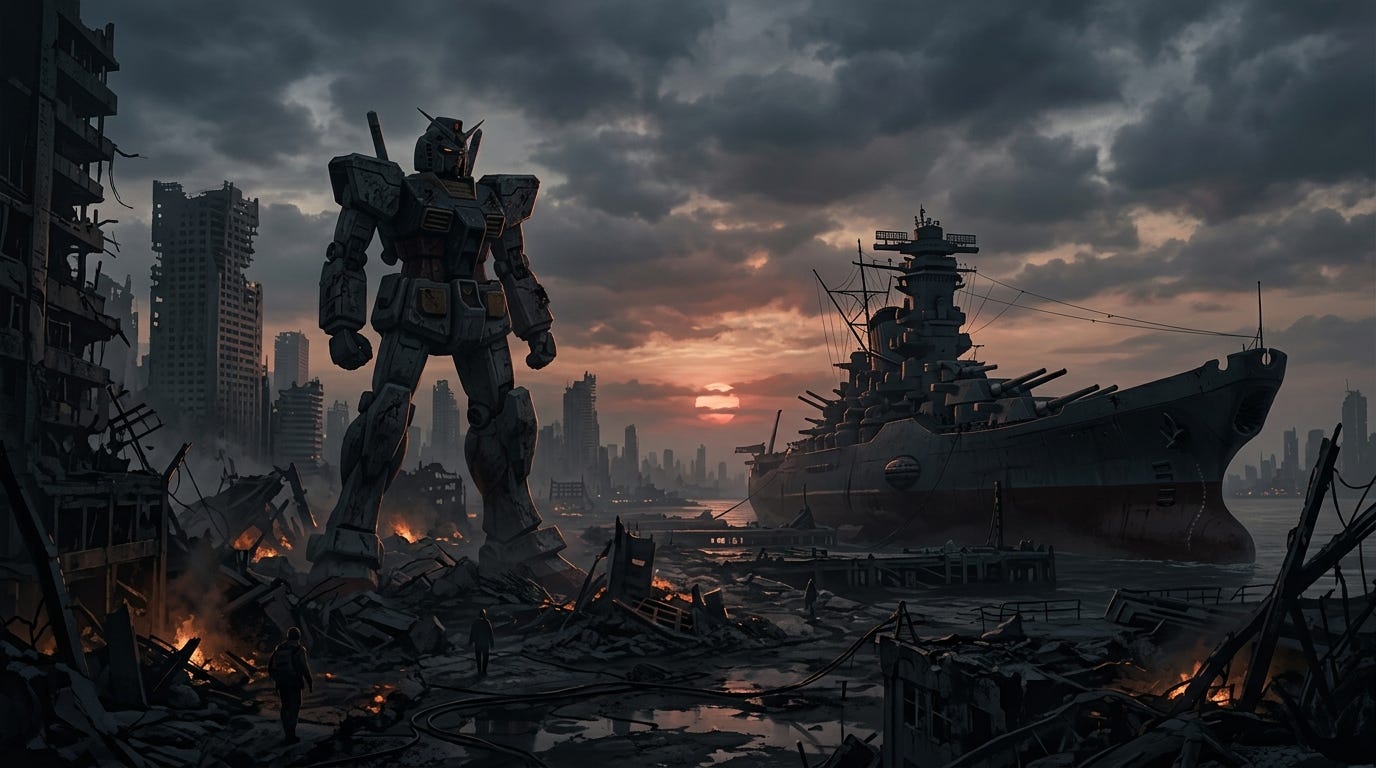
I. The Illusion of Passive Amnesia
There is a contradiction between the geopolitical perception of Japan's "historical amnesia" and the obsessive processing of WWII present in its pop culture. Neighboring nations like China and South Korea and increasingly, the West, view Japan through the lens of political controversies such as historical textbook revisionism, high profile visits to Yasukuni Shrine, and the denial of comfort women. As a point of comparison, consider US debates over Confederate monuments or the 'Lost Cause' narrative. Just as those domestic battles often obscure deeper reckonings with the legacy of slavery, the international focus on Japanese textbook revisionism distracts from how the culture actually processes its imperial past.
Japanese military science fiction, in particular, is entirely occupied with this history. By displacing conflicts into the future or into deep space, science fiction provides an allegorical distance. Japanese media almost always leans into the trauma of being the victim while often sidestepping the role of the aggressor. In mecha and space opera anime like Neon Genesis Evangelion or Space Battleship Yamato, which literally resurrects the sunken WWII battleship as a vessel of salvation, humanity serves as a stand-in for Japan. Here, humanity is positioned as a desperate, technologically outmatched underdog fighting a purely defensive war against an overwhelming threat.
This mirrors Japan's experiences once the war against the US begins. Materially Japan is completely outmatched. So much so, that it was the primary reason the US did not anticipate an attack on Pearl Harbor. Once the initial shock of the surprise attack passes, the rest of the Pacific War is a war where every engagement, material exchange, is a loss. By comparison, the Second Sino-Japanese War, that had been going on for a decade prior, is forgotten as it doesn't fit the narrative.
(Putting My Military Historian Cap On: Unlike modern revisionist historians, the disparity in industrial capacity was obvious enough to the Japanese High Command that their entire strategy revolved around it. They wagered that the American public would lose the will to fight if Japan could bleed the counter-attack heavily enough. This is why Pearl Harbor, for all its tactical and logistical brilliance, was a strategic error of the highest degree.)
Japan was ultimately defeated by superior technology culminating in the atomic bomb. Conversely, post-war sci-fi routinely features Japan saving the world through its own technological supremacy, often via mechas. This is a subconscious rewriting of history where technology brings salvation rather than destruction.
Whatever you call this, amnesia is not it. It is active rewriting. It is the digestion of the past, filtering out the toxic elements while absorbing the elements that foster national solidarity. As modern audiences no longer connect with WWII, the underlying source of these narratives shifts, blending wartime trauma with newer anxieties: the economic devastation of the Bubble Burst, and later the ennui of contemporary life.
This raises a question. is there a line between "processing trauma" and "glorifying the military past?" If one were to draw a Venn Diagram, glorifying the military past is almost completely inside processing trauma. Consider American war media like Band of Brothers or British Empire literature like Sharpe. Are these narratives really the triumphant blaring of horns just because their respective nations 'won?' All victory is hollow in time, and the nature of conflict is cyclical—or as Doctor Manhattan succinctly puts it, 'Nothing ever ends.'
Paul Fussell argues in The Great War and Modern Memory, in the wake of industrial slaughter, all modern war literature is ironic. Glory is paint applied to the memory of the meat grinder.
There is, however, a subset of media (in every culture) that exists outside this dynamic. These narratives do not try to process trauma so much as erase it. Because trauma is inherently individual and subjective, to excise the trauma, one must erase the human being in favor of the collective myth. Lacking nuanced characters on the page, these narratives can only draw upon the pre-existing grievances of one: the reader. Thus, the 'glory' depicted here is heavily tainted with a deep personal resentment.
This mechanism scales to the level of the state. Just as jingoistic myths erase trauma by erasing the individual, history can be forgotten by denying the nation itself. Both are reactions to the same underlying cognitive dissonance. Koichi Iwabuchi explores this concept in Recentering Globalization through the lens of mukokuseki—statelessness or "cultural odorlessness." Some recent commentators assume that Japanese creators stripped their characters of racial or national markers to make them easier to sell. This assumes the arrow of causality points the wrong way. Post-war Japan had a deep desire to escape its own historical identity. Emulating the West was a dissociation from the trauma of being Japanese in the aftermath of 1945.
This culture of statelessness preceded market forces by decades. The global export market for anime is a relatively recent phenomenon. For decades, domestic consumption vastly dwarfed international sales. It was only later, in the late 1990s and early 2000s, that market forces took the reins. What began as a domestic coping mechanism became a highly lucrative vehicle for international soft power.
This contextualizes the "historical amnesia" that frustrates elements of the international community today. Japan's ability to maintain this diplomatic posture is subsidized by the mukokuseki nature of its exports. This cultural odorlessness strips the political controversy from the product and allows all nations, including those Japan brutalized in the past, to consume its media. Japan digested its trauma and exported the resulting odorless culture to the globe, burying the past beneath a pop-culture hegemony.
II. Postmemory and Plastic Models
Japanese military science fiction frequently begins with humanity on the brink of extinction, whether through colony drops in Gundam, Gamilas radiation in Yamato, or the Beta invasion in Muv-Luv. This apocalyptic threat almost always arrives from the sky, creating a subconscious echo of the B-29. In contrast to Western science fiction, which often treats space as an empty canvas for Manifest Destiny, these narratives feature a rejection of the frontier. The protagonists are born into a broken world they did not create, mirroring the experience of post-war baby boomers who grew up in the firebombed ruins of Tokyo, forced to navigate the devastation wrought by their parents' generation.
Pre-war Japan demanded absolute loyalty to the Emperor and State. When that system led to national suicide in 1945, the ideological metanarrative was annihilated. Applying Jean-François Lyotard's definition of postmodernism as an incredulity toward metanarratives, 1945 planted the seeds of a post-ideological society. This incredulity took time to fully manifest, peaking with the failure of the radical student movements in the late 1960s and early 1970s. Thus, it was in the late 70s, within the vacuum left behind by these grand narratives, that a new need for speculative fiction arose.
When a society’s guiding metanarrative collapses, it rarely invents a new system from scratch. Instead, it reverts to its lowest-energy state of organization, the tribe. This is not some uniquely Japanese feature subject to Orientalist interpretations. This is not a reaction to "late-stage capitalism," a thought terminating cliche that even communist theorists do not use seriously because it fails to distinguish between the 1920s, the 1970s, or right now.
Individualism is a highly constructed, resource intensive ideology rooted in the Enlightenment, whereas the tribe has been the primary mode of human organization since pre-agriculture. In an evolutionary sense, it is where we were built to belong. Bounded by Dunbar’s number, the micro-community becomes the only trustworthy locus of meaning. In post-war Japanese society, this manifested in the familial tribalism of salaryman culture. In fiction, the primary unit of allegiance similarly shifted to the micro-collective or found family, such as the White Base crew in Gundam or the Yamato crew. These micro-collectives often actively rebel against macro-state apparatuses, like the Earth Federation or the UN, which are depicted as corrupt and incomprehensible.
Protagonists like Amuro Ray are thrust into a war they did not ask for, contrasting sharply with volunteer heroes like Captain America. Placing a 14 year old in the cockpit of the ultimate weapon is a stylized reflection of 1944 and 1945 realities, when student draft deferments were canceled and children were mobilized for factory work. In these narratives, adult military leaders are rarely heroes. Instead, they are corrupt, cowardly, blindly dogmatic or plain evil. This alienation from high command reflects a post-war distrust of the government that led the country to ruin.
In later works like Patlabor 2, Ghost in the Shell, and Evangelion, this cynicism extends to the civilian government. Anger shifts toward bureaucratic paralysis and the subservient relationship to the "American Empire" via the US Security Treaty, framing Japan as a pawn in a larger geopolitical game. The target of the critique changes to reflect the times: from the corrupt militarists of 1970s to the paralyzed bureaucrats of the 90s and beyond. The tribe has to step up because the state is completely impotent.
The hardware in these narratives substitutes military supremacy with technological and industrial supremacy, evolving alongside Japan's post-war GDP. This tracks the economic miracle from Yamato's resurrected World War II ship, to Gundam's mass produced industrial weapons, to Patlabor's civilian construction equipment. Space combat, particular those between mechas acts as a sanitized form of warfare. It allows for clean duels that sidestep the realities of civilian casualties, acting as an upmoded version of the fighter pilot. Furthermore, mechas allow for controlling the uncontrollable. The atomic bomb was an overwhelming force of destruction that Japan could not control; the mecha is a weapon of equal power, but it has a pilot. This aligns with Takashi Murakami's infantilization thesis: the 14 year old pilot represents the postwar Japan, while the robot acts as a psychological fantasy, a compensatory prosthetic for a nation forced to rely on the United States for defense.
There is a contradiction deeply embedded in the genre. While the stories are often anti-war, the visual language fetishizes military hardware and uniforms, affirming François Truffaut's adage that there is no such thing as an anti-war film. Creators like Yoshiyuki Tomino frequently expressed frustration that audiences ignored the anti-war message and just bought the Gunpla models.
This reveals a fundamental weakness in Marianne Hirsch's concept of postmemory. Inherited duty or debt does not actually transmit between generations. What the second or third generation inherits is not authentic trauma, but a reconstructed, imagined experience, reflecting the problem of other minds. While Hirsch admits postmemory is mediated by imagination, she stops short of the logical conclusion: that without lived experience, inherited trauma is ultimately performative.
Because true trauma cannot be passed down, the anti-war message fights a losing battle against human nature. Subsequent generations do not inherit the drudgery of war; instead, they are left with its aesthetic cool.
Consider two of the oldest, civilization defining works of literature: the Iliad and the Mahabharata. The Iliad contains anti-war sentiments, such as the grief of Priam, yet it lovingly details the bronze of Hector's helmet and the divine craftsmanship of Achilles' shield. (Achilles' armor is essentially the Bronze Age equivalent of a Gundam). Similarly, while the Mahabharata explores deep spiritual and moral philosophies, most notably in the Bhagavad Gita, as Krishna counsels Arjuna on his duty, it remains an epic centered on visually spectacular warfare, featuring celestial weapons (vajra) that read like nuclear strikes.
The aesthetic inevitably outlives the anti-war message because the aesthetic is the only part that is truly transmissible. The paint on the meat grinder becomes the painting.
III. Reclamation and Romance
A Methodological Note
The following sections (Parts III through VI) traces the evolution of Japanese military science fiction across four historical periods. The journey begins with the 'Reclamation and Romance' of the 1970s, moves into 'The Turning of the Gyre' defining the late '70s and 1980s, transitions into the 'Post-Bubble Identity Crisis' of the 1990s and 2000s, and finally examines the 'Revisionism and Nationalism' that characterizes the 2010s and 2020s.
Each section begins by establishing the socio-economic background, providing the historical context in which these narratives were born. Following this, we dive into a defining work of the period, assuming a baseline of unfamiliarity on the part of the reader. We then examine what the period is responding to, acknowledging that no cultural movement is created from nothing. Finally, we conclude with examples of the 'modern synthesis.' Recognizing that no cultural movement ever truly dies.
Space Battleship Yamato - 1974
By the 1970s, the immediate devastation of the war was over in Japan, and the Economic Miracle was in full swing. However, the cultural shame of defeat lingered. Furthermore, while the Miracle made Japan wealthy, it relied entirely on imported oil. The 1973 oil crisis shattered the illusion of stability and violently reminded the nation of its existential vulnerability: resource scarcity. The very anxiety that had driven Japan into World War II was suddenly relevant again, demanding cultural processing.
A defining work of this era is Space Battleship Yamato (1974). In the year 2199, Earth is on the brink of extinction. The alien Gamilas Empire has bombarded the planet with radioactive meteors, forcing the remnants of humanity underground. In a desperate bid for survival, humanity resurrects the sunken World War II battleship Yamato, retrofitting it with an alien Wave Motion Engine. The image of a World War II dreadnought sailing through the stars is the ultimate aesthetic triumph over historical defeat. It allows a postwar audience to indulge in naval military aesthetics, complete with Imperial Japanese Navy motifs, without the guilt of the actual Pacific War. Commanded by the stoic Captain Juzo Okita and driven by the hot blooded tactical officer Susumu Kodai, the crew embarks on a 148,000 light year journey to Iscandar to retrieve a device capable of cleansing the Earth.
Four elements characterize the series. The first is the resource quest. To survive, the crew must secure a magical resource from a foreign power, a desperation underscored by the title card at the end of every episode counting down the days until humanity's extinction. The second element is the Wave Motion Gun. Rather than reveling in this power, Captain Okita and his crew treat the weapon with extreme reverence, firing it only as a last resort. When forced to use the gun to destroy the Floating Continent at Jupiter, the crew is visibly horrified by the scale of the destruction. Okita explicitly establishes that the Yamato is a ship meant to save lives, framing the ultimate weapon as a curse rather than a triumph.
The third element is the humanization of a faceless enemy. Initially depicted as blue-skinned Nazi analogues, the Gamilas are later revealed to be bombing Earth to terraform it for their own survival. Near the end of the series, the Yamato is ambushed at the Gamilas homeworld. Forced to fire the Wave Motion Gun to survive, the crew inadvertently trigger the destruction of the entire world. Watching the alien civilians burn, Kodai breaks down weeping on the bridge, realizing the Gamilas were fighting for the same reason humanity was: a dying homeworld. He tearfully laments that instead of fighting, they should have loved each other.
The fourth element is the micro-collective. Despite internal clashes, the crew forms a loyal and familial bond under Captain Okita, entirely isolated from the rest of the world. Following the near total destruction of the Earth Defense Force in the first episode, the Yamato operates with zero contact with high command. When Okita falls ill, authority is passes down to Kodai. In the series finale, the crew successfully retrieves the device, but Captain Okita succumbs to radiation poisoning from old wounds just as the restored, blue Earth comes into view. His death is a noble sacrifice that saves humanity. This rewrites the reality of World War II, where millions of Japanese deaths were ultimately meaningless, resulting only in national destruction.
The 1970s were marked by conflict between the older generation, who fought the war and rebuilt the economy, and the younger generation, who engaged in the radical student protests of the 60s and 70s. Yamato processes this tension through the relationship between Captain Okita and Susumu Kodai. The narrative responds to the generational schism by having the stoic, wounded father figure of the World War II generation guide and ultimately pass the torch to the rebellious, hot blooded youth of the post-war generation, suggesting a reconciliation through a desperate struggle for survival.
The Modern Synthesis
Zipang - 2000
The story follows the Mirai, a state of the art Japanese Self-Defense Force Aegis cruiser that sails into a temporal anomaly and is transported back to June 1942, on the eve of the Battle of Midway. The crew is led by the idealistic Yosuke Kadomatsu, who insists on strict adherence to modern doctrine and non-intervention. However, their presence alters history when Kadomatsu saves the life of Takumi Kusaka, an Imperial Navy officer, who had been stranded at sea. Recognizing the power of the Mirai, Kusaka attempts to manipulate the crew and alter the war to forge an undefeated Japan, a new empire he dubs Zipang.
The Mirai possesses the radar and missile technology to single handedly annihilate the US Pacific Fleet. Despite this overwhelming power, Kadomatsu orders the crew to keep away from the conflict and when intervention in inevitable, minimize casualties on both sides. Early in the series, the Mirai is attacked by American dive bombers. Rather than using its Aegis system and Sea Sparrow missiles to slaughter the incoming planes, Kadomatsu orders the crew to use their Phalanx Close In Weapon System to shoot down the bombs in mid-air and to fire warning shots to scare the pilots away. A decision that nearly results in the loss of the ship when one of the American pilots makes a dive for the deck.
The core tension of the story is the debate between Kadomatsu, representing modern and demilitarized Japanese humanism, and Kusaka, representing Imperial pragmatism and nationalism. Kusaka attempts to orchestrate the assassination of Adolf Hitler, hoping to manipulate the geopolitical chessboard to secure an early peace for Japan. Kadomatsu tries to stop him, arguing that altering history on this scale is arrogant and destructive. Kusaka counters by asking Kadomatsu if his pacifist ideals are worth letting millions of Japanese civilians burn in the Tokyo firebombings and the atomic strikes that he knows are coming.
The breaking point arrives during the Guadalcanal campaign. As the Mirai sits idly by in adherence to JSDF non-intervention policy, the crew is forced to listen to the radio transmissions of Imperial Japanese soldiers being slaughtered on the island. Unable to stomach this, Lieutenant Kikuchi leads a mutiny. He argues that watching their ancestors die when they possess the power to save them is a betrayal of their identity as Japanese people, leading a faction of the crew to side with Kusaka's plan.
The conflict reaches its climax when Kusaka acquires an atomic bomb and mounts it aboard the Yamato, intending to annihilate the US fleet and force an immediate peace. In a stark inversion of the 1974 series, the Yamato is not resurrected as a savior, but is instead transformed into the very instrument of apocalyptic trauma that defined 1945. Kadomatsu and the modern crew of the Mirai are forced to engage and sink the Yamato. In the ensuing battle, the Mirai is also sunk, with the entire crew lost at sea except for a crippled Kadomatsu.
Ultimately, Kusaka successfully manipulates history. He posthumously orchestrates a negotiated peace, as his singular bomb is seen as a sign of a successful Japanese nuclear weapons program. Japan avoids the atomic bombings and absolute surrender, becoming a stronger, independent nation called Zipang. Kadomatsu survives into the modern day of this altered timeline, which is peaceful but different from his original home. This is a sophisticated form of revisionism. It does not erase the war, but it actively rewrites the trauma of absolute defeat. By negotiating a peace and avoiding the atomic bombs, the narrative creates a timeline where Japan retains its pride and sovereignty, dodging the very trauma that necessitated works like Yamato in the first place.
IV. The Turning of the Gyre
Mobile Suit Gundam - 1979
The late 1970s and 1980s marked a transition in Japanese society, pivoting from the desperate recovery of the post-war era to the zenith of the Japanese Bubble Economy. By the end of the 1970s, Japan had emerged as an economic superpower, rivaling and in some sectors surpassing the United States. This economic triumph coincided with the climax of the Cold War, where the geopolitical reality was defined by global proxy conflicts playing out under the constant threat of Mutually Assured Destruction (MAD).
As a result, the locus of cultural anxiety shifted. The fear was no longer about humanity uniting to fend off an alien threat. It was about navigating the ideological battlefield behind proxy wars and immense state power. The stories transitioned from unified struggles for survival to binary clashes of political ideology. These new narratives were morally ambiguous yet simultaneously idealistic, reflecting the cognitive dissonance of a generation raised in economic prosperity but living under the shadow of nuclear war.
The defining work of this era is Mobile Suit Gundam. Set during the "One Year War," the series depicts a conflict between the Earth Federation and the Principality of Zeon, a coalition of space colonies fighting for political and economic independence. The narrative centers on the rivalry between Amuro Ray, a drafted civilian teenager fighting for the Federation, and Char Aznable, a deeply ideological and driven enemy ace fighting for Zeon.
Combat in the series relies on Mobile Suits, an innovation that marked the birth of the Real Robot genre. Here, the fantastical element is deliberately stripped of its mysticism. The mecha is no longer a singular, magical savior vessel like the Yamato; it is a mass-produced and expendable tool of war. Furthermore, the enemy is no longer aliens, but human beings fighting for recognizable political aims.
The war begins with Zeon dropping a massive space colony onto Earth, wiping out half the human population. This staggering act of violence establishes the foundational violence of the setting. The Earth Federation is depicted as a corrupt and oppressive hegemon that treats its citizens as expendable assets. Conversely, while Zeon is fighting a historically legitimate war for colonial independence, it utilizes Nazi imagery and is willing to utilize any and all methods to achieve it. On both sides of the conflict, the narrative focuses on young idealists whose noble intentions are ground down and exploited by the machinations of corrupt adults.
Gundam introduces the concept of "Newtypes," a psychic evolution triggered by living in space that allows humans to understand each other perfectly without misconception. This represents the hope that human evolution might eventually grant us true, frictionless empathy. However, the core tragedy of Gundam is that instead of bringing peace, the military immediately weaponizes this empathy to create highly efficient killers. When Amuro and Char finally achieve perfect psychic understanding, facilitated by the death of the Newtype Lalah Sune, the result is not reconciliation. Instead, absolute understanding breeds a deeper more intimate hatred that drives them to kill each other, serving as a reflection of Cold War realities. It argues that even if humanity achieves perfect communication, we will still destroy one another.
The war ends at the space fortress of A Baoa Qu in a chaotic battle where the leadership of both sides is violently wiped out. The conflict is ultimately resolved by a negotiated political treaty signed by exhausted bureaucrats. Yet, while the macro-state apparatus proves entirely hollow, the narrative does offer a form of salvation. Amuro survives the final battle not by saving the world, but by escaping the exploding fortress to reunite with the surviving crew of the White Base, proving that while ideological metanarratives fail catastrophically, the micro-collective endures.
Gundam operates as a direct reaction against the "Reclamation and Romance" of Space Battleship Yamato. While Yamato deconstructed the faceless enemy, it still sanitized the method of war, presenting clean ship-to-ship combat and noble sacrifices. Gundam strips away this veneer. It forces the audience to look directly at the collateral damage, the civilian casualties, the debilitating PTSD of its child soldiers, and the inherent rot of the state. It argues that the "romance" of the WWII generation, the idea of beautiful, meaningful sacrifice for the nation, is a manufactured lie designed to feed the meat grinder.
Despite the era's deep textual cynicism toward institutions, there is no irony; the characters themselves remain fiercely earnest. Unlike the paralyzed, apathetic protagonists of the 1990s, the characters in Gundam still believe in what they are saying. They believe in colonial independence, they believe in defending the Earth, and they desperately believe in the evolutionary promise of the Newtype. War in Gundam is fought by children who still believe their sacrifices matter. They believe that, for all its flaws and devastating consequences, ideology is still something worth holding onto. In fact, surrounded by the horrific, chaotic realities of the meat grinder, they cling to their ideals all the more because ideology is the only thing capable of giving the bloodshed any meaning.
This dynamic—a profound cynicism regarding the macro-institutions of the state paired with a fierce earnestness in the individuals fighting for them—finds its truest advocate in the sprawling space opera Legend of the Galactic Heroes (1988). Like Gundam, the narrative offers no clear moral high ground. The democracy is depicted as rotting from the inside, bogged down by jingoistic populism, corrupt politicians, and apathetic voters who treat the endless war as background noise. Conversely, the autocracy is depicted as ruthlessly efficient and capable of grand reform.
Despite the cynicism aimed at the systems of government, the heroes of the narrative, the democratic tactician Yang Wen-li and the autocratic conqueror Reinhard von Lohengramm, are men of absolute purpose, willing to send millions to their deaths for the sake of their political ideals. The tragedy is not that ideology is dead, but that it is very much alive. The characters are painfully aware of the hypocrisy and rot within their respective systems, but they fight on regardless. They are driven by an earnest belief that if they can just win the war, they might finally build a state worthy of the blood it cost.
The Modern Synthesis
Attack on Titan - 2009
Humanity lives inside three massive concentric walls, believing itself to be the last survivor of the human race, protected from man-eating giants known as Titans. The story follows Eren Yeager, who vows to exterminate all Titans after his hometown is breached and his mother is eaten. The narrative revolves around Titan Shifters, humans who can transform into intelligent Titans. Mechanically, these operate like mechas, utilizing the 'flesh mecha' concept pioneered by Evangelion. The human pilot resides in the nape of the neck, piloting a giant biological weapon.
The protagonists belong to the Survey Corps, the military branch dedicated to outside exploration. They are defined by extreme mortality rates and are united by a single purpose: reclaiming lost territory for the survival of humanity. The initial setup of the series in Seasons 1 and 2 operates like the Reclamation and Romance of 1970s sci-fi. Humanity is united against an apolitical and existential threat in the form of the Titans. The tone is one of desperate survival, where the Survey Corps serves as the micro-collective, making noble, unironic sacrifices for the survival of the species.
At the end of Season 3, the characters discover that humanity outside the walls is not extinct. The walls are located on an isolated island called Paradis, and the Titans are actually a weapon used by a nation called Marley to subjugate the island's inhabitants for their ancestral sins. This revelation violently shatters the metanarrative. The existential, faceless threat is gone, replaced by a geopolitical proxy war. The new monsters are human beings fighting for political aims. The series introduces The Paths, a dimension connecting all subjects of Ymir, the islanders, across time and space, allowing for shared memory and the altering of biology.
The Basement Reveal shifts the genre from Yamato to Gundam. Furthermore, The Paths operates as a direct parallel to the Newtype of Gundam, representing the weaponization of empathy. When Eren gains access to The Paths and achieves understanding of the historical context, it does not lead to peace. Instead, achieving understanding of the world's hatred confirms for Eren that reconciliation is impossible, driving him to the ultimate ideological extreme.
To protect his island, Eren triggers The Rumbling, unleashing millions of Titans hidden within the walls to march across the ocean and flatten the entire outside world. The surviving members of the Survey Corps, Eren's closest friends, must ally with their former Marleyan enemies to stop him. They ultimately succeed in killing Eren, but only after 80% of humanity has been crushed. Attack on Titan synthesizes these eras, proving that history rhymes both externally (in the evolution of the genre) and internally (within the cyclical violence of its own world). It argues that the Reclamation and Romance of a united humanity seen in Seasons 1 and 2 is a fragile lie that can only exist in ignorance. Once the reality of historical trauma is introduced in Seasons 3 and 4, the narrative descends into the ideological meat grinder of Gundam.
Eren’s Rumbling is an attempt to use an apocalyptic weapon, equivalent to Mutually Assured Destruction, to artificially reset the world back to the blank slate of Season 1. However, the narrative rejects this. Even after Eren is stopped and the world is temporarily saved, the epilogue shows the island of Paradis being destroyed by conventional warfare in the distant future. It is a bleak synthesis, concluding that neither the unified survival of Yamato nor the ideological battles of Gundam can stop the cycle of human conflict.
V. Post-Bubble Identity Crisis
Patlabor 2: The Movie - 1993
The 1990s and 2000s marked the Lost Decade. In 1985, the Plaza Accord saw the United States, frustrated by trade deficits, pressure Japan into appreciating the yen. To combat the resulting export slump, the Bank of Japan slashed interest rates, flooding the market with cheap credit. This directly contributed to the subsequent asset price bubble. It demonstrated that even at the height of Japan's economic status in the 1980s, the nation was still ultimately subject to American dictates. This era was followed by the catastrophic bursting of the Japanese asset price bubble in 1991, leading to prolonged economic stagnation. The 1995 Tokyo subway sarin gas attack perpetrated by the Aum Shinrikyo cult further traumatized the nation. All of this occurred alongside the ongoing legacy of the US-Japan Security Treaty, which kept Japan reliant on the American military umbrella even after the end of the Cold War.
The economic collapse shattered the national myth of upward progress, while domestic terrorism shattered the myth of internal safety. Japan found itself still wealthy but directionless, politically paralyzed by bureaucratic infighting, and subservient to a foreign nation for its defense. This created a pervasive cultural sense of apathy and impotence. The Cold War, the ideological war had been won, yet things had seemingly only gotten worse and it was now unclear who was friend and who was foe.
Released in 1993, Patlabor 2: The Movie follows Tokyo as it is subjected to a series of seemingly disconnected terrorist attacks, designed to mimic a military coup by a former JSDF officer named Tsuge. The film operates as highly grounded science fiction. Mechas, known as Labors, exist but are treated as heavy industrial equipment or specialized police vehicles, bound by maintenance cycles and bureaucratic red tape. The main characters, Captains Goto and Nagumo of Special Vehicle Section 2, are middle-aged, deeply cynical, yet highly competent police bureaucrats. This shift from hot-blooded teenagers to exhausted, middle-aged civil servants reflects the weariness of the genre. The mecha is stripped of romance and mysticism. It is just another tool tangled in red tape, emphasizing that the true battlefield is political and bureaucratic, not physical.
A defining element of the film is the concept of the 'Unjust Peace.' Tsuge's core philosophical argument is that Japan's post-war peace is a deceptive illusion subsidized by the proxy wars and suffering of other nations under American hegemony; he brings the war to Tokyo to wake up a complacent nation. During a pivotal monologue, JSDF Intelligence Officer Shigeki Arakawa takes Captain Goto on a boat ride through the canals of Tokyo. Arakawa argues that Japan's peace is not real. It is a deceptive peace subsidized by third-world bloodshed (much like Tsuge's own deployment) and protected by the American military umbrella. He asks Goto if a 'just war' is better than an 'unjust peace.' The Director, Mamoru Oshii, frequently cuts away to silent lingering shots of Tokyo: snow falling, birds, empty canals, and glass skyscrapers. This visual choice reinforces the apathetic and sterile nature of this 'unjust peace.'
The civilian government and the JSDF freeze in the face of the attacks. Terrified of American intervention or political fallout, they turn on each other, leading to martial law and the military occupation of Tokyo without a single real enemy army present. Following the bombing of the Yokohama Bay Bridge, which the government tries to cover up as an American F-16 gone rogue to avoid admitting to domestic terrorism, the police and the JSDF end up in an armed standoff. Two branches of the state point guns at each other because the politicians refuse to take responsibility and pass the buck. Tsuge disables the city by severing its communication networks, rendering the bureaucratic state deaf and blind, which immediately causes it to cannibalize itself. This is highlighted by sequences like the fake air raid, where electronic warfare creates phantom fighter jets on radar screens, causing national panic and proving the state's fragility without firing a shot.
In the prologue, Tsuge's unit is deployed to Southeast Asia on a UN PKO mission. They are ambushed by guerrillas, but because of the paralyzing Rules of Engagement imposed by politicians back in Tokyo who are terrified of domestic political fallout, his unit is denied permission to return fire. Tsuge is forced to sit in his cockpit and watch his men be slaughtered. A year before the films release, in 1992, following pressure from the US and the international community after the Gulf War, Japan passed a highly controversial law allowing the JSDF to deploy overseas to Cambodia for the first time since World War II. It caused massive domestic protests over fears of a return to militarism. Patlabor 2 takes a different line to the public. It does not fear a return to militarism per se. It fears being incompetent about it.
To stop Tsuge and prevent a civil war, Goto and Nagumo form a rogue micro-collective. They go completely off the grid, defying the paralyzed state apparatus to take decisive action. Meanwhile, JSDF tanks roll through the snowy streets of Tokyo.
The ending sees Special Vehicle Section 2 navigate the submerged ruins of "Old Tokyo," a symbol of the forgotten past that the Bubble Economy paved over, to reach Tsuge. They breach his stronghold and capture him. He does not resist, having successfully proven his point about the fragility of the nation. Goto and Nagumo are victorious but will likely face severe disciplinary action. Tokyo returns to its "unjust peace." There is no grand ideological salvation. The micro-collective succeeds in stopping the immediate violence, but the macro-state remains broken, and the philosophical rot of the deceptive peace remains entirely unresolved.
This era reacts against the fierce earnestness of the 1980s seen in Gundam and the existential, species wide unity of the 1970s seen in Yamato. Gundam protagonists believed that ideology, however flawed, could give the meat grinder meaning. Patlabor 2 argues that ideology is dead and the state is too paralyzed to even function. It rejects the external alien or colonial threats of past eras, arguing that the true threat to Japan is internal.
The Modern Synthesis
Ajin: Demi-Human - 2012
Beings known as "Ajin," immortals who instantly regenerate following death, are discovered. Rather than being treated as miracles, they are stripped of their human rights by governments around the world. The Japanese government hunts them in the name of public safety, only to secretly sell them to corporations as infinitely reusable, zero marginal cost test subjects for human experimentation. The story centers on two figures. Kei Nagai is a fiercely apathetic high schooler who just wants a quiet life. Sato, or Samuel T. Owen, is a sociopathic half-Chinese former US Marine who uses his immortality to wage a terrorist war against Japan simply for the thrill of it.
Sato is explicitly shown not to be the product of abuse. A farmhouse scene where Sato kills hens briefly plays with the idea that his father beat him, before revealing his psychopathy to be entirely innate.
Ajin's core fantastical element operates as a literal manifestation of the Jungian Shadow. Ajin can summon invisible, lethal avatars known as Black Ghosts. This operates as a semi-supernatural evolution of the loss of bodily control seen in 1990s cybernetics like Evangelion and Ghost in the Shell, but here, the 'mecha' is no longer a machine you pilot; it is the weaponization of repressed identity. Characters who embrace their psychopathy, like Sato, are perfectly in tune with their ghosts. Those who repress their true nature to pretend to be normal, like Kei, have ghosts that disobey them. When two ghosts collide, their users' memories and thoughts merge, touching upon past themes of connection, but this empathetic bridge proves completely useless against a sociopath like Sato.
The government is no longer just paralyzed as in Patlabor 2; it is actively malicious and willing to auction its authority for capital. Early scenes show Kei strapped to an operating table, repeatedly vivisected and killed by bureaucrats who calmly record the results on clipboards. The cultural anxiety has shifted from the 1990s, where the government was seen as too cowardly to act, to the 2010s neoliberal era, where the government treats rights as a subscription service.
Sato's background as a former enforcer for the US military-industrial complex is crucial. If Patlabor 2 explored the anxiety of Japan being subservient to the American security umbrella, Sato is that umbrella turning into a weapon. He brings asymmetrical warfare and terror tactics to the glittering streets of Tokyo.
One of the more shocking moments is an entirely wordless sequence of panels. It begins by showing Sato walking through the security checkpoint at an airport while his black ghost carries the power tools he needs to cut through the Post-9/11 reinforced cockpit door across the ceiling. Once the plane is in the air, the manga show his first person perspective as he uses a disc saw and nail gun to force his way into the cockpit, bar the door and the final moments as the plane goes fully vertical and the passengers within scream in terror as Sato reaches his target: a corporate skyscraper. The entire sequence is replaced in the Netflix produced anime for its proximity to 9/11.
Kei is an attempt to survive a state that treats humans as test subjects by becoming a perfectly rational, utility calculating machine. He rejects the "found family" warmth of the 1970s and 1980s, treating his allies as tactical assets. However, the narrative shows the way Kei, who is not an innate sociopath, ultimately fails at being an equal to Sato on his own. Kei's plans only succeed because others are willing to execute them: idealists like Ko (a loud, idiotic, traditional hero), sympathetic bureaucrats, and blank-eyed professionals.
In the finale, Kei and his fragile coalition manage to outsmart and neutralize Sato through a highly convoluted trap. However, there is no celebration or healing of society at large (a return with the elixir). Kei immediately dissolves the alliance and vanishes on his own, the government remains corrupt and complacent, and Sato's threat is merely paused. The "unjust peace" that Tsuge warned about in Patlabor 2 has birthed a generation that claims not to care about the nation, because caring is fatal.
This synthesis argues that while the macro-state is irredeemably broken, survival requires a balancing act. The modern hero wears the armor of individualistic pragmatism, while fiercely protecting a tiny, hidden core of idealism. In the absence of ideological fervor, the narrative's highest respect is reserved for cold competence, embodied by the mortal professionals (Togashi's untouchables, JSDF base commander, Anti-Ajin Squad) who stand against the abyss and remain completely immune to the fear of death.
VI. Revisionism and Nationalism
How did we move from the Post-Bubble Era to the overt revisionism and nationalism of the 2010s?
The "American Empire" was not dismantled, nor did it suddenly begin acting more morally. The postwar Japanese generation remained bitter critics of American hegemony and the invasion of Iraq. They were not silenced, and they continued producing works. However, their narrative collapsed due to the rise of China. In 2010, China officially surpassed Japan as the world's second-largest economy. Military tensions escalated in the South China Sea and over the Senkaku/Diaoyu Islands, highlighted by the 2010 boat collision incident. Additionally, North Korea repeatedly fired ballistic missiles directly over Japanese airspace throughout the 2010s, triggering the J-Alert system on millions of civilian cell phones and warning them to seek shelter.
The 2011 Tohoku triple disaster—an earthquake, a tsunami, and the Fukushima meltdown—further shifted the cultural landscape. Before 2011, the public often viewed the JSDF with lingering post-war suspicion or dismissed them as bureaucratic stooges. However, in the aftermath of the disaster, the JSDF deployed over 100,000 troops for rescue and recovery operations. Following 3/11, public approval of the JSDF skyrocketed to record highs. The political push to revise Article 9 gained mainstream traction and pop culture responded with a sharp pivot toward overt nationalism.
The geopolitical reality moved on from Hu Jintao to Xi Jinping and plans to invade Taiwan. Japanese defense doctrine explicitly ties the survival of Taiwan to the survival of Japan. The philosophical cynicism and bureaucratic introspection of the 1990s and 2000s were suddenly a luxury that seemed absurd. Shinzo Abe returned to the Prime Minister's office in 2012. His entire political brand, under the slogan "Take Back Japan," was built on restoring national pride, breaking free from the post-war regime, and explicitly pushing to revise Article 9 of the pacifist constitution. Abe understood that 90s cynicism was dead. He harnessed the fear of China to justify expanding the JSDF's capabilities, passing the controversial 2015 security bills that allowed for collective self-defense. Politically, he dominated the 2010s.
The release of The Wind Rises in 2013 highlighted the displaced post-war cultural juggernaut. Hayao Miyazaki represented this generation. Right as The Wind Rises was being released, Studio Ghibli published a special issue of their magazine, Neppu, focusing on the constitution. Miyazaki wrote a scathing essay explicitly condemning Shinzo Abe and the push to revise Article 9. He stated he was disgusted by politicians trying to change the constitution and downplay World War II atrocities without understanding history. Miyazaki was aware the cultural tide was turning against his generation's anti-war consensus. It is also quite clear he did not understand why. No amount of World War II mea culpa would be effective. Apologizing to China and Korea for 1945 does not stop the People's Liberation Army from expanding into the South China Sea in 2015. The post-war generation's strategy of contrition had lost its geopolitical utility.
In the 1970s with Yamato, the threat was an external, existential enemy that required national unity to defeat. In the 1990s with Patlabor, the threat was entirely internal, characterized by bureaucratic rot and domestic terrorism. In the 2010s, the threat is external again. But this time, it is not alien Gamilas dropping radioactive meteors; it is the Chinese Navy and North Korean missiles. The cultural need for Reclamation and Romance returned, but it returned wearing the uniform of the JSDF.
GATE (Gate: Jieitai Kanochi nite, Kaku Tatakaeri) - 2015
A portal known as the Gate opens in Ginza, Tokyo, unleashing a medieval fantasy army from the Saderan Empire that slaughters civilians in the streets. The JSDF quickly repels the invasion and then invades the Special Region on the other side of the Gate to establish a forward operating base and demand reparations. The protagonist, Youji Itami, is a 33 year old JSDF Ranger and unapologetic otaku who leads a reconnaissance squad to explore the fantasy world and win hearts and minds.
The portal fantasy is radically inverted here. Instead of a child stranded in a fantasy realm undergoing a coming of age story, it is an evolution of the Isekai or arbitrage narrative applied to a whole nation. A technologically supreme, organized national military invades a lesser civilization. The fantastical element provides a consequence free sandbox where the JSDF can act as a fully unrestrained, lethal expeditionary force, indulging the nationalist fantasy of a remilitarized Japan free from constitutional Article 9 or historical constraints.
In the 90s, in works like Evangelion, the otaku was a symbol of paralyzing apathy and withdrawal from society. GATE rehabilitates the otaku into the ideal nationalist soldier. The JSDF leverages Itami's nerd knowledge of fantasy tropes to navigate the world.
A defining element of GATE is total technological and moral supremacy. Battles are one sided slaughters where artillery and attack helicopters obliterate sword and shield formations. The JSDF is depicted as morally flawless, protecting the local populace from their own corrupt empire. The United States, along with China and Russia, is portrayed as a greedy, meddling antagonist attempting to steal the resources of the Special Region. The JSDF engages in a firefight with American black ops teams and wins easily. The show is also literal state sponsored propaganda. In 2015, the JSDF Tokyo Provincial Cooperation Office officially partnered with the creators of GATE to print recruitment posters featuring Itami and his harem of female fantasy characters from the anime.
During the Battle of Italica, JSDF helicopters play "Ride of the Valkyries" while annihilating a bandit army. The helicopter scene is a direct visual quote of Francis Ford Coppola's Apocalypse Now, arguably the most famous American anti-war film condemning the horrors of imperial overreach in Vietnam. GATE takes this imagery, strips it of all horror and plays it completely straight as a triumphant display of Japanese supremacy. The paint on the meat grinder has become the painting. They inherited the aesthetic cool of American war films but discarded the anti-war message entirely.
In the ending, the JSDF successfully topples the hostile faction of the Saderan Empire, establishes a friendly puppet ruler, and secures the Gate. This ensures continued access to the resources of the Special Region and solidifies Japan's status as the sole gatekeeper. There is no meaningful sacrifice required. The ending is a pure triumph of the macro-state, one that fulfills the nationalist geopolitical fantasy: Japan stands alone, technologically superior, morally righteous, completely independent from the United States, and utterly victorious on foreign soil. Every imperialism trope is played straight. (Post-colonial theory is in shambles.) The JSDF overthrows the backward local government, brings civilization to the grateful, submissive natives, and takes their best women, with the main character getting three. We never moved on from the Rape of the Sabines.
Zipang was sophisticated revisionism, where the crew of the Mirai agonized over the morality of their actions and had to negotiate a timeline to avoid trauma. GATE is unsophisticated revisionism. It requires no negotiation and faces no moral dilemmas. It simply constructs an enemy so technologically and morally inferior that slaughtering them is framed as a moral good, demanding zero introspection from the audience.
GATE reacts aggressively against the paralyzed, impotent state of the 1990s seen in Patlabor 2 and completely ignores the historical guilt and anti-war warnings of the 1970s and 1980s seen in Yamato and Gundam. If Patlabor 2 argued that the state was broken and the peace was an illusion, GATE argues that the state is glorious and the peace must be defended with overwhelming, righteous violence. It strips away the nuance of the ideological mirror from the Gundam era, reverting to a black and white morality where the Japanese military is unequivocally good and its enemies are objectively evil and primitive.
Modernized Antithesis - We are breaking the pattern
Godzilla Minus One - 2023
Set in the days immediately following the surrender, Japan has been reduced to zero, only to be pushed to minus one by the appearance of Godzilla, a monster mutated by American nuclear tests at Bikini Atoll. The protagonist, Koichi Shikishima, is a disgraced Kamikaze pilot suffering from survivor's guilt after faking engine trouble to avoid his suicide mission. He returns to a firebombed Tokyo and slowly forms a makeshift, found-family with a woman and an orphaned baby. When Godzilla attacks, neither the paralyzed Japanese government nor the US military, fearing Soviet tensions, will intervene. Shikishima must join a private coalition of veterans and citizens who use ingenuity to defeat the monster.
The film directly tackles the core trauma of 1945 but synthesizes the historical eras. When Godzilla fires his atomic breath in Ginza, the visual framing with the mushroom cloud, the shockwave, and the black rain is explicitly designed to evoke Hiroshima and Nagasaki. It reclaims the existential threat and the Wave Motion Cannon of the 1970s but filters it through the state-cynicism of the 1990s. The macro-state is useless, forcing the micro-collective of citizens to act.
Shikishima is openly mocked and shunned for returning alive. When he arrives in the ruins of Tokyo, his neighbor Sumiko screams at him in the street, asking why he is alive when her children are dead, accusing him of failing his duty as a Kamikaze. Furthermore, Shikishima suffers nightmares of the mechanics on Odo Island, who were slaughtered by Godzilla after Shikishima froze and failed to fire his plane's guns, surrounding him and asking why he did not shoot.
The government is entirely absent from the effort to stop Godzilla, explicitly covering up the threat to avoid a panic. Meanwhile, the US military under MacArthur refuses to deploy forces, terrified of provoking the Soviets in the early days of the Cold War. Thus, both the domestic and imperial states are paralyzed. The defense effort, Operation Wada Tsumi, is conceived by a former naval engineer and executed entirely by civilian volunteers using decommissioned Imperial Navy ships, like the Takao and the Yukikaze, that have been stripped of their weapons. While GATE relies on the overwhelming power of the JSDF to solve all problems, Godzilla Minus One strips the state of all power. Operation Wada Tsumi forces demilitarized citizens to rely on ingenuity, like manipulating buoyancy to sink the monster, rather than military firepower.
The anti-imperial ethos is unmistakable. Before the final battle, the civilian commander gives a speech condemning the Imperial military for throwing away lives cheaply, noting they built tanks with thin armor and planes like the Zero with no ejection seats. He declares that this new battle is not a fight to the death but a fight for the future, ordering every man to prioritize coming back alive. The climax of the film reinforces this when the mechanic, Tachibana, secretly installs a German ejection seat into the experimental Shinden fighter plane. Unlike the Imperial state, which mandated Shikishima's death, Tachibana, a member of the localized tribe, gives him the mechanical means to live. Just like the Yamato in 1974, the Kyushu J7W Shinden is a real, historical piece of Imperial hardware (an experimental interceptor designed to shoot down B-29s that never saw combat). Here, it serves as the reconstruction of technological salvation.
In the ending, Shikishima flies a fighter plane loaded with explosives directly into Godzilla's mouth to destroy it. However, at the last possible second, he pulls the lever on the ejection seat. He parachutes to safety and is reunited with his found family. By surviving, he defeats the monster, overcomes his guilt, and processes the trauma of the war. It reclaims patriotism by proving that true heroism is found not in dying for the state, but in living for the future.
VII. The West as Paint
For decades, the defining characteristic of Japanese military sci-fi was the rejection of Western military tropes. American media traditionally features extremely competent, volunteer professionals operating with the righteous backing of their government to project power abroad. Historically, Japan could not write that story.
If we look at works that try to critique nationalism, such as 86 Eighty-Six or Fullmetal Alchemist, they universally rely on European coded settings. Critiquing Japanese ethno-nationalism or wartime atrocities using a Japanese setting remains taboo and commercially risky. 86 Eighty-Six centers on a European coded Republic that strips a minority population of their human rights, forcing them into internment camps and making them pilot mechas to die on the front lines while the government covers up the atrocities.
Similarly, Fullmetal Alchemist features Amestris, a militaristic state led by a Führer (very subtle) that aggressively expands its borders and commits genocide against the Ishvalan minority. While the aesthetic is European and the tactics resemble American interventions in the Middle East, the core narrative maps onto the Japanese invasion of Manchuria and China. It features a nation expanding into neighboring territory using highly trained, remorseless soldiers (State Alchemists) who later suffer PTSD and guilt over their war crimes. Creators like Hiromu Arakawa are likely also critiquing American and European imperialism, but the domestic parallels are undeniable.
In the 1970s, creators had to use space and aliens to talk about the atomic bomb. Today, Japanese creators who want to explore the horrors of ethno-nationalism and internment camps borrow the German aesthetic of guilt, because Japan never established a domestic visual language for its own perpetrators. Vergangenheitsbewältigung, or working through the past, is not a natural process; it does not just happen. Returning to Attack on Titan, the nation of Marley forces the Eldian minority into internment camps and makes them wear armbands with stars on them—a direct visual quote of the Holocaust. Hajime Isayama uses the most universally recognized Western aesthetic of guilt, Nazi Germany, to explore themes of historical guilt and extreme nationalism.
This is a case of Occidentalism. Just as Orientalism involves the West projecting its fantasies and fears onto a generalized, mystical East, Japanese Occidentalism involves projecting domestic political taboos onto a generalized, aesthetically mashed up West, where French architecture, American military tactics, and Prussian uniforms all blend together. The West in anime is not a real place; it is a psychological mirror for Japan.
Early creators used mukokuseki to strip characters of Japanese markers to escape the trauma of defeat. Modern creators use Occidentalization and Western coding to escape the guilt of perpetration. The mechanism is the same.
Works That Sit Between Eras and Definitions
Code Geass: Lelouch of the Rebellion - 2006
The Holy Britannian Empire, an alternate-history American superpower, launches a surprise invasion of Japan using mechas known as Knightmare Frames to secure a monopoly on Sakuradite, a nuclear adjacent energy resource. Japan is defeated, stripped of its sovereignty and name, and rebranded as Area 11. The native Japanese are relegated to impoverished ghettos while the Britannians live in opulent settlements. The protagonist is Lelouch vi Britannia, an exiled Britannian prince living in hiding in Area 11. He acquires the Geass, a magical power that grants him the ability to command absolute obedience, and adopts the masked persona of Zero to lead a Japanese rebellion to destroy his father's empire.
The series executes a complete historical flip. Imperial Japan's history of launching a surprise attack on America due to an oil embargo is completely inverted. Here, Britannia (America) launches a surprise attack on Japan for Sakuradite (Oil). Because this flip is so direct, the text can operate simultaneously as a critique of imperialism and a revisionist fantasy of either Japan or the West through irony. Furthermore, Lelouch serves as the evolutionary missing link of the era. The setting features the geopolitical victimhood and paralysis of the 1990s, but Lelouch operates with the agency that would come to define the naked nationalism of the 2010s seen in works like GATE.
By contrast, Suzaku Kururugi, the son of Japan's last prime minister, Lelouch's best friend and series nemesis, represents the bureaucratic institutionalism of the 1990s seen in Patlabor 2. Suzaku joins the Britannian military, fiercely believing that the only moral way to change a corrupt empire is from within, by strictly following the rules. Suzaku's 90s-style institutionalism fails completely, and he just becomes a complicit tool of the empire. Lelouch's radical action succeeds, but at the cost of staggering atrocities. While on the surface this may seem as an attempt to balance the scales and create moral equivalence, the narrative clearly favors Lelouch's approach.
A defining element of the series is the theatricality of rebellion. Lelouch does not just fight a war; he manufactures a national myth. He uses mass media, PR stunts, and his theatrical persona as Zero to unite the fractured and defeated Japanese resistance into a formalized military called The Black Knights. Lelouch genuinely wants to build a gentler world for his sister, but he is willing to commit staggering atrocities and treat his allies as expendable pawns to do it.
Consider the Special Administrative Zone massacre. Euphemia's peaceful diplomatic solution nearly ends Zero's rebellion, forcing Lelouch to confront her directly. Quite conveniently for him and the plot, just as he is about to acquiesce to her moral superiority, Lelouch's Geass goes out of control, accidentally commanding the Britannian princess to slaughter the Japanese. (The precise wording of the "joke" that triggers this is highly suspect, the writer's hand is made visible.) Lelouch immediately capitalizes on the tragedy, using the massacre as a PR tool to finally begin his end of season one national revolution.
In the finale, Lelouch successfully conquers the entire globe, establishing himself as a universally despised world emperor. He then orchestrates his own public assassination. The now reconciled Suzaku, taking on the persona of Zero that Lelouch once used, stabs Lelouch in front of the world, theatrically closing the curtain on the cycle of hatred and leaving behind a unified, peaceful blank slate. The ending is a product of taking the high romanticism of the 1980s far beyond what those living under the real shadow of war could have possibly imagined or taken seriously.
Metal Gear Solid 2: Sons of Liberty - 2001
(I had to fit MGS in somewhere in this essay)
Metal Gear Solid 2: Sons of Liberty is a geopolitical techno-thriller where a terrorist group seizes control of the Big Shell, an offshore environmental cleanup facility in New York. The narrative introduces two main characters: Solid Snake, the legendary hero, and Raiden, a former child soldier from the Liberian civil war raised almost entirely on VR combat simulations. The initial threat of Metal Gears is eventually superseded by the revelation of The Patriots, an AI cabal that secretly controls the flow of global information.
Metal Gear Solid 2 sits outside the standard East and West binary of Japanese pop culture. It actively appropriates the Western action hero aesthetic, but it uses that aesthetic to critique the American imperialism and digital hegemony that the genre was built to glorify. Furthermore, it injects highly Japanese anti-nuclear anxiety, represented by the Metal Gears, into the heart of the American military-industrial complex.
After a brief prologue, the player is stripped of the ability to play as the macho American hero, Solid Snake, and is forced to play the entire game as Raiden. Because Raiden was trained almost entirely in VR simulations of Solid Snake's previous missions, he inherited the aesthetic of the hero without the lived experience. This makes him an avatar for the modern media consumer who plays war games but has no concept of actual war.
The true enemy is not a rival nation-state, but an AI system designed to filter human history. The Patriots argue that humanity is drowning in junk data and that without AI controlling the context of information, society will tear itself apart. During the climax inside Arsenal Gear, the AI commanding Raiden begins to malfunction, breaking the fourth wall and bombarding the player with surreal, nonsensical codec calls. Raiden is subsequently stripped of his gear and forced to navigate the bowels of the American superweapon completely naked, visually representing his total lack of agency and the stripping of his identity by the state.
In the ending, Raiden defeats the terrorist leader, Solidus Snake, in a sword fight on the roof of Federal Hall in New York, right at the feet of the George Washington statue. The Patriot AI remains active and in control of the world. Solid Snake tells Raiden that there is no absolute truth in the digital age. He must choose his own legacy and pass on what he believes in, independent of his genes or the memes forced upon him by the state. The ending is a rejection of the macro-state, but it also rejects the traditional Japanese retreat into the micro-collective. Instead, it demands individual agency, a somewhat contradictory message given what has just been revealed.
The Patriots cannot be destroyed by a rocket launcher because they are a pervasive system of control. By placing the final battle on Federal Hall, the birthplace of American democracy, Metal Gear Solid 2 uses the historical iconography of the West to dismantle the West's own grand narrative, that of democratic freedom ensured by institutions and laws. It demands that the individual find their own truth in a world where nothing is free.
Postscript - The Cost of Normality
What is the cost of being normal?
From an artistic perspective, the conclusion of this journey is a tragedy in terms of the diversity and depth of the works produced. However, if there is any definitive sign that a nation has finally "normalized," it is that it has begun to behave like every other country. When a nation heals, or at least scabs over its deepest historical wounds, its media regresses to the mean. For military science fiction, that norm has always been the revisionist power fantasy.
Why does this regression occur? The answer lies in two inescapable human realities, the first being the loss of lived experience and the ultimate failure of postmemory. Because true, visceral trauma cannot be genetically or socially inherited, the anti-war message is always fighting a losing battle against time. When the generation that felt the firebombings and the starvation passes away, they cannot pass the horror down to their children. Only the aesthetic cool of the meat grinder survives the generational gap. The blood dries and the gleaming hardware is left behind.
The second reality is the psychological path of least resistance when dealing with the cognitive dissonance of shame. A populace cannot sustain eternal, intergenerational guilt. The path of least resistance for any collective consciousness will always be to rewrite its own history until the shame is replaced with pride. It is a defense mechanism against national self-loathing.
This mechanism is as true anywhere else in the world as it is in Japan. The wheel of history turns, ensuring that no one is a perpetrator forever, and no one remains a victim forever. One of the more insidious urges of performative trauma is to freeze this wheel in time, a fundamentally conservative act of lessening cognitive dissonance by denying the world's ability to change and move beyond its initial nature.
As Doctor Manhattan put it, nothing ever ends. Every nation, given enough time and distance from its darkest chapters, writes stories that trend toward this baseline. They are all, inevitably, trending toward being normal.
Because this essay has focused on military science fiction, it might give the misleading impression that the 'aesthetic of cool' is inherently tied to warfare and military hardware. It is not. Rather, the 'cool' is a tool of assertion; it is what gives individuals the volume to shout into a seemingly meaningless world—aligning with Camus's definition of revolution rather than rebellion.
The reality of the matter is that Imperial Japan is now about as real as American Slavery. Because these eras are no longer a lived reality for anyone currently breathing, the past can be commodified and manipulated for modern political aims. There is no genuine reaction left to be provoked, only a performative awareness. When a culture reaches this point, the unique brilliance of its art fades into a standard, nationalist template. The cost of normalization is the loss of the tortured soul that produced the art in the first place.
Normal is, ultimately, all that it says it is.
It’s a wonderful feeling to stumble across something that overlaps with one’s own niche interests the way this article does. I’d like to offer a few thoughts of my own, and a potential thread you can make a more detailed deep-dive into regarding one of the pieces of media you mentioned: Muv Luv. For Muv Luv is in many ways directly addresses a lot of the points you bring up and tries for a more direct reckoning with Japan’s Imperial past through speculative fiction by foregrounding the Empire in its narrative of mankind on the brink of destruction. It shares some commonalities with Zipang, but coming at it from a different direction.
In the alternate history that underpins Muv Luv’s timeline, the Japanese Empire managed to pull off the impossible: bleed the Americans hard enough to where a conditional peace is signed between the United States and Japan in 1944. Spared from total defeat and the complete re-making of its society by an American occupation, the Empire persists as a more autonomous vassal state of the United States past the invasion by the Alien BETA and until the point where the BETA, having conquered all of China and Korea, cross the sea of Japan to strike the Japanese mainland.
For the second time, Japan is faced with an overwhelming enemy force, and it proceeds to repeat all of the mistakes the historical Empire did when it fought the United States in our timeline’s WWII. The strategies are inadequate, defense plans collapse upon first contact with the enemy and soldiers are wasted in stubborn last stands that achieve nothing but costing more lives. Half of Japan is overrun and destroyed, and the imperial capital of Kyoto is burned. Salvation only comes in a repeat of historical trauma: the United States dropping two sci-fi super-nukes called G-Bombs onto the BETA in Japan, destroying them and turning back the invasion. Framed as a necessity to save Japan from the invasion, but one that leaves cold comfort for the Japanese upon whose territory the bombs were used.
This repeats the Imperial experience in an alternate history scenario against aliens and demonstrates it as a losing one without any allegorical distance. The empire is spared defeat and in the process learns nothing, repeating the same defensive strategy against the aliens as it tried against the Americans in our WWII, and as the pop cultural definition of insanity goes, the outcome is an identical losing struggle. The Empire survived being occupied by the US, and in the process those traits that doomed it in our WWII were allowed to persist. It’s a surprisingly sharp critique of Imperial Japan and how it tried to wage war, even as other parts of the narrative work along more nationalist lines to rehabilitate aspects of the Imperial system of modern liberal Japan as a solution to mukokuseki and restoring Japan’s pride as a sovietiegn nation ready to rejoin the global community as a full-time partner.
I’ll swerve here and push back against your characterisation of the UN by talking about how it’s framed, not just in Muv Luv, but also in a few other shows like Evangelion and the genre-hybrid series Senki Zesshou Symphogear. They all share a unique view of the United Nations, not as necessarily corrupt and incomprehensible (though often with corrupt people as part of its overall structure), but rather as a neutral platform upon which Japan can act as a sovereign nation that is part of the global community and a defender of it against outside threats. That depiction of the UN is both a fantasy of a Japan unshackled from being a puppet of the US-led order and also an aspiration for Japan to be trusted by the global community to not immediately repeat the imperialism of its past, a country that is far enough removed from a near-century old war and can be relied upon as a responsible stakeholder in the current global community. In that regard, the United Nations in Muv Luv exists to allow the cast to see the Empire of Japan from both inside and outside, as Japanese nationals fighting for humanity under the banner of the UN because Japan itself was unable to save itself from the BETA, requiring outside intervention to survive.
The ‘American Empire’ aspect is also very front and center, and in a way it was ahead of the times. Muv Luv in many ways predicted the direction of the United States as it moved from upholding the international order it created in the wake of WWII, to feeding upon it like a wolf among sheep once the historical memory had faded enough for that order to be perceived as a burden to the United States and not an asset. The US is a self-interested superpower concerned with ensuring that the outcome is always favourable to American interests, even the outcome of an Alien invasion.
The most political moment of the whole VN is a repeat of the historical 2–26 incident, called the 12-5 Incident to hammer the comparison home. There, the officers who launch the coup are nationalists opposed to US and UN control over Japan. It is revealed the US was aware of the coup and are using it to cement their own power over Japan. In this part of the VN there is an eerie foreshadowing of Operation Absolute Resolve in 2026 and the use of American military power to ensure a favourable regime in a state deemed important to the American interest, Japan being framed as a victim of the same kinds of American imperialism seen elsewhere in the world. And yet there is no morally right side in this arc, with the rebels being shown as the same kinds of people who nearly led Japan to its death when the BETA invaded, stubborn, inflexible, willing to see every Japanese die if it means they die free. The spirit that helped foster the conditions for the dropping of the Atomic Bombs in our timeline’s 1945. Thus both American Imperialism and the Japanese Empire’s Imperialism are pitted against each other and both are found wanting.
While nationalistic, Muv Luv is not revisionistic. It concedes that the Empire failed the Japanese people through waging a war it could never win, while stating that there was something about the Japan of that period that made it more self-confident, more independent, akin to the famous photo of the China Relief Expedition sent to crush the Boxer Rebellion in 1901 where a Japanese soldier is lined up alongside representatives of all the other world powers of that period like Britain, France, Germany, Russia and the US as they ensured that Imperial China would not rank among their number. Those times are long past, and as the world moves increasingly back towards one shaped by the great power competition of the 19th century with China as a full partner in the global scramble for influence and control, the aspiration of many in Japan to stand up and be counted as an equal great power unshackled from American ‘oversight’ is one that Muv Luv is unafraid to indulge in.
This was a really good essay, and I want to thank you for your hard work and allowing the chance to articulate a few thoughts I’d been having about one of the entries mentioned in this essay.